
The Diagnosis: Pharmaceutical Advertising is Still Advertising
Great ads need to be great ads no matter what category. DTC pharmaceutical advertising is still advertising. It must gain attention, link to the brand and motivate action. However, it differs in needing to work with “unusual” brand names, complex messages and fair balance. The latter is a particular challenge, occupying numerous seconds in a typical video ad during which attention can and will wander. Yet we know that getting viewers to stick with the ad so you can end on a positive brand impression is important.
Download our detailed paper featuring insights for marketing teams to ensure their creative is optimized for the pharma sector.
KEY FINDINGS
- Direct-to-consumer pharmaceutical advertising is first and foremost advertising, despite challenging regulatory requirements.
- Pharma ads break through the clutter, probably because their messages are highly relevant to their targeted consumers.
- Distinctive brand assets are an important tool in ensuring that the sometimes-opaque product brand names stick in people’s minds.
- One key weapon: New and differentiating information that captures the attention of target consumers and drives people to talk to their doctor or seek more detail in other channels.
These key points are evident following an analysis by Ipsos’ Creative Excellence team of 202 direct-to-consumer pharmaceutical video ads tested in the U.S. between 2017 and 2020.
It’s still advertising
Great ads need to be great ads no matter what category. DTC advertising is still advertising. It must gain attention, link to the brand and motivate action. However, it differs in needing to work with “unusual” brand names, complex messages and fair balance. The latter is a particular challenge, occupying numerous seconds in a typical video ad during which attention can and will wander. Yet we know that getting viewers to stick with the ad so you can end on a positive brand impression is important.
The marketing team should focus on bringing engaging creative elements to this interlude. We have seen music, the depiction of positive emotion and showing human relationships all succeed at maintaining viewer interest, according to our analysis.
It’s all about relevance
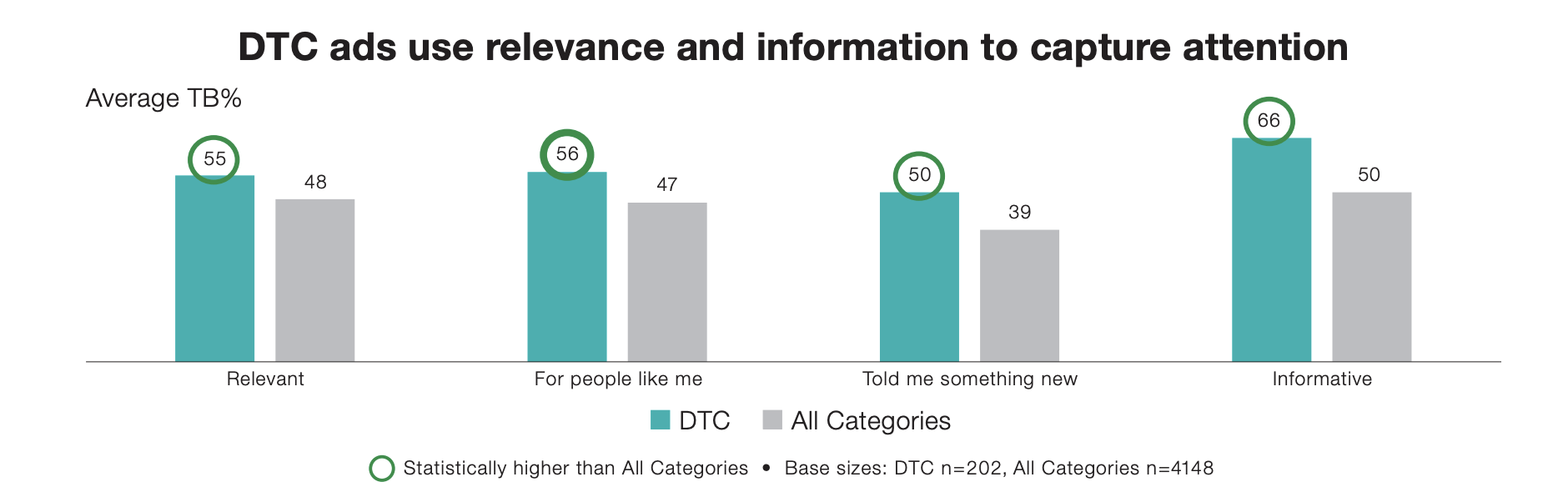
Perhaps surprisingly, DTC ads tend to break through more than the average ad. This may be due to the highly relevant and informative nature of DTC ads when communicating to their specific target audiences. They significantly outperform all ads in being seen as “relevant” and “for people like me.”
 Nonetheless, within the DTC category, brands should be wary of getting lost in a sea of sameness. When looking for opportunities to stand out, brands could seek more variety in their creative approaches. Most DTC ads use “slice of life” storytelling—as many as 97% in our database—depicting their target in everyday scenarios. Compared with all ads, the DTC category underperforms on being perceived as “entertaining” and “imaginative.” Exploring different creative techniques might help escape the somewhat formulaic landscape while remaining appropriate to the sector.
Branding memory devices are key
Direct-to-consumer pharmaceutical brands often have names that use unfamiliar or novel words, and as such are undoubtedly different. But this does not easily translate to memorability. DTC ads are no more or less likely to achieve strong brand linkage than other categories. It’s important to think about developing distinctive brand assets that can help brand memorability. Creative must go beyond showing and saying the brand name and logo, which is table stakes for brand recognition. Reaching a higher standard of branding requires building memorable features over time such as brand characters, mascots and jingles, which significantly boost brand recognition.

Creative should showcase new information
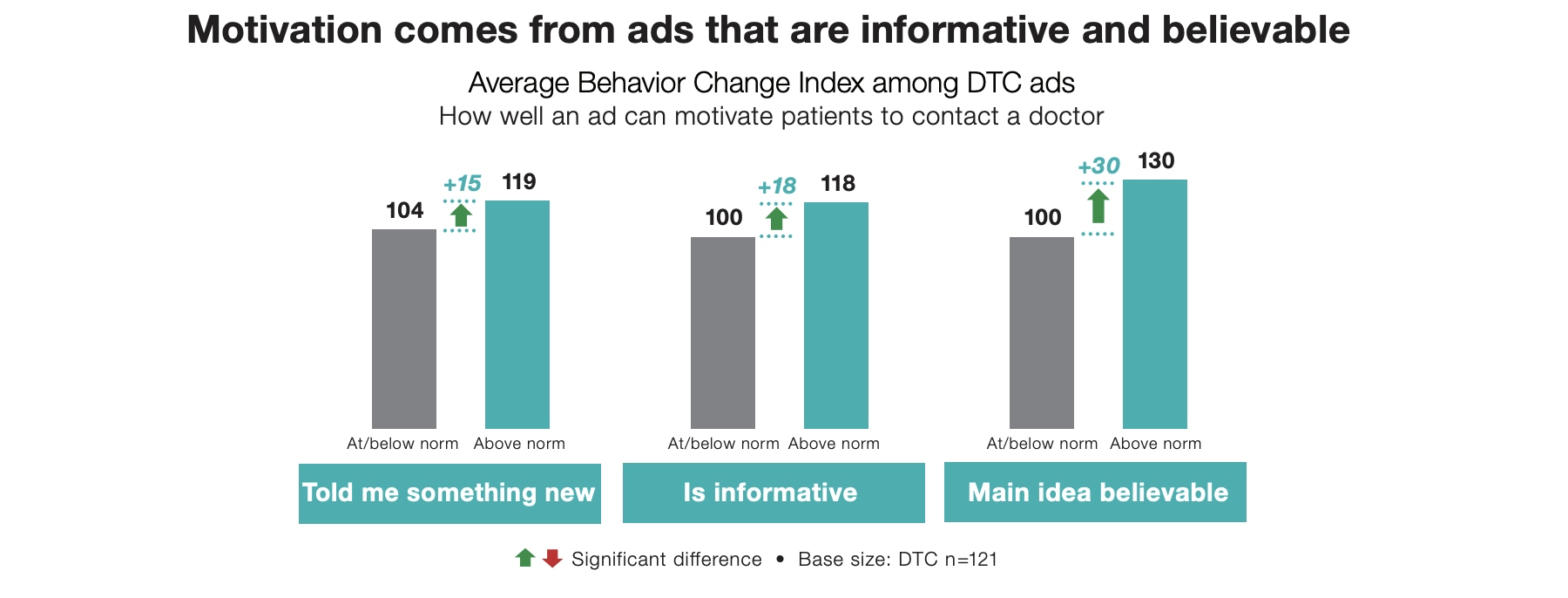
How persuasive an ad is can depend on the severity of a patient’s condition. For example, a brand targeted at a skin condition is typically more persuasive than one targeted at a heart condition. It’s easier to present believable information about product benefits that set it apart from its competitors. Relevant information motivates, and pharma brands must make sure their creative provides a strong framework in which to share their claims and benefits. Successful pharma ads outperform on “told me something new” and “believable main idea.”
WHAT’S NEXT
- Brands should consider developing distinctive assets that help memorability.
- Companies should seek more variety in their creative approaches; don’t just depend on “slice of life” storytelling for DTC ads.
- Key to maintaining viewer interest: depicting positive emotions and showing human relationships.

![[WEBINAR] How winning brands are making themselves essential in a tight economy](/sites/default/files/styles/list_item_image/public/ct/publication/2026-09/thumbnail-templates%20demo_3.png?itok=0YmowUKN)
