How news consumption impacts views of the pandemic
We often describe America as existing in a split reality, with public opinion divided neatly along partisan lines. Yet as our polling data reveals, where Americans get their information can be just as determinative of where they stand on the pandemic as partisanship.
Naturally, there’s a strong overlap between what news Americans consume and what their core beliefs are. People tend to gravitate towards sources that reinforce their particular point of view, which then becomes a self-fulfilling prophesy as fact, spin and belief all collide to form a closed loop.
Perspectives become even more complicated when news source overlaps with partisanship. As our polling with Axios tells us, Republicans who get their news from FOX or conservative online news hold different beliefs from those who get their news from more “mainstream” channels like ABC, CBS or NBC. Conversely, Democrats who get most of their news sources like CNN or MSNBC tend to think differently than those who get them from local radio or news.
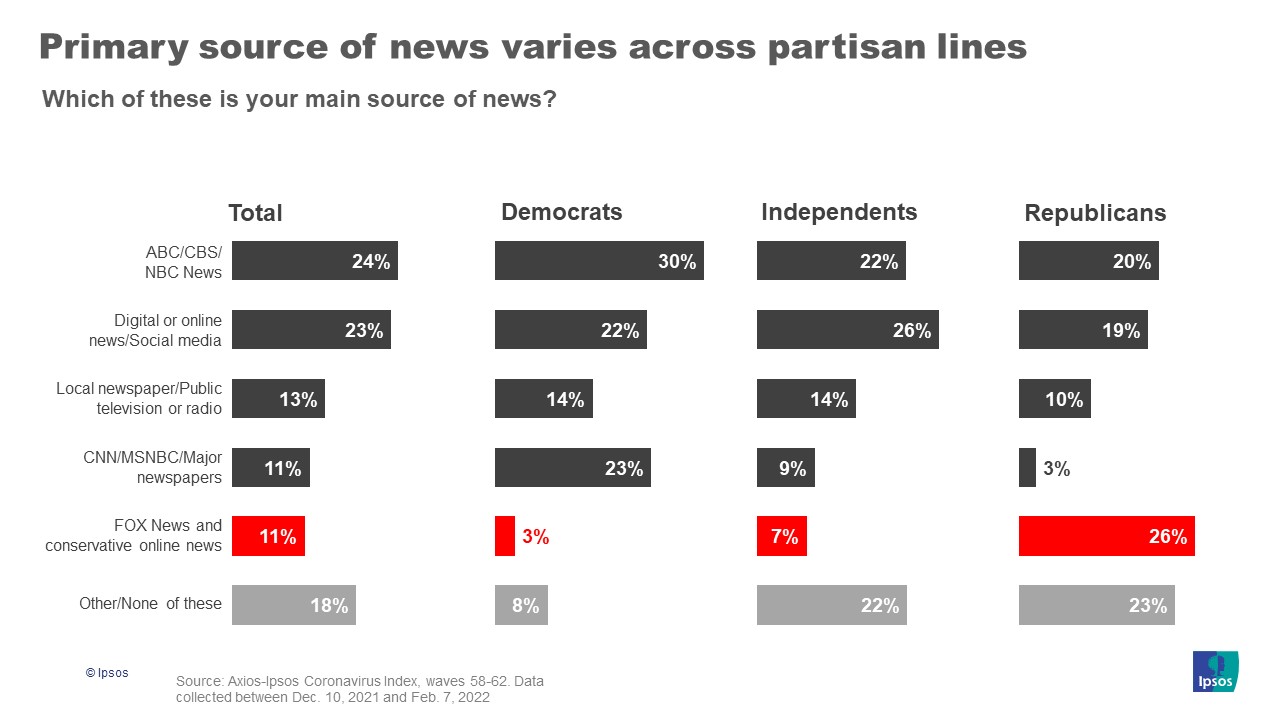
Social media adds another dimension to the information ecosystem – approximately one in four adults say they get most of their news from social media or digital sources, according to our Axios data. When cut by partisan identity, this group tends to show more skepticism about authority and see COVID as less risky relative to many of their red and blue peers.
Below, a review of how news consumption filters views on COVID:
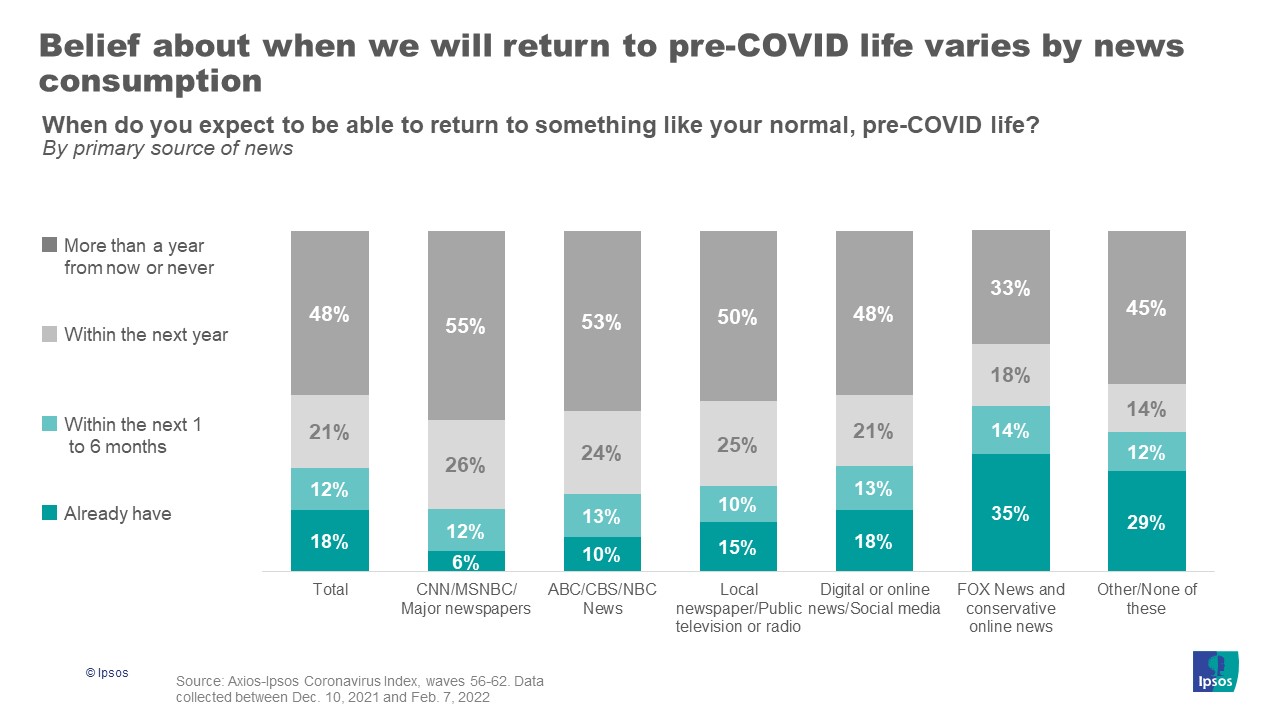
- Return to normal. Americans don’t agree on where we stand in the nation’s progress on the pandemic. For approximately one in five, pre-COVID life is already here. But most believe a full return to pre-COVID life is further out in the distance, a year or more to come. These perspectives vary considerably by news consumption, with people who turn to FOX or conservative outlets most likely to think pre-COVID normal is already here or shortly to arrive.
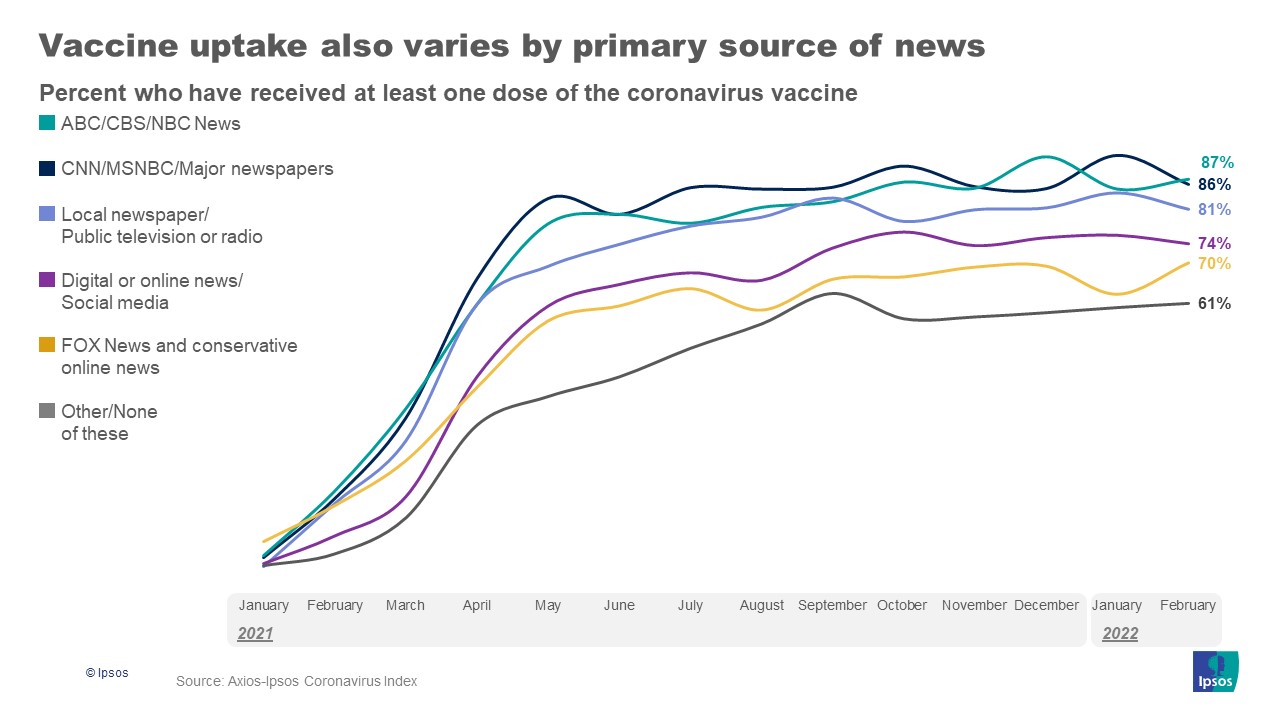
- Vaccine hesitancy. Disparate beliefs about the pandemic influence vaccination rates. As our Axios tracking data shows, vaccine uptake has consistently lagged among people who get their news from FOX, conservative sources, digital news, and social media. But vaccinations are lowest among people who are disconnected from traditional sources of news altogether.
- Primary source. America’s changing relationship with news is well-documented. Americans, particularly younger generations, are increasingly turning to digital sources, social media or even podcasts. Meanwhile, local news sources continue to vanish. Within this changing landscape, certain sources have a clear gravitational pull over specific partisan audiences.
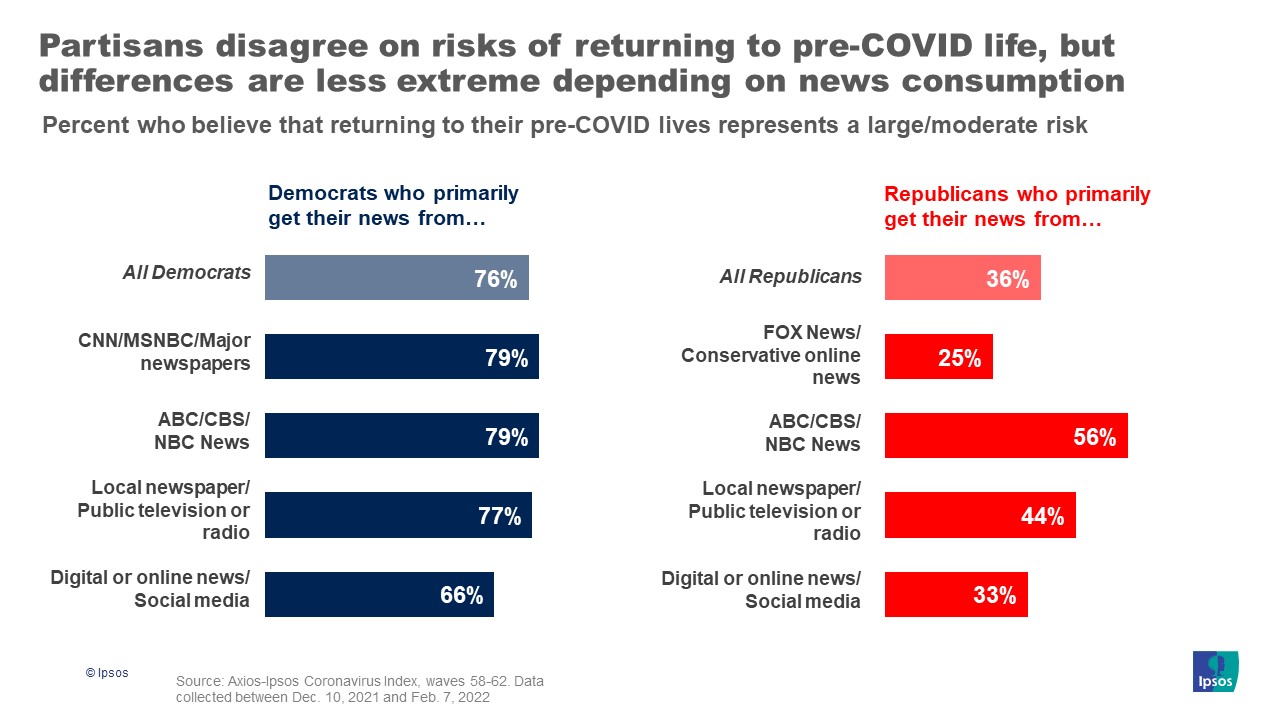
- Risk of return. The impact of our varied news landscape becomes clearer when filtered by partisanship. For instance, a minority of Republicans who get their news primarily from FOX and conservative online news believe that returning to pre-COVID life is a large or moderate risk, compared to the 56% of Republicans who get their news from ABC, CBS, or NBC News. Meanwhile, Democrats move more in lockstep, except for those who get their news from digital, online sources, or social media. A tale of two Americas, but with a twist.
- Trust in authority. News consumption has implications for public trust in entities like the federal government. Partisan trust in the federal government is increasingly tied to the party in power, with trust rising and falling among Republicans and Democrats depending on which party has won the White House. But, as a closer look at news consumption and partisanship shows, Republican and Democrats’ views are not wholly monolithic.
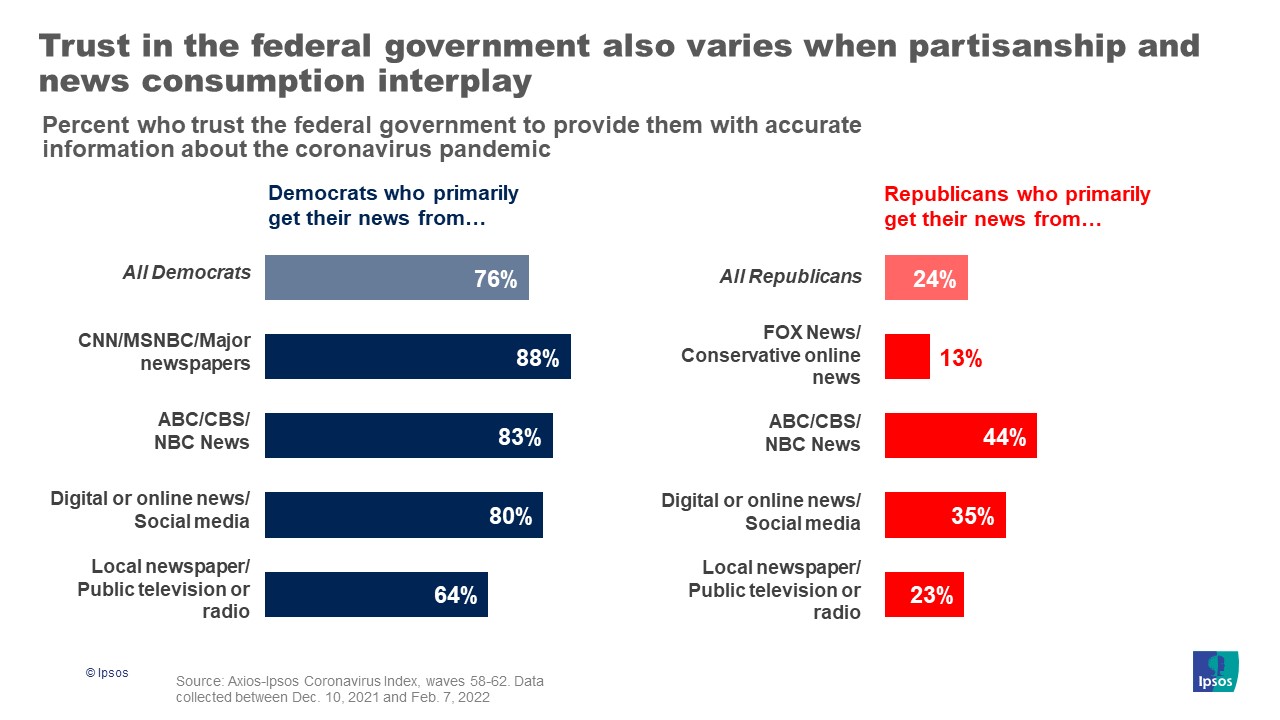
Though our data often points to a somewhat binary tale of two Americas – one red, one blue – in reality, partisan perspectives aren’t always so monolithic when other variables are taken into consideration.
In our fractured and evolving media landscape, part and parcel of a society that is increasingly reliant on digital devices, it is critical to understand how news consumption shapes our perspective of the world around us.
This has had direct implications for belief and attitudes around COVID, manifesting in vaccine hesitancy and skepticism of organizations like the CDC or federal government. At the same time, let’s not forget that for many Americans, mistrust of the media is deeply rooted, and that a small but significant minority report opting out of the traditional news cycle entirely.