What the Future: Shopping
What are the new brand rules as AI helps drive the shopping cart?
Shopping is changing as AI shapes how people discover, evaluate and buy products. Yet the underlying questions for brands and retailers have as much or more to do with human behavior as the technology itself.
What happens to brand loyalty as AI shopping agents become capable of doing more? How will people decide what or whom to trust? If AI can handle routine purchases, what aspects of shopping will people want to keep for themselves?
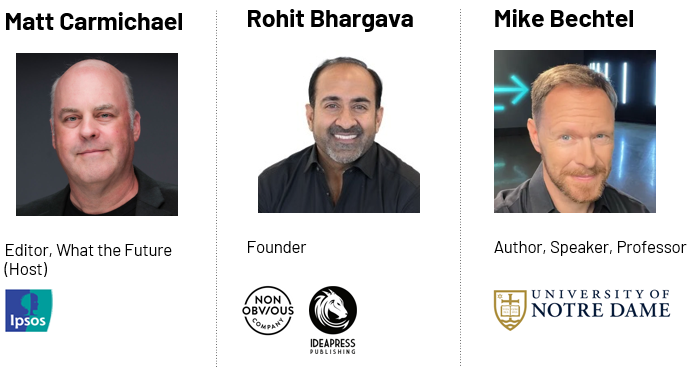
Listen in as What the Future Editor Matt Carmichael hosts futurists Rohit Bhargava and Mike Bechtel to discuss what’s next for consumers, brands and retailers. While technology could transform how people buy, the future of shopping will also be shaped by how people balance convenience, trust, expertise and experience. This discussion explores how those dimensions will evolve for the next generation of shoppers.
Speakers:
This session is part of our Insights to Activate deep dive into Winning the Wallet War.
Key highlights and takeaways:
Trust is the real barrier to AI commerce
Host and What the Future Editor Matt Carmichael spells out what purchases people are more comfortable using AI for recommendations versus delegating actual transactions to. Brands and retailers need to consider how to help shoppers be more confident in AI-assisted shopping experiences than just replacing their decision-making.
“I have a working theory that there's something in play that I like to call the Human AI Risk Reward Matrix, HARRM for short. When asked about things people like doing and things people trust AI to do, you see one clear trend:We today trust AI much more to help research than execute. That's a big and important trust gap,and one brands and tech companies will need to close for the tech to change how people do things in a thing that is so ingrained in their lives.”
“Dealusion” in retail has created a confidence crisis
Rohit Bhargava, author, speaker and founder of the Non-Obvious Company, highlights the weakness of retail pricing optimization that unintentionally undermines consumer confidence that they’re getting a fair deal.
“One of the most fundamental things that's happening right now is this breaking down of trust in terms of me believing that I'm getting the value that I think I should be getting. … We have a word for it, we call it a “dealusion,” which is like, I have the illusion that I got a deal, but I, after I click buy, I still think, "Oh, wait, if I may waited, like, maybe 20 seconds, I might have been able to have another best discount code or maybe the price went up or down, and so I don't even have faith that I paid the right price for it, which means I don't enjoy the thing anymore because I feel like maybe I overpaid for it and I'm a sucker."
Agentic commerce will change how people shop but won’t end shopping
Futurist Mike Bechtel, who is a professor at Notre Dame, posits that as AI focuses on bots buying for people, consumers will continue making shopping choices but at a higher level of abstraction. Brands will need to adjust for shoppers to communicate their intentions rather than their product selections and everything from merchandising to loyalty programs and user experience will need to serve both humans and AI agents.
“You're still shopping, but you're doing it in an abstracted, elevated way where the bots are servicing the request.Now, if that sounds goofy, think back to 100 years ago when shopping was negotiating with the butcher, this slice, not that, trusting the baker, don't short me on that bread, right? What online was to that, I think AI will be to online.”
Effort itself is becoming a form of luxury
As friction disappears from many aspects of life, consumers may put greater value on experiences that require skill, attention, participation and intentionality, something Rohit Bhargava calls “Effort Luxe.”
“One of the insights that we've been watching, and we have a word for that one, too, is ‘effort luxe.’ This idea that like when it takes more effort, that's the luxury. The luxury is the actual time spent. The friction that's involved, the fact that it's not just pick it up and buy it. It's maybe requiring some level of effort to find this piece, find this piece, find this piece and put those together yourself in order to experience it the way that you want to experience it.”
Transcript:
Matt Carmichael (02:01):
Hey, everybody. Welcome to the future of shopping. Today, what the future is actually in the Ipsos Chicago office. And I'll be joined by some of my futurist friends, Rohit Bhargava, author, speaker, and founder of the non-obvious company, and Mike Bechtel, former Deloitte futurist, consultant, and soon-to-be author. 13 years ago, Amazon announced its plans to have drones deliver items right to your doorstep. And I had two very different conversations at that time. One was someone who lived in a very urban area, and one was someone who lived much more rurally. And they both said, "Man, those are going to get shot out of the sky where I live." The urban resident was talking about theft, and the rural resident was thinking more about property rights. And it reminded me of a story I read in Wired magazine decades earlier about satellite TV pirates, which is so anachronistic that I will explain it.
Matt Carmichael (02:50):
For those who need a refresher, before the internet, it was prohibitively expensive to get physical cables for TV to rural areas. So people bought these huge satellite dishes, and the signal was encoded, but a sizable percentage of people bought pirate boxes to get around the fees for the decoder boxes that they tried to sell you. So Wired ran this story in the 1990s, featuring a double-page spread photo of a farmer in his field with rolling Midwest hills in the background. He has a barn on one side and a dish behind him, and he's holding a rifle. And the pull quote reads, "If a TV signal comes trespassing onto my property, I should be free to do any damn thing I want with it, and it's none of the government's business." It's the same attitude my rural friend felt about the drones, and it's the same attitude we say in discussions today about AI data centers, which currently disproportionately impact people in less dense areas.
Matt Carmichael (03:45):
Technology changes, but people don't. If nomadic protohumans hunted and gathered, today we regularly forage through 2.7 grocery stores just to fulfill our daily need to eat. Time is marked by shopping seasons, as well as meteorological ones, holiday shopping, back to school, spring fashions, et cetera. So with all the talk of the future of agentic shopping, where AI agents buy goods and services from other AI agents, and humans just have the stuff show up on their doorsteps without getting involved, that brings up a couple central tensions in this issue. First is that people like shopping. Eight in 10 like shopping online, just as many say they like shopping in stores, and that's mostly consistent across genders. And while yes, half of younger folks say shopping stresses them out, 37% say they're excited to have help from AI assistants. But younger people are also more likely to frequent shopping malls, twice as likely even, than older Americans.
Matt Carmichael (04:46):
And that's partially because they're hitting the malls, not as much to shop as to socialize, people watch and just have a place to go for some fun. AI cannot replace that for you. And there's another issue with AI. We don't trust it yet. I have a working theory that there's something in play that I like to call the Human AI Risk Reward Matrix, HARRM for short. When asked about things people like doing and things people trust AI to do, you see one clear trend. We today trust AI much more to help research than execute. That's a big and important trust gap, and one brands and tech company will need to close for the tech to change how people do things in a thing that is so ingrained in their lives. It's possible, and we certainly move to trusting e-commerce despite initial misgivings. Thankfully, with every obstacle comes a built-in blueprint for how to solve it.
Matt Carmichael (05:41):
Yes, close the trust gap, but in the meantime, there are ways to make people feel more secure by keeping them in the loop, guaranteeing their safety. And I think part of the hesitation is because the risk of losing money versus the reward of perhaps some added convenience. That risk is an especially salient one because money is tight. When give or take, four out of 10 possible customers don't have any money left over after paying their bills each month to spend on the things they want, that's a problem. And it's one we've been living with for years now. As the cost of something goes up, today that's gas, but it's been electricity, it's been meat, it's been overall groceries, something has to come down in a zero-sum budget. And so in just one year, we see more people shifting things that we used to consider everyday purchases into more luxuries or a splurge.
Matt Carmichael (06:36):
As with AI challenges, the challenges for brands and innovators provide a roadmap. Brand reputation for quality leads the way, and then more human concerns about worries about being wasteful or future regret. In the shopping issue, we talk further about malls, e-commerce, agentic, and how to get folks to shop with you. You can check it out at our 50 plus back issues at future.ipsos.com for free. But for now, let's dive into this discussion with Rohit and Mike.
Matt Carmichael (07:11):
All right. So we are going to talk about the future of shopping, and now I am joined by my awesome panelists, and I'm so psyched to have Mike and Rohit here. We are actually in the Chicago office of Ipsos today, so we're doing this on home turf, and I'm psyched to get the conversation going. So I'm going to have Rohit introduce himself.
Rohit Bhargava (07:29):
Awesome. my name's Rohit Bhargava. I am the founder of the Non-Obvious Company and IdeaPress Publishing.
Mike Bechtel (07:37):
My name is Mike Bechtel. I'm an author, speaker, and professor at the University of Notre Dame, focused on what's new and next in tech.
Matt Carmichael (07:46):
And so we are just going to have a quick conversation about future of shopping and retail and consumerism and really the t- two topics that everyone is talking about at the moment, which is AI and the economy. And one of the things that I think is an interesting disconnect that we see in our data a lot is that consumer sentiment is not that great. People don't feel like the economy is doing well, but by a lot of traditional economic and economist kind of metrics, things are actually coming along fine. Like, the markets are all up, investors are all happy. What do you think is leading to some of that disconnect? And I certainly have some theories I will chip into.
Rohit Bhargava (08:26):
Well, I, in my opinion, it's pretty simple. Money is making money. So if you have money invested that is making you money, then, you know, you might be okay. And I think where the struggle is, is there's a lot of people who are trying to make money themselves through their labor, through their work, through their jobs, and that is where a lot of people are struggling.
Mike Bechtel (08:45):
Yeah. Yeah. Rohit, I, I, I agree with you. You know when you're finding yourself on a, on a hockey stick, on, on, on an exponential like we are today there's this interesting phenomena where definitionally that means that the, you know, the person to your left might have about half as much as you, the person to your right has twice as much, right? So let's say, you know, easy numbers, let's say 100 grand, 50 grand, 200. Well, move up that curve. It's 200, 400, 100. Keep going. You've got miserable millionaires who feel $9 million behind the fancy Dan up there. So, so one of the things that, that I think we're seeing, and Rohit, you said it well, capital begets capital. The further you are, the faster you're going, right? But interestingly, sometimes the worse you feel.
Matt Carmichael (09:40):
You were talking about something when we were chatting earlier that used a phrase I am going to now adopt and use more of hedonistic adaptation, if I'm getting that right. That we just get used to having all the things and then when we don't have all the things anymore. Right,
Mike Bechtel (09:55):
Right. I mean, I mean, Matt, it, it, you know, there's, there's this interesting, there's this interesting idea where when our comparison set is a multi-billionaire, you, you lament all these luxuries you don't have, but if your comparison set is like King Henry VIII, man, he didn't have running water. He didn't have germ-free meat, right? And, and I guess that's all to say, there's a tendency to take for granted whatever you've experienced, it becomes the new baseline. So yeah, hedonic adaptation, it's real, man. Yeah.
Matt Carmichael (10:34):
And I keep thinking that, and we have some data to back this hypothesis because I have the superpower of being able to just ask people when I have hypotheses that the things that people care about in the economy are not the things that economists care about. So like people are not tracking GDP, people don't care about GDP, they don't care about unemployment unless they are unemployed, they don't really care about interest rates unless they're in the market for a mortgage at the moment, but they really care about the price of gas and they really care about the price of their groceries. And so they see those things going up and even though the rest of the economy and, you know, if they're not invested in the market, they don't care about the markets. So they have this sense that things aren't going well because they are looking at their own credit card bill and their own paycheck and not looking at the holistic picture that all of the policy leaders are excited about.
Matt Carmichael (11:23):
Does that track?
Rohit Bhargava (11:26):
Yeah, I mean, I, I think it's hard for anyone, it's macroeconomics and microeconomics, like it's hard for any of us to look at the world in macro and be like, "Well, my life represents country policy or whatever." , that's not how we think - No. Generally, even if we are an economist because the day-to-day doesn't really match that. And I think that, you know, one of the things that, that I've been tracking, and just like you, a- a- and just like all of us, I think, we're all tracking these signals, right? And I think one of the most fundamental things that's happening right now is this breaking down of trust in terms of me believing that I'm getting the value that I think I should be getting, because all these things are being inserted in between it, right? So I get on a plane and I paid for that flight, but now I have to sit through listening to a bunch of offers for different credit cards and stuff.
Rohit Bhargava (12:17):
And when I log into the thing that I've paid for, now I have all these pop-ups trying to upsell me on stuff. And because of dynamic pricing, now I have this, like, we, we have a word for it, we call it a “deal-lusion,” which is like, I have the illusion that I got a deal, but I, after I click buy, I still think, "Oh, wait, if I may waited, like, maybe 20 seconds, I might have been able to have another best discount code or maybe the price went up or down, and so I don't even have faith that I paid the right price for it, which means I don't enjoy the thing anymore because I feel like maybe I overpaid for it and I'm a sucker." Like, that's a breakdown of trust in retail that is very difficult to counter.
Matt Carmichael (12:51):
One of the things I love at the moment is that genre of ad you see online a lot of, "We really sorry for all the people who just bought our product, but now we're putting it on sale." Yeah. I'm not quite sure what that's supposed to communicate, but I keep seeing those a lot.
Rohit Bhargava (13:03):
I mean, it's this reinvention that, like, I mean, Oatly, for example, like, great brand, they launched, like, Oatly Natural, which only has a few ingredients, and so now everyone's like, "Wait, I was buying the, the not good one now I should buy the, the better one." It's like
Mike Bechtel (13:17):
When you're talking to someone, they say, "Can I be honest?" You're like, "Well, what was that?"
Rohit Bhargava (13:20):
Right. Yeah.
Mike Bechtel (13:22):
You know, guys, one of the things that I've been thinking about in, in reading a bit about is this idea that with the advent of machine intelligence, what we're finding is with more perfect intelligence and, and more perfect information, it's the end of arbitrage. And arbitrage is, it's such a nerd word, right? But, but think of it as think of it as a, you know something, somebody else doesn't know, you buy low, but you sell high, inefficiencies in the market. In the '90s, I remember when eBay first came out, I would literally buy guitars in Calumet City, Illinois at Music Lab, no longer a going concern, and then I'd sell them on eBay to, to fancy Dans across the country who expected to pay a lot more than a steel mill rat for a Strat. That's gone, right?
Mike Bechtel (14:18):
Those efficiencies are gone because everybody's got a post-doc in their pocket, right? And, and so I wouldn't be surprised if that's helping drive this “deal-lusion” thing and these credit card deals on planes because everybody's scrapping for vapors of margin that are exponentially harder to get than they were a generation ago.
Matt Carmichael (14:38):
Yeah. And I think that tracks with the discussion of the economy, too, of like money is really tight for a lot of people and they're all trying to find that efficiency because as gas prices go up one month and milk prices go up another month and meat prices go up another month, like, anytime we ask this question, we get somewhere between like 35% and 40% of people say, "Once I pay my bills, I don't have any money left over." And that's not just lower income people, it's higher with lower income, but still like a third of higher-income families too, again, with that hedonistic adaptation, like we are used to having whatever we're used to having, wherever that baseline is, when it goes down, we notice. And so, yeah, like, we're all trying to find the places where we can find that deal. We can lean into that and we can find the little scraps on the margin that are enough of a difference to make the difference.
Rohit Bhargava (15:28):
Well, and I think we're starting to realize that in certain cases, like, some things that were fun were like, "Well, we just can't compete with the algorithms anymore." Like fantasy football, right? Like the numbers can be crunched by someone way faster than any of us can do it. Or you think about like these betting markets, right? Yeah. And people are betting on really stupid things because someone else has the insider knowledge. Like people were betting on who else is going to perform with Bad Bunny at the Super Bowl? And everyone who was in rehearsals already knew. Yeah. And you're trying to bet based on like no knowledge at all and someone who already knows is like, "I already know who's going to perform because I was literally there yesterday." Yeah. That's a stupid bet. Yeah. And people are maybe starting to figure it out, but we're in the margin right now where people are like, "Oh, I think I can," you know, to your point, like there's vapor, right?
Rohit Bhargava (16:18):
And I'm like, "I think I can get some information and maybe figure this out." And there's a, there's a big, just like any gambling, there's a promise of a big win, so I want to give it a shot, right? But it doesn't work.
Matt Carmichael (16:30):
Yeah. Gives us a little hope. Yeah. And we're talking a lot in the world at the moment and have brought it up a little bit about like agentic AI and the idea that AI will go out and do your shopping for you and AI will also be the merchant selling the thing and the AIs will just talk to each other and the goods will arrive at your house magically somehow. A, let's start with, do we think that's plausible and are we making too big of a deal out of it or is it really going to kind of change the way consumers shop everything?
Mike Bechtel (17:00):
I mean, it's wild and that, that's a, that's a pretty limp opening, but I think it's the right word. It's wild because I think a year ago I may have scoffed a little. But over the last six months having slung together all sorts of wackadoo agents for all sorts of business cases up to and including fantasy football, right, I felt recognized when you mentioned that. Yeah. But to me, I think of it as automation is this waterline that's, that's been rising for two million years. Like we, we don't need to bring Homo habilis into this, but humans have been tool builders from the jump.
Mike Bechtel (17:48):
Now that we're automating cognition, discernment, decision making, what humanity always tends to do is elevate above that rising tide. Now, what, what I mean there is, once we automate things that we now consider muck, we get busy living in a new level of magic. And so to your adaptation point, grocery shopping becomes more of an expression of abstract value. Like allocate 5% of my monthly income to healthy organic foods and a fleet of cheap and cheerful robots goes out and does that. You're still shopping, but you're doing it in an abstracted, elevated way where the bots are servicing the request. Now, if that sounds goofy, think back to 100 years ago when shopping was negotiating with the butcher, this slice, not that, trusting the baker, don't short me on that bread, right? No, we just ... So what online was to that, I think AI will be to online.
Rohit Bhargava (18:56):
Yeah, I mean, I think that a lot of the automation, what's going to happen in retail is going to be joy related. Do I find joy in doing this and therefore I don't necessarily want automation? Or do I hate doing it? In which case, great, automate it for me and I, I don't have to deal with this anymore. Like I don't want to have to do it, right? And I think that what that means is that the priority now for anyone who's trying to create a retail experience is, let me find the people for whom this is joyful. And it's not always everybody, right? And same thing with prioritization when you think about like what people find value in, right? So I'm the same consumer, I have the same amount of money, but I probably would never buy sunglasses for more than 15 bucks.
Rohit Bhargava (19:36):
I don't find value in that and I lose them too often and I break them too often. But I'll easily spend hundreds, maybe even thousands of dollars on luggage. I'm a luggage guy. So for me, the priorities are that I'll spend time, I'll spend effort, I'll go into a place, I'll try these things out for this. Sunglasses, I'm not going to spend my time doing that and I'm not going to spend money doing it because that's not a valuable thing for me. And it's not because I don't have the money, it's because I don't find value in that particular thing. So that's going to be where the data comes in to say, look, these are all ... I might be a consumer in the sense that I bought that product, but I'm not a believer. I'm not a, an enthusiast of it. And the way we're going to be able to create those is by finding who's the enthusiast and who's just the occasional buyer and treating them differently.
Matt Carmichael (20:19):
There's a thing I'm actually introducing in this issue of What the Future which I'm calling the HARRM, the Human AI Risk Reward Matrix. And it's how much do I like doing this thing and how risky is it if the AI gets it wrong? And of course, this turns into a two-by-two grid because that's what we communicate with. Shocker. Right, right. And so there's like, I really hate doing this and I trust AI. Like I would love AI to do my expenses and time sheets. Who wouldn't, right? Like it, there's no risk to me if it goes badly and I hate doing it with a just white-hot passion. So yes, I would love to offload that, but the things that I like doing or the things that are super risky, I am not as willing to offload yet. And so I think there's this interesting tension that roughly 80% of people say they enjoy shopping both online and in stores. That's pretty consistent across genders. I know what people might be stereotyping, but like dudes like shopping too. We want our suitcases. I think my -
Rohit Bhargava (21:21):
Or whatever thing is.
Matt Carmichael (21:21):
Luggage like yours. Yes. Yeah. Wherever we find our joy. And so I think there's this kind of interesting tension that there's a lot of shopping that maybe we're willing to offload, but some of the things we're not.
Rohit Bhargava (21:33):
Yeah. And I think it's not just it's not just the shopping, it's the, one of the insights that we've been watching, and we have a word for that one too is “effort luxe.” This idea that like when it takes more effort, that's the luxury. The luxury is the actual time spent, the friction that's involved, the fact that it's not just pick it up and buy it. It's maybe re- requiring some level of effort to find this piece, find this piece, find this piece and put those together yourself in order to experience it the way that you want to experience it.
Mike Bechtel (22:04):
Yeah. The, like the, it's an old, it's an old like Greek philosophical idea that the, that the, the joy is in the striving. Right. And maybe where that lines up with your point around cheap sunglasses and, and I think yours, Matt, around the HARRM matrix is I think everyone has a different mixing board of signal and noise of joy and muck. And retailers, if I'm tracking with both of you, retailers have an opportunity to avoid a race to the bottom on things that people consider muck, right? That's going to be robot palooza. But if you can create rich experiences in the areas that people are pumped about, like game on.
Matt Carmichael (22:53):
Yeah. And it seems like one of those things that the early adopters are going to have to have a good experience with it. And if they run into a lot of friction and it's like, "Oh, I sent the agent out and it bought me all the wrong produce." Or like, "Why doesn't it understand that I don't like broccoli? Like I've told it six times and yet all I got was different kinds of broccoli." And that, that seems like one of the things that like, it's got to get right, right out of the gate or it's going to slow the progress because the early adopter's going to be like, "No, it doesn't really work just yet."
Matt Carmichael (23:25):
Yeah. Rohit has a couple times kind of mentioned this, so I'm going to bring it a little more to the forefront, but you have a book coming out in this fall with Henry Coutinho-Mason. He showed me an advanced copy that's so advanced it actually says advanced copy on it. And I love the premise of this, that it's words that we don't have, but we're going to need in the future. And you've mentioned a couple of them. So do you have a couple more that are like super shopping focused that we should just drop in a conversation
Rohit Bhargava (23:55):
Here? Yeah, we have a, we have a ton. I mean, I was thinking about this ahead of this conversation. I think one that might be interesting is we called the word “nopium,” and nopium is a product that is elevated because of what it leaves out. Ooh. So it's the essence of luxury by omission. I like it. So you choose these things that you don't get - Right. And therefore you see that experience as more, or that product as more luxurious because it doesn't have stuff. So you think about the dumb phone, for example, right? It leaves out all these features and therefore it's more of a, a desirable product for some people. So that's one example where we're like, we could pack everything in - Right. But we've chosen to do the opposite.
Mike Bechtel (24:36):
Yeah. Remember Commodore, the computer brand? Yeah. Yeah. They have brough it back. They have a dumb phone, not-so-smartphone that I, I remember when I saw it, I, I went through, you know, you know, they talk about, what is it, the Kübler-Ross stages of grief. I went through my own stages of confusion. At first, I thought, like, that old brand, what? And then my second thought was just like, well, it could be a cost savings opportunity. And, and then I was like, well, oh, it's priced at a premium. Yeah. But it was exactly your point. They were, they were pushing the Nopium - Yeah. That was a world freed from socials. And I thought, wow, what, like, what?
Rohit Bhargava (25:18):
So many examples of that. Like if you think about, like, my kids, they're 18 and 21. And when my son went on vacation with his friends, he took the old Sony Cyber-shot that I had from, like, 15 years ago with the memory stick, and he's using that. We are shooting back on film again. Like, you know, that's coming back. And so you only have 24 shots or 36 shots or whatever it is, and you got to make sure that, do I really want to take this picture or not? Let me take every picture possible and then end up with thousands of photos.
Mike Bechtel (25:47):
It's wild, Rohit, that your, your kids are leaning into that too. I -
Rohit Bhargava (25:53):
Not just my kids, like, kids of that age.
Mike Bechtel (25:54):
Well, my, my daughter - Yeah. For me, this was a data... Now, now I've got two points to make a line, and maybe we'll make a plane, Matt, if you've got experience. But my daughter was over the moon that the 15-year-old used car... It's a good car. I was going to say beater. It's better than beater. But it had a CD player. And I saw it as this anachronism, and as a technologist, I'm thinking, like, it's the worst of digital and inconvenience. Yeah. She promptly got herself a Fleetwood Mac CD and an Eagles CD, and it's not that she's walking around like a continental philosopher rejecting modernity. It's that there's something righteous to listening to nine songs in a row. And that's
New Speaker (26:47):
The way the musician intended,
New Speaker (26:49):
Right? Yeah. So, yeah. Yeah.
Rohit Bhargava (26:51):
Wild. Yeah. We've lost that whole thought process. I mean, musicians would think about, like, what song do I want someone to hear first? How do they traverse this journey through the album? Right. And now it's just like, here's one song, here's one song, here's another song. Yeah. I
Matt Carmichael (27:04):
Miss that. And you'd, like, make a mix tape of my favorite track one side one. Like -
Rohit Bhargava (27:10):
Well, but that's your version of that, right? Yeah. Which is you're telling a story. Yeah. Which is also amazing. Yes.
Matt Carmichael (27:16):
Right? Yeah. And I also have data points on this. My kids, one of them just picked up one of the old digital cameras around the house and is like, "Hey, can I use this?" And the other thing I -
Rohit Bhargava (27:25):
You're like, "Let me find the charger."
Matt Carmichael (27:29):
Oh, yeah. Back to the other point, like, there's a weird consumer insight in this, and I don't know what it is, but I still have the box for my Commodore 64, but I no longer have the computer. And I actually regret the fact that I don't have the computer, although Lord knows what I would do with it.
Rohit Bhargava (27:42):
Sell the box on eBay as-is
Matt Carmichael (27:43):
Yes, exactly.
Rohit Bhargava (27:44):
Give someone a surprise.
Matt Carmichael (27:46):
Yes. And at some point I sold off the computer and I'm like, "Why did I do that?" But yes, exactly. It brings up an interesting point though. Like, I don't know about your kids, but my kids hate everything about AI. Like, if I mention AI, they will roll their eyes in a very teenager-y way and walk out of the room. And it comes from a couple places. One, they love anime, they love fanfiction. They see this whole creator and fandom being threatened by generative AI that can write fanfic itself. And the other is, they sit in their class and they see the students who got A's on all their homework and then fail the in-class test. And sometimes they can see the kids around the room like, "Oh, they're cheating, they're cheating, they're cheating, and I'm over here doing my work like a sucker." And so everything that they care about as teenagers, school and creative things, don't mesh with the AI economy.
Matt Carmichael (28:44):
And so they're just like, "Let me out of this." And we see this starting to pop in our data, too, that the youth who are generally the first ones onto any technology are like, "We're going to wait and see just a little bit on that."
Mike Bechtel (28:56):
There's this old Douglas Adams quote. He's the science fiction author. Really he's a humorist who happened to build humor into science fiction. But he says, you know, any technology that came out before you were born is just a natural part of the world. Anything that came out between you were, when you were about 15 and 35, you probably built a career out of it. And anything that comes out after you're 35 is unnatural and should not be entertained. And I, I think part of that generational rejection is they see it less as a transformative magic trick. And, and to your point, Matt, a little bit more like a, a lazy hack, right? Just sort of, you know, mindlessness metastasized into mayhem, which is all to say I think things hit different when it's part of the water you're swimming in. And for a generation who's only ever swam In water where you can generate, you know, illusions as it were, tricks. They're a little more skeptical. It's like doing magic for magicians.
Matt Carmichael (30:13):
Yeah. That's a good analogy.
Rohit Bhargava (30:14):
I mean, I think, yeah, I think that what they're seeing is something that I think us parents are also feeling, which is in a world where you have all easy answers you stop wondering. You stop having curiosity. Ah, that's well said. And so like our word for that is unwondering. And one of the things that we did Henry and I, when we're like thinking about how do we promote more curiosity in the world I'm a big believer, and I tell my kids this too, that like, if you're going to have curiosity and wonder about the world, you got to put the device away and you got to go somewhere interesting, right? So it's not just put the device away, it's also go somewhere. But then the question is, well, where do you go? So what we launched was the Unwondering Project where we built an entire database of cool places to go across the U.S. that you could search by zip code.
Rohit Bhargava (31:02):
So you put in your zip code and you'll find like carousels or like lighthouses or museums or independent bookstores, like places of wonder that you can go with your family to experience that in the real world. Yeah. And that's what we tried to put out there. So right now it's @unwandering.com and it's basically a compilation of all these cool places. And sometimes as parents, we're like, "Well, we want to go and do something new and interesting, but like, what's going on? Like how do we find out? Do we go into the magazine website and figure it out?" And, and these are just places that are always there. It's not a short-term exhibit. It's not like a show. It's just historic trees.
Matt Carmichael (31:40):
Nice.
Mike Bechtel (31:41):
I think that's super cool. There. Remember REM “Man on the Moon” for audience of a certain age or a certain proclivity. Maybe my daughter has the CD. Yes. But there's this line "If you believe there's nothing up his sleeve, then nothing is cool." And it always, it always stuck with me, A, because REM lyrics are a wonder, but B, I think back to what we're saying, in a world saturated with digital magic it can be easy to think nothing's cool. Yeah. And I think to your point, man, Rohit, I love the idea of, it's called the Wondering Project?
Rohit Bhargava (32:27):
Unwondering. Unwondering Project.
Mike Bechtel (32:28):
Unwondering. Yeah. It's, it's like, no, here's an indicia of brain breaks from the algorithm. Yeah. Let's go. Right? I think that's great. Yeah.
Matt Carmichael (32:39):
This reminds me kind of tangentially, and we're going to bring it back to Agentic for a moment. I don't know if you guys saw this report, but someone did an experiment with two agents that were buying and selling like coffee beans or something. And what they realized is the agents are trained to behave rationally and logically. And so they expect rational and logical transactions. And if you introduce what they were calling whimsy into it, it all breaks down. So if you're like, "Oh, it's Tuesday. I'm not allowed to spend more than $1 for coffee beans," which doesn't make any sense at all. The other agent's like, "Oh, well, okay. I mean, if you say it's Tuesday and you can't spend more than $1, then I'll go to you for $1." Yeah. And it just completely short circuits the process to introduce whimsy into it.
Matt Carmichael (33:25):
So I don't know if you want to add a new word. I think there's possibly a job in the future of being a whimsy engineer.
Rohit Bhargava (33:33):
That's a good one. There should be like a future jobs associated with this, right? Exactly. I mean, we do have a word that I think approaches it a little bit in the sense of when we learn to read, you know, we become literate. And when we learn how to interact with AI, the word that we chose was “literalcy” because you have to learn how to be literal in the sense of like you have to explain things that shouldn't need explaining - Yeah. In a very step-by-step way if you're going to get back what you actually want. So imagine you're in this scenario, this is what you do, don't do this, don't follow this departure. Don't do it yet. Just think about it. Then tell me, like when you start using AI and you realize that you have to do this level of literalness in order to get what you want, that becomes a skill.
Rohit Bhargava (34:22):
And it's not so much... I mean, it's sort of prompt engineering, but it's a way of speaking to the technology.
Matt Carmichael (34:28):
Yeah.
Mike Bechtel (34:29):
It, there, there's... What, what you both got me thinking about was a friend of mine who, who was a, a data scientist at Accenture for years now at Carnegie Mellon, his name's Rayid Ghani. He's, he's been a leader in, in data science and machine learning for years. And he testified before Congress explaining this idea that part of what machines need, to your point, Rohit, his version of the literalism, he called it the making the tacit explicit. All the things that humans have learned through like a little bit of ah-ah, right or mm-mm, robots don't play that. And so I think the implication potentially for retailers, for brands is think of all the myriad unsaid things, the beliefs, the value systems, right? The, the, the fabric that holds our brand and our customers together and say, wait a minute, that might not be overtly expressed and we may need to get that into these systems if these systems hope to have a shot at being better stewards of our real values.
Matt Carmichael (35:39):
Yeah. And you can imagine that this is going to be a challenge for people to train their agents how to buy for them. Like I do not know the entire vocabulary of how to buy a suit jacket. And I went to like Indochino one time and like actually ordered the thing and they were like, "Here are 45 different things you can customize." I'm like, "I honestly don't have a preference on that, but suddenly I need to figure out which box to check, right? Like - Yeah. I've never considered what color my thread count should be. Like, you know, a lot of things like that. And suddenly we're going to have to have all of that or else the AI is going to have to have some way to understand what our style and preference is, what kind of things matter to us, all the things that we generally learn by going shopping and touching things and picking things up and holding things and seeing how they look and seeing how big it really is on the shelf in front of me, like - Right.
Matt Carmichael (36:27):
We're going to have to be able to communicate all of that to our agents and our agents are going to have to be able to communicate all of that to the other agents on the other side. And I can see that being not an insignificant human problem to overcome with the technology.
Mike Bechtel (36:40):
Well, I mean Rohit, I'd, I'd love your intuition on this and I'm going to lean into a personal example and get your take. But my better half, Barb and I, are at the season of life where the obligatory kitchen remodel awaits. And -
Rohit Bhargava (37:02):
Good luck. Yeah.
Mike Bechtel (37:03):
Right. But, but, but here's the thing, but, and by the way, that's an example of the tacit explicit, that gesture, like, good luck. Like there's a lot to be learned for the contractor industry right there. But we, in our first discussion with a, a builder, they talked about this and that and the other thing and like a- apparently how close your cabinet doors are is like this exponential impact on how expensive it is. And I'm sitting there thinking like, I don't care how close they are, but the punchline is this. I told Barb, I said, "I just want a lady with a giant coffee and a jaunty scarf to boss me around to tell me that's fabulous and that's no." And Barb laughed because she said, "But you love data and you love choice and you love all that." And I said, "No, in this instance, I need a considered purchase, a curator and real human - You need expertise. Expertise and taste." And, and I'm wondering like, would that be an example to your point of like maybe the luggage versus the sunglasses and why the success comes in the str - the striving or to yours, does that sit somewhere in that HARRM matrix? I don't know. It's like I dread it, but you almost, you just have to do it right. Yeah.
Rohit Bhargava (38:14):
Well, I do think that there's, I mean, there's this idea that anytime we're making a purchase of something that we're not really feeling qualified to buy, whether it's a kitchen remodel or like I was in the market for like a new, like a really nice espresso machine where I could properly make it with like the porta filter and everything like a real one. Right. now I needed to do my research. So like most people now, I've started to turn to AI. I'm looking for the details and the sort of things I'm putting in there is, is it going to fit on my counter? Is it like, you know, what's the size of this thing? Right. And it struck me that as AI's doing the research for me and presenting the alternatives, it's reviewing what the publicly available information is. And yeah, it's looking at like, here are the top five espresso makers you should get from like some blog or whatever.
Rohit Bhargava (39:03):
Sure. But it's also pulling data and information from the manufacturing website of the company that makes them. And if you don't have that information in terms of how big is that machine, what are the specs of it, how do I, and it's readable by AI in an easy way, then you don't get discovered or put into that information. So now the priority becomes like, how do we put all of this information in one place? How do we catalog it all in one place? Not just from a specs point of view but also like from a discount point of view because people are going into AI and saying, "Well, get me the discount code." Yeah. And for the longest time, it was like, let's try and, you know, not make them find the discount codes. And now maybe it's, let's make the discount code super easy to find because if somebody's about to buy and they just want that 10% off and we can get that sale right away instead of the abandoned shopping cart, that's worth it.
Rohit Bhargava (39:53):
Yeah. So let's make it easy for AI to find it so that people put that code in and they make the purchase. All
Matt Carmichael (39:59):
Right. So Mike, in a recent newsletter, you talked about “Minority Report.” And I think that is a movie that sticks with the people who have seen it in a way that a lot of movies don't. And it creates this kind of utopian/dystopian view of the future with like media is customized and everything is around us and there are retail messages and retail shopping messages like literally on every surface and even things that aren't surfaces that are just projected in front of us. When you think about the future of shopping, the future of retail and future of retail media, like what do you think that gets right and what do you think it's kind of missing a bit?
Mike Bechtel (40:35):
Well, for starters, it's, it's wild to think that that movie is what, over 20 years old now and, you know, ha- half a lifetime for me. And, you know, I, I think, I think what “Minority Report” spoke to was this, this idea that, hey, early internet citizens, you ain't seen nothing yet. And the, the thought that what was once a banner ad tuned to your cookies on your browser could one day become a sub-second retinal scan that could figure out which of those two sweaters you looked at and which one should be discounted and delivered. It felt like science fiction because it was, but, but now it's real. And so I think the thing that it got right was, as humans, we're interested in customization, specialization, getting our needs recognized and met, right? Bezos has this famous line, he said, "The wrong way to future is to think about everything that changes.
Mike Bechtel (41:43):
The right way to future, think about what endures." Right? Quality product, quality price, next day delivery.
Mike Bechtel (41:54):
Where I think “Minority Report” may have, may have gotten it wrong was shading data science as inherently dystopian, because there was this feeling with the idea of pre-crime and reading thoughts and all the rest that , this is going to end poorly, full stop. In my take, and, and I love, I value yours, Rohit. We are the heroes we're looking for. We are also the villains we should be wary of. Mindful use of personalized tools can do well for consumers and retailers and brands alike. Malicious mustache twisting villains can use it to create all sorts of mayhem. And then in the middle, right, mindless lazy use is just going to create a bunch of waste. I think like any next generation transformational tool, it's about stamping out ignorance and ensuring mindful use. That's how we'll get what Arthur C. Clark called something indistinguishable from magic.
New Speaker (43:01):
I mean, I love the “Minority Report” story. I actually opened my South by Southwest talk the keynote with the backstory behind it, which I find so fascinating. What
Mike Bechtel (43:11):
Was it?
Rohit Bhargava (43:12):
Yeah. So Steven Spielberg wanted to, he's big, he's always been a filmmaker who wants to imagine the future. Sure. And he wanted to create this movie, “Minority Report,” to imagine what D.C. would look like in 2050. So he called 20 futurists into a room together for three days in California and said, "Imagine D.C. in 2050." And most of the stuff that they came up with is what got reflected into the movie. So that wasn't a prediction. They actually created a roadmap for what we eventually built. Everyone who saw that movie over those 20 years, they were influenced by what these 20, mostly guys, I think all guys. Sure. they didn't publish the list, but you know, you can imagine, right? It was the late 90s.
Mike Bechtel (43:52):
A preponderance of dude bros.
Rohit Bhargava (43:54):
Yeah. So these dudes came up with this imagined future, and then they put it in a movie that inspired people for 20 years to now create what they built. Wow. And I think the conclusion that I took from that is the only future we make is the one we can imagine because it's not predicting what's going to happen, it's creating the roadmap for somebody to build it. So that's what we have to do and the work that we do is we have to imagine what we want that future to be. And then the people who are going to be inspired by that work, whether it's through our books or through what we talk about or people like us or this program right now they're the ones who will then go and build that.
Matt Carmichael (44:31):
So that is a fantastic note to end on. It is a hopeful one. It is a pragmatic one. It is one that ties to the theme that I try and kind of always land my talks on, that if you start to imagine these possible tomorrows and you start to think about the questions that you're going to need to answer in the future, you're going to ask better questions today and do better research today. And so today we've had a great discussion. I'd like to thank Mike and Rohit for being here and being awesome. And we talked about a lot of interesting technology problems that I think are novel and new and we're going to have to figure out ways to solve, but also a lot of human problems that are less novel, that we are still as shoppers trying to buy a good deal and trying to find the right thing and trying to figure out which of the many products available to us we should choose.
Matt Carmichael (45:19):
And navigating that future for both the humans and the technology is going to be tricky and challenging, but also not exactly new problems, just different ones. And all of these things are things you can read about in the What the Future Shopping issue, which is at future.ipsos.com as well as all of our past issues. And we look forward to coming back next year. We're going to have a great new slate of topics, which I can't talk about yet, but they're going to be awesome. And Roth's book will be out this year, November. Mike's book will be out next year and it's going to be great. So we look forward to seeing you in the future.
Other events
-
05
Nov 2026
-
09
Dec 2026 -
29
Oct 2026