Concept Testing with Digital Twins
Today's leaders face a critical challenge: balancing the need for rapid innovation with the desire for precise, data-driven insights. A recent Ipsos study found that while 82% of leaders expect innovation to drive growth, 60% feel their innovation cycles are falling short. With millions of dollars riding on every product launch, brands face a difficult balance between speed and accuracy.
Our Ipsos Views paper, Concept Testing with Digital Twins, introduces a powerful solution to this challenge – the use of digital twins. The paper outlines:
- The difference between digital twins and persona bots
- The role of digital twins in innovation screening
- The effectiveness of different approaches
- The best tools for varying risk levels
Digital twins are not just a tool but a catalyst for more strategic and impactful market research. By using AI-powered virtual consumers, digital twin models provide accurate predictions of product acceptance in mere hours, not weeks, allowing for the instant mass screening of product ideas.
Digital twins are virtual AI representations of real individual people generated from real data to simulate attitudes, decision-making, and behaviors.
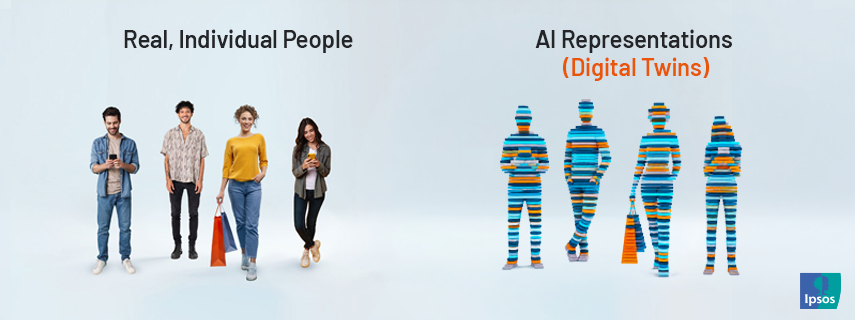
Drawing on findings from our comprehensive research study, where we built and validated digital twins for concept screening across the food sector, we show how marketing and insights professionals can accelerate their innovation cycles and trust predictions. We also identify where there are limitations – including instances where digital twins should not be employed.
Key takeaways include:
- You CAN screen ideas and concepts instantly and get the right results:
Digital twins allow instant, AI-driven screening of numerous product ideas, enabling marketers to focus research on promising concepts, significantly speeding up time-to-market decisions.
- Digital twin development makes all the difference:
Models need specificity, flexibility, and practicality; leveraging behavioral science ensures evaluations mimic human decision-making, comparing new products against existing ones rather than in isolation.
- Use it right, or don’t use it at all:
Once developed, care should be taken to ensure digital twins are used only for what they were designed for. Avoid misuse, like A/B testing minor changes, to prevent tool abuse and ensure optimal effectiveness.
This paper is the fourth in our Humanizing AI series, following: