
The Economic Pulse of the World - January 2018
Global @dvisor Welcomes Chile and Malaysia
After a brief pullback at the end of 2017, the global national economic assessment is up 3 points in the first month of 2018, as nearly half (49%) of respondents around the world rate their national economy as ‘good’. The national assessment is given a little nudge up by two new countries added to the monthly economic pulse this year: Chile and Malaysia. While Malaysia’s national average (45%) is on par with global numbers, Chilean citizens rate their national economy above the global average, with 57% saying their national economy is ‘good’.
The local economic assessment average is up one point since last sounding, as over one third (35%) of global citizens agree that the state of the current economy in their local area is ‘good’. Similar to the national assessment, respondents in Chile (50%) rate their local economy above the global average, while those in Malaysia (33%) are on par with the average.
After losing ground for two months in a row, the future national economic assessment is up 3 points this month, with 30% of global citizens surveyed in 28 countries expecting their local economy to be stronger six months from now. Chile (61%) is one of the top 3 countries, with India (62%) and China (61%), driving the future assessment up this month. Only one quarter (25%) of respondents in Malaysia expect the strongest economy in the near future.
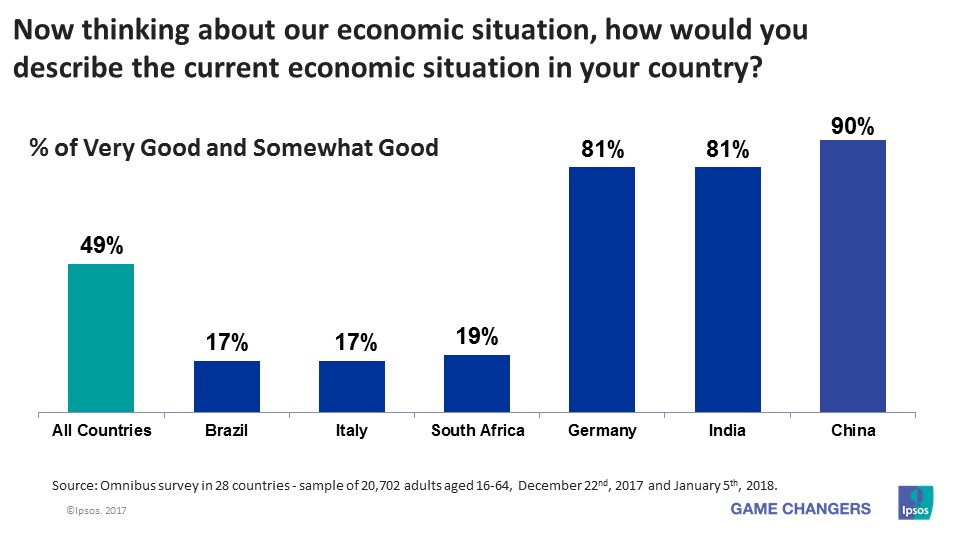
Global Average of National Economic Assessment Up Three Points: 49%
The average global economic assessment of national economies surveyed in 28 countries is up three points this wave with 49% of global citizens rating their national economies as ‘good’.
China (90%) has the top spot in the national economic assessment category again this month, followed by India (81%), Germany (81%), Saudi Arabia (73%), Sweden (71%), Australia (67%), the United States (66%), Canada (65%) and Peru (63%). Brazil (17%) share the lowest spot in this assessment with Italy (17%), followed by South Africa (19%), Spain (24%), Hungary (26%), South Korea (29%), Mexico (31%), Argentina (32%) and France (27%).
Countries with the greatest improvements in this wave: Russia (42%, +8 pts.), Great Britain (43%, +8 pts.), South Africa (19%, +7 pts.), France (34%, +7 pts.), Poland (59%, +6 pts.), Brazil (17%, +6 pts.), Australia (67%, +6 pts.), the United States (66%, +5 pts.), Japan (42%, +5 pts.), Peru (63%, +4 pts.), Mexico (31%, +4 pts.), China (90%, +4 pts.), Canada (65%, +4 pts.) and Argentina (32%, +4 pts.).
Countries with the greatest declines: Saudi Arabia (73%, -8 pts.), Sweden (71%, -6 pts.), Belgium (56%, -2 pts.), Turkey (35%, -2 pts.) and South Korea (29%, -1 pts.).
Global Average of Local Economic Assessment (35%) Up One Point
When asked to assess their local economy, over one third (35%) of those surveyed in 28 countries agree that the state of the current economy in their local area is ‘good’. The local economic assessment is up one point since last sounding.
China (73%) remains the top country in the local assessment category, followed by Sweden (62%), India (60%), Germany (58%), Israel (57%), Saudi Arabia (56%), the United States (53%), Chile (50%) Canada (44%), Australia (43%), Poland (38%) and Belgium (37%). Serbia (14%) and Russia (14%) are the lowest ranked countries in this category this month, followed by Italy (15%), South Africa (17%) Spain (18%), Brazil (19%), Japan (19%), Hungary (21%), Mexico (23%), South Korea (24%), Argentina (26%) and France (26%).
Countries with the greatest improvements in this wave: the United States (53%, +6 pts.), Brazil (19%, +6 pts.), Australia (43%, +6 pts.), South Africa (17%, +5 pts.), Great Britain (31%, +5 pts.), India (60%, +3pts.), Hungary (21%, +3pts.), France (26%, +3pts.), Canada (44%, +3 pts.) and Argentina (26%, +3 pts.).
Countries with the greatest declines in this wave: Saudi Arabia (56%, -7 pts.), Russia (14%, -6 pts.), Germany (58%, -2 pts.), Turkey (28%, -2 pts.) and Italy (15%, -1 pts.).
Global Average of Future Outlook for Local Economy (30%) Up Three Points
The future outlook is up three points since last sounding, with nearly one third (30%) of global citizens surveyed in 26 countries expecting their local economy to be stronger six months from now.
India (62%) remains at the top of this assessment category, followed by China (61%), Chile (61%), Saudi Arabia (53%), Brazil (53%), Peru (49%), Argentina (44%), the United States (35%), South Africa (32%), Mexico (31%) and Poland (31%). Italy (10%) has the lowest future outlook score this month, followed by Great Britain (12%), Hungary (14%), France (16%), Japan (16%), Russia (16%), Serbia (17%), Australia (17%), Spain (17%), Israel (18%) and Belgium (21%).
Countries with the greatest improvements in this wave: South Africa (32%, +19 pts.), Sweden (24%, +8 pts.), Poland (31%, +8 pts.), Hungary (14%, +6 pts.), Mexico (31%, +5 pts.), Germany (25%, +5 pts.), Israel (18%, +4 pts.), Canada (22%, +4 pts.), France (16%, +4 pts.), the United States (35%, +2 pts.), Japan (16%, +2 pts.) and Italy (10%, +2 pts.).
Countries with the greatest declines in this wave: South Korea (25%, -8 pts.), Saudi Arabia (53%, -4 pts.), Spain (17%, -2 pts.), Belgium (21%, -1 pts.), China (61%, -1 pts.), Great Britain (12%, -1 pts.), India (62%, -1 pts.), Russia (16%, -1 pts.) and Turkey (27%, -1 pts.).

![[WEBINAR] KEYS: Dialling Up the S In Sustainability](/sites/default/files/styles/list_item_image/public/ct/event/2026-06/keys-webinar-sustainability.webp?itok=xPunvoGu)
![[Webinar] Real-World Evidence: Empowering the Patient](/sites/default/files/styles/list_item_image/public/ct/event/2026-05/healthcare-real-world-evidence-webinar.jpg?itok=kT0PwLPQ)