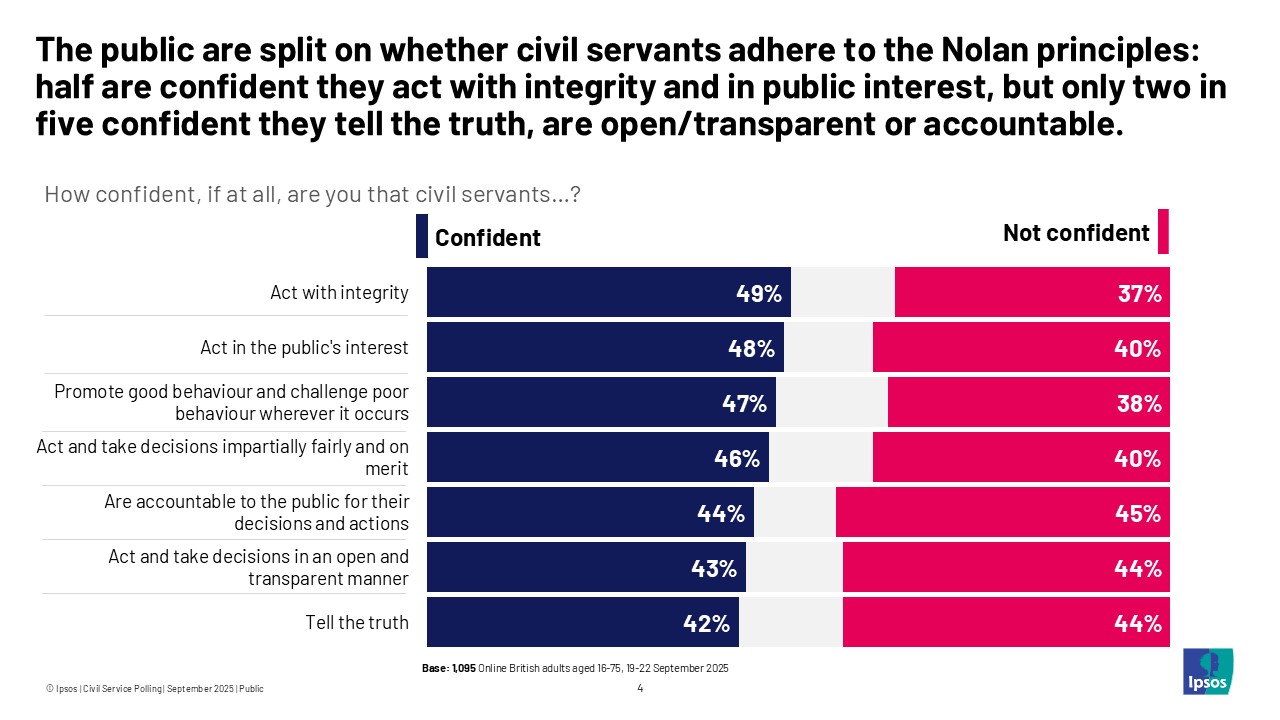
30 years on, the public are split on whether the Civil Service adheres to the Nolan principles
A new poll from Ipsos in the UK and the Institute for Government, carried out 19-22 September 2025, examines the British public’s perceptions of the UK Civil Service.
Key findings
- Awareness limited: Four in ten, 43%, say they know at least a fair amount about the UK Civil Service, but 56% say not very much or nothing.
- Bureaucratic but professional: The Civil Service is most likely to be described as bureaucratic (41%), political (33%), and stuck in their ways (30%), but also professional (36%). Few describe them as lazy (11%), but few describe them as innovative (10%) or accessible (9%) either.
- Mixed views on the Nolan principles: While around half are confident civil servants act with integrity (49%), in the public’s interest (48%), and promote good behaviour (47%), the public are split on whether civil servants tell the truth (42% confident, 44% not confident), make decisions openly and transparently (43% confident, 44% not confident), or are accountable to the public (44% confident, 45% not confident).
- Would work equally well with any party: Half (50%) are confident the Civil Service would work equally well with any party that might be in government (35% not confident).
- But there are doubts about its ability to deliver and be in touch: Over half lack confidence that the Civil Service can solve the most important issues facing Britain today (57%), deliver major projects on time and on budget (53%), or understand the needs of local communities (54%).
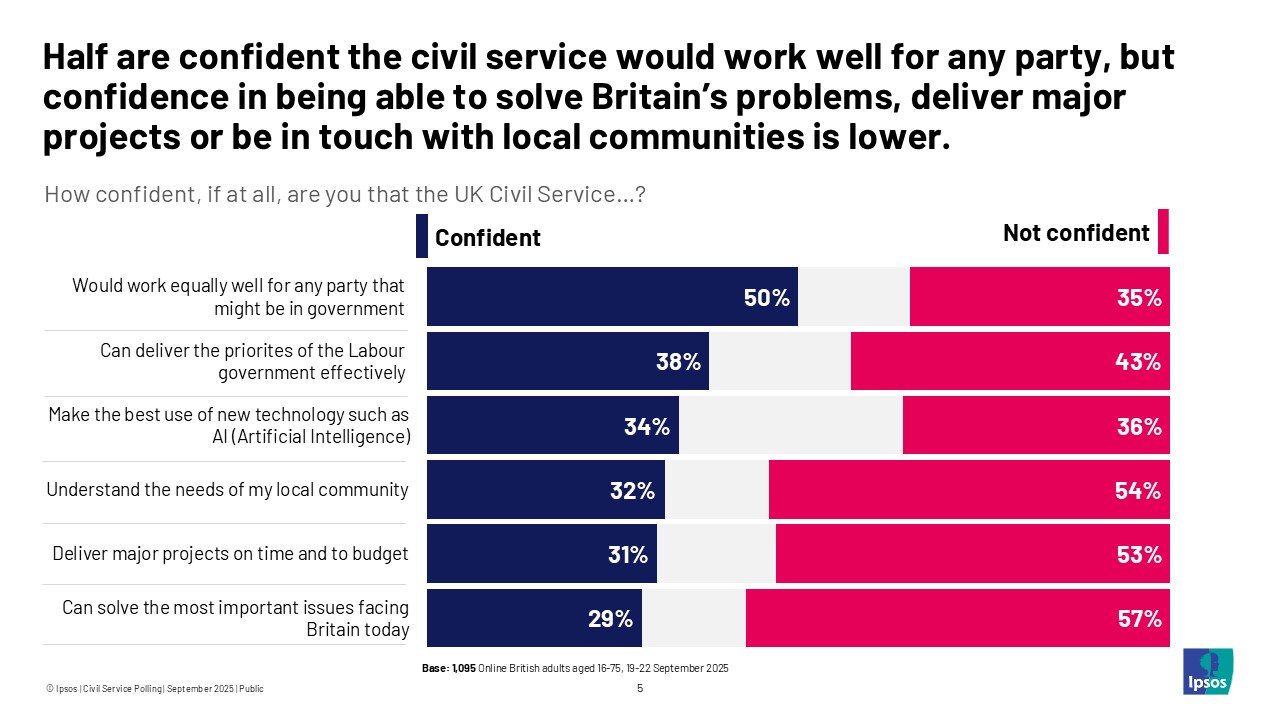
- Split views on AI: Britons are split on whether the Civil Service can make the best use of new technology such as AI (34% confident, 36% not confident). At the same time, only 10% would describe the Civil Service as innovative.
- Emphasis on diversity, equality and inclusion: Over a third (37%) think the Civil Service places about the right amount of emphasis on DEI, and one in four (24%) too much, with 12% saying too little. Labour 2024 voters are most likely to say there is about the right level of emphasis (47%), as do young people (49% of 18-34s), while Conservative and Reform UK voters are more likely to say there is too much emphasis (42% and 53% respectively).
- Pay: A third think civil servants are paid too much (34%), with three in ten (30%) saying they are paid about the right amount (12% say too little). Over half of Reform UK 2024 voters think civil servants are paid too much (59%). Just over a third (36%) of the public think civil servants are paid more than their counterparts in the private sector.
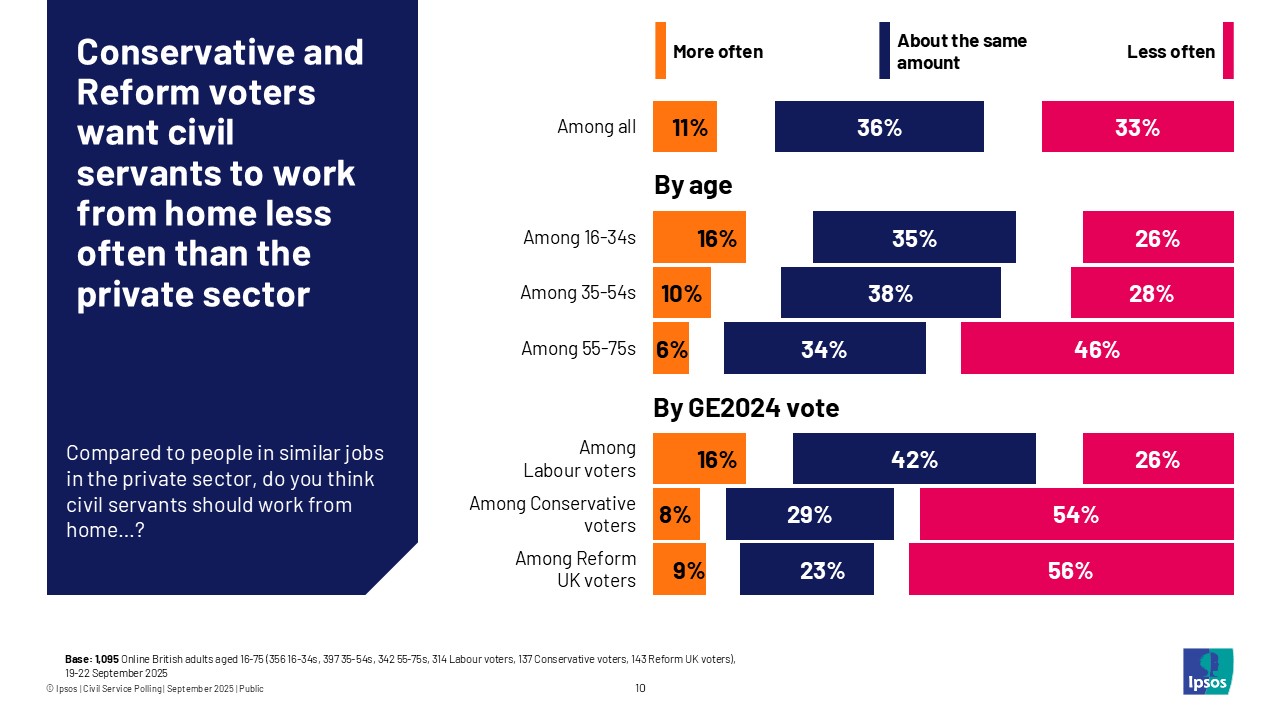
- Working from home: The public are split over whether civil servants currently work from home about the same (32%) or more often (24%) than their counterparts in the private sector. The public is also split between wanting them to work from home about the same amount (36%) or less (33%) than the private sector. Reform and Conservative voters have a clear preference for less home working in the civil service compared with the private sector (56% and 54% respectively).
Gideon Skinner, Senior Director of UK Politics at Ipsos, said:
The wider lack of public faith in government is impacting views of the civil service too. While Britons trust civil servants more than they do politicians, and public confidence has been lower in the past, the UK civil service still faces a challenge to convince an ambivalent public both of its professional standards and of its ability to make a real difference to the problems the country faces. In part this reflects a lack of awareness among most people about the civil service, but that is not the only issue. The civil service is seen as bureaucratic, with doubts over its capability to manage major projects, and how it has an impact on improving people’s day-to-day lives. More positively, civil servants are broadly seen as professional, acting with integrity and with an ability to serve all parties equally, but underneath this there is a clear division in political views, with Conservative and Reform voters much more critical. And just as important are the attributes which are not associated strongly with the civil service – innovative, accessible, and in touch with people’s local communities.
Alex Thomas, Programme Director at the Institute for Government, commented on the findings:
This fascinating polling should be read closely by civil servants and all those who care about the civil service. It's encouraging that many members of the public see the civil service as professional, competent and trustworthy, and back public officials to act with integrity. But far too many people see civil servants as remote and unable to solve the most important issues facing Britain today. The civil service needs to do much more to improve its capability, to encourage innovation and to become more accountable to the public. It's especially notable that older British people seem to be falling out of love with the civil service; the institution needs to prove its worth to all sectors of the public.
Technical note:
- Ipsos interviewed a representative sample of 1,095 adults aged 16-75 across Great Britain. Polling was conducted online between 19-22 September 2025.
- Data are weighted to match the profile of the population. All polls are subject to a wide range of potential sources of error.