
Andy Burnham preferred to Keir Starmer as PM, narrowly leads Nigel Farage
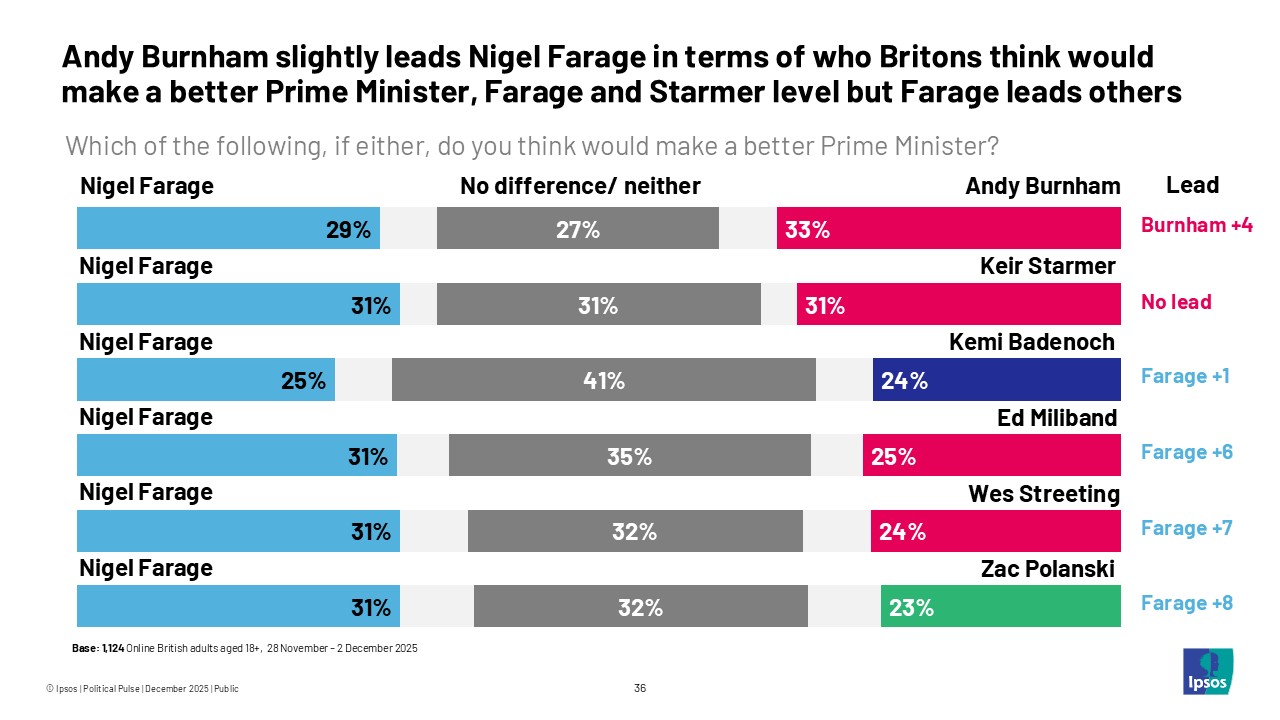
New data from Ipsos in the UK’s Political Pulse survey, taken 28TH November – 2nd December, pits a list of leading politicians head-to-head against Keir Starmer and Nigel Frage. Andy Burnham leads both, although he only leads Farage narrowly. Keir Starmer and Farage are level, with both leading Wes Streeting, Ed Miliband, and Green party leader Zac Polanski. Meanwhile Kemi Badenoch is statistically level with both Keir Starmer and Nigel Farage – reflecting an improvement in her position.
Keir Starmer head-to-head
- When the public are asked whether Keir Starmer would make a better Prime Minister than a host of leading politicians, he is neck and neck with Nigel Farage and Kemi Badenoch. However, he trails Andy Burnham by 13 points, with 2024 Labour voters preferring the Manchester Mayor by 36% to 29%.
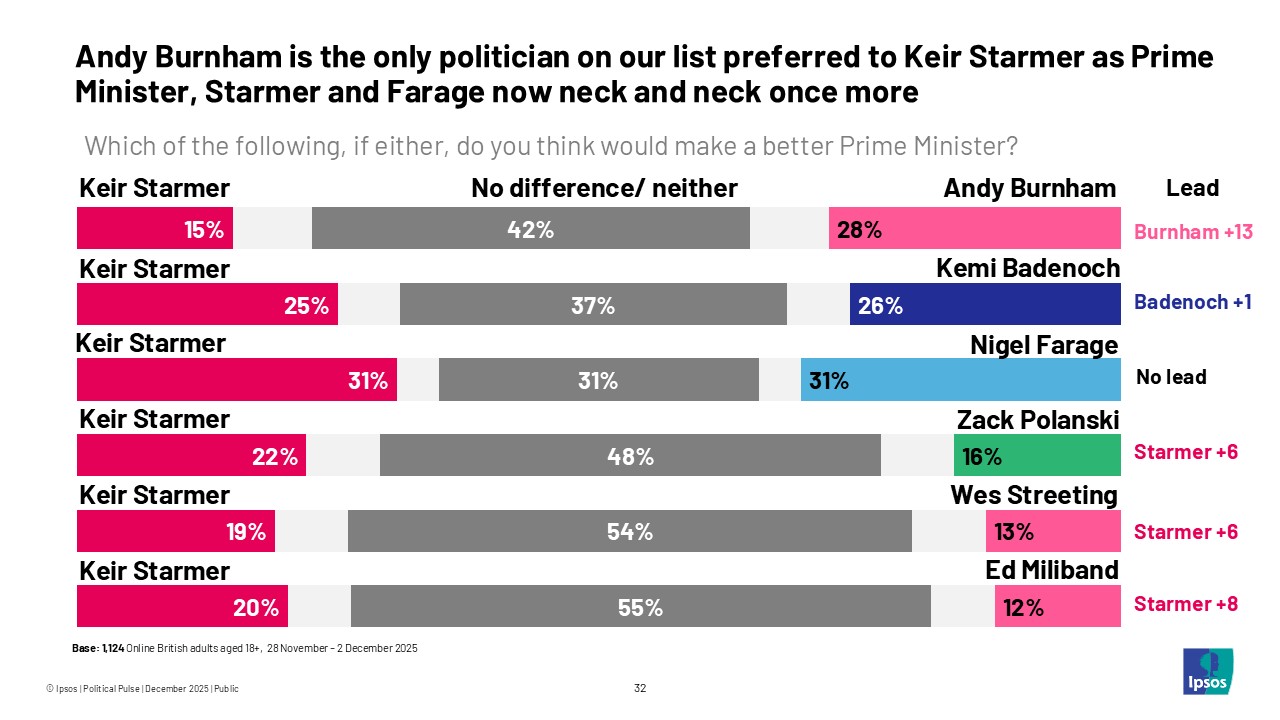
- Keir Starmer is preferred as Prime Minister to each of Zack Polanski (Starmer +6), Wes Streeting (+6) and Ed Miliband (+8). Starmer leads Streeting by 38% to 14% among 2024 Labour voters and Miliband by 39% to 15%.
Nigel Farage head-to-head
- Nigel Farage leads Ed Miliband (+6), Wes Streeting (+7) and Zac Polanski (+8), but is neck and neck with Keir Starmer and Kemi Badenoch.
- Andy Burnham narrowly leads Farage by 4 points – a marginally better position relative to Starmer’s.
Kemi Badenoch improving
- Notable in this data is that Kemi Badenoch’s position versus both Keir Starmer and Nigel Farage has improved of late.
- In a head-to-head 25% prefer Keir Starmer and 26% prefer Kemi Badenoch. Whilst this is technically a statistical tie it is a marked improvement from October where Starmer led by 5 points (27% vs 22%) and September where he led by 12 (27% vs 15%). Prior to that our series has always shown Starmer with double digit leads.
- Similarly, Badenoch is in a statistical tie with Nigel Farage (24% vs 25%). In July she trailed by 5 (24% to 19%) and December 2024 she trailed by 7 (23% vs 16%).
- In this context, it is unsurprising that Kemi Badenoch’s favourability ratings have also improved. 23% are favourable towards the Conservative leader (+5 from November) and 42% unfavourable (-10). The proportion favourable being the joint highest recorded since she became leader – although this is lower than Nigel Farage (29%) and Andy Burnham (30%).
Right direction/wrong direction
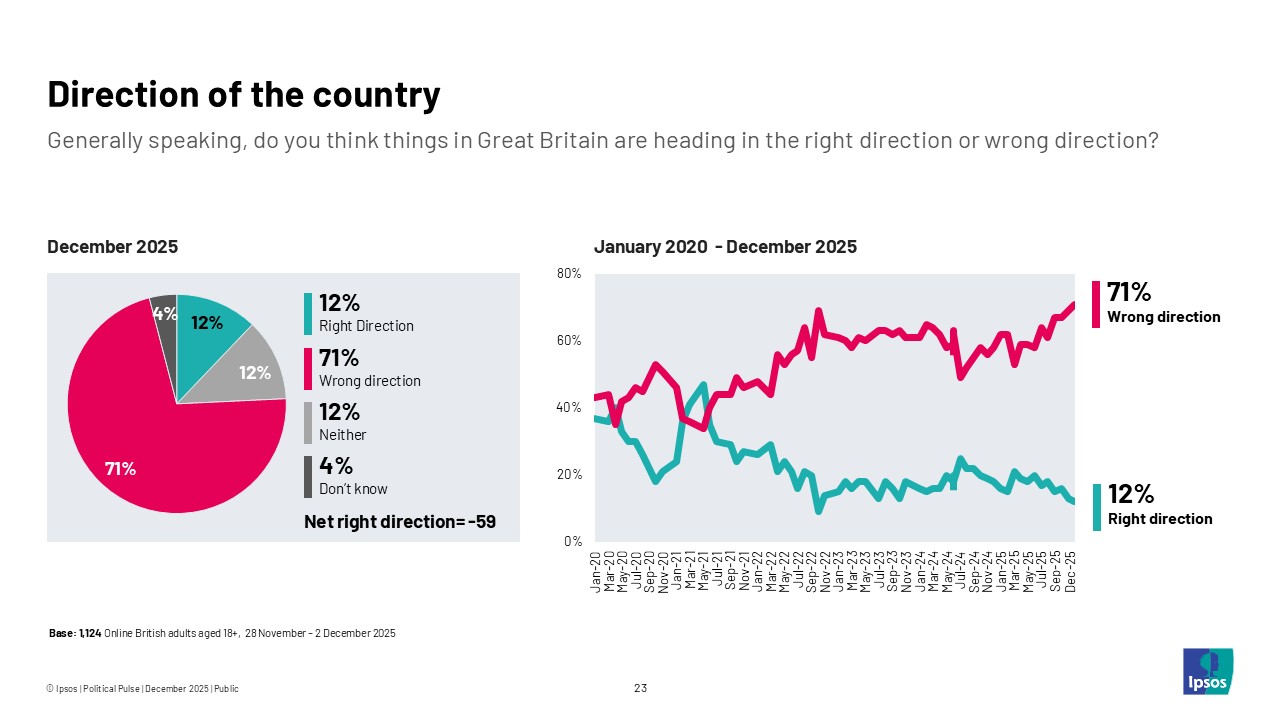
- Meanwhile, public pessimism about the state of Britian continues. 71% think Britian is heading in the wrong direction. 12% say right direction.
- This is the first time in this Ipsos series more than seven in ten have said wrong direction (going back to January 2020). However, in net terms (e.g. when you subtract wrong from right) this score of -59 is statistically equivalent to October 2022 where 69% said wrong direction but just 9% said right.
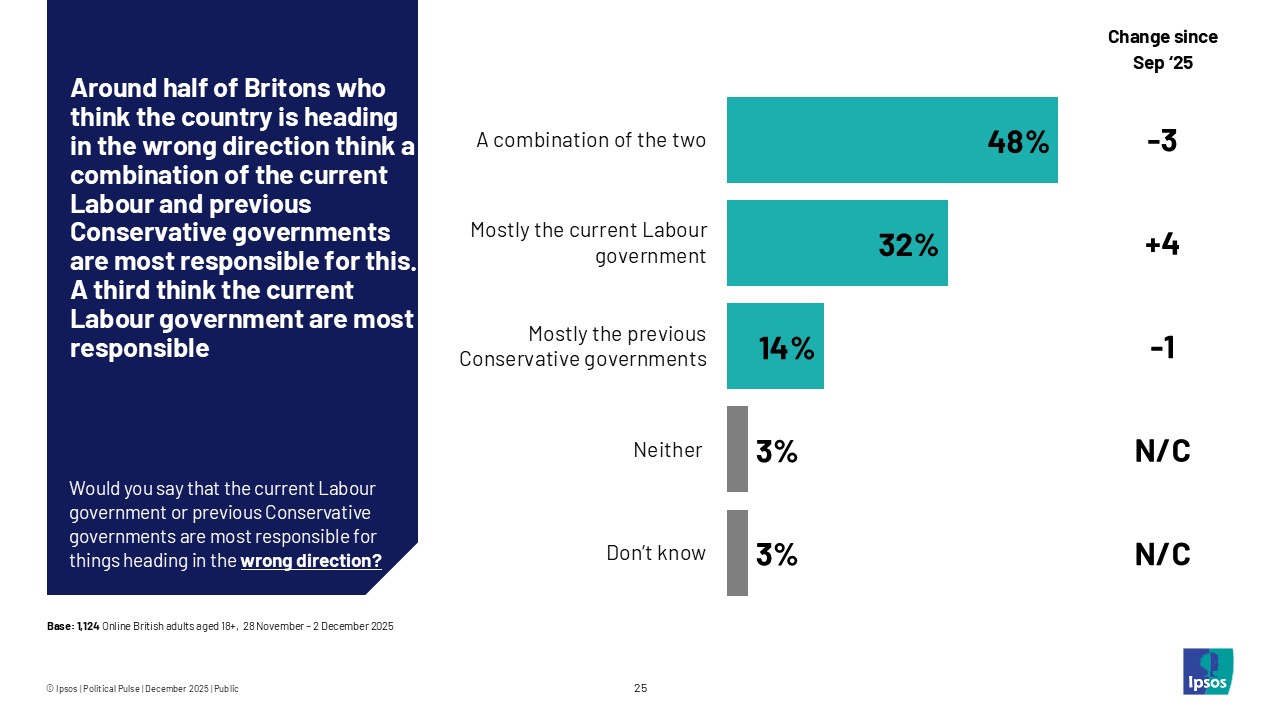
- When asked who is most responsible for the country moving in the wrong direction, 48% blame a combination of the current Labour government and past Conservative one (-3 from September) whereas 32% blame mainly the current Labour government (+4). 14% mainly blame the previous Conservative government (-1).
- Despite this, when presented with a binary choice the public are split on whether they prefer a Labour government led by Keir Starmer (37%) or a Reform-led government led by Nigel Farage (37%). Farage and Reform had led by 3 points in October.
Keiran Pedley, Director of UK Politics at Ipsos said:
Both Andy Burnham and Kemi Badenoch will take positives from these figures. Burnham holds net positive favourable ratings and is preferred as Prime Minister to Keir Starmer and slightly leads Nigel Farage too. Meanwhile, Kemi Badenoch’s personal poll ratings – and relative position versus Starmer and Farage have also improved. Of course, both still face significant obstacles to becoming Prime Minister. Andy Burnham isn’t in parliament and whilst Badenoch’s personal ratings have improved, there is no notable uptick observed for her party.
Technical note:
- Ipsos interviewed a representative sample of 1,124 adults aged 18+ across Great Britain. Interviews were conducted online between the 28th November to the 2nd of December 2025.
- Data are weighted to match the profile of the population. All polls are subject to a wide range of potential sources of error.


