
Britons split on increased defence spending as public resists core tax and spend trade-offs
• 37% of Britons say government spending on defence and the Armed Forces should be increased, even if this means extra Government borrowing, higher taxes, or less money to spend on other public services. This is a decline of 11ppts from March 2026 (48%), but support for more defence spending remains higher than it was in 2022.
• A similar share (40%) think defence spending should remain the same, while 15% think defence spending should be decreased.
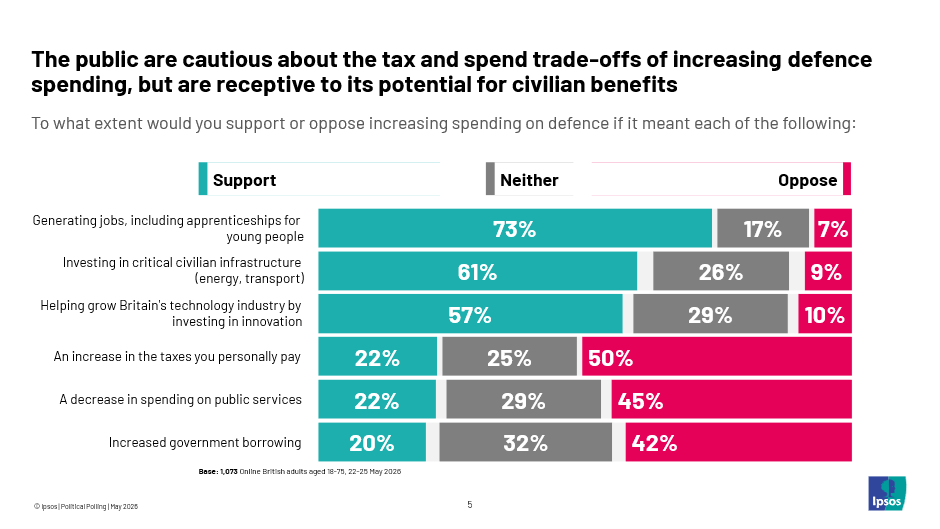
• Around half of the public would oppose an increase in defence spending if it meant a decrease in spending on public services (45%) or an increase in personal taxes (50%).
• However, the public is highly receptive to defence spending that yields civilian advantages, with 73% supporting increases that generate jobs and apprenticeships, and 61% backing investments in critical civilian infrastructure.
London, UK. New polling from Ipsos, conducted between 22–25 May 2026, reveals that British public opinion on increased defence spending is finely balanced, with 4 in 10 supporting more spending in principle but opposition higher when the public face the trade-offs in terms of higher taxes, cuts to other public services or more government borrowing.
Public divided between believing spending on defence and the Armed Forces should be increased or should remain the same
• 37% of Britons say government spending on defence and the Armed Forces should be increased, a decline of 11ppts from March 2026 (48%), but still higher than in 2022 when support for more defence spending stood at 28-30%.
• A similar share (40%) think defence spending should remain the same, while 15% think defence spending should be decreased.
• Around half of the public would oppose an increase in defence spending if it meant a decrease in spending on public services (45%) or an increase in personal taxes (50%).
• However, the public is highly receptive to defence spending that yields civilian advantages, with 73% supporting increases that generate jobs and apprenticeships, and 61% backing investments in critical civilian infrastructure such as energy or transport.
Funding preferences and the "War Bond" option
Amongst the 37% of Britons who believe defence spending should be increased, opinions are split on the primary funding mechanism: 35% prefer higher taxes, 33% support cuts to other public services, and 15% favour extra government borrowing.
When presented with specific funding strategies if the government were to increase defence spending, the public showed distinct preferences:
• Taxation: If the government were to hypothetically fund increased defence spending through increasing taxation, 44% would prefer targeting income tax on earnings over £125,000, followed by tobacco and alcohol duty (31%) and corporation tax (22%). Only 3% would support increasing basic rate income tax or VAT.
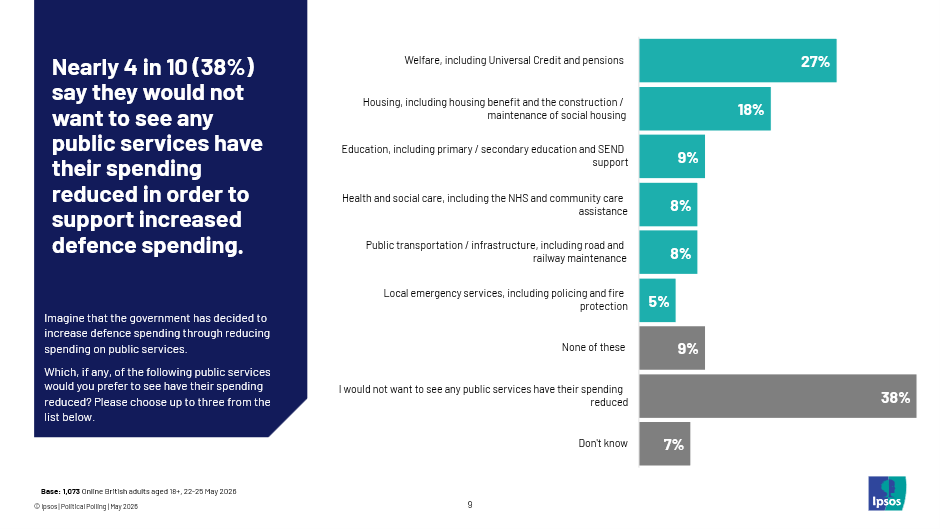
• Spending Cuts: In a similarly hypothetical scenario in which the government were to fund increased defence spending through the reduction of spending on public services, 38% say they would not want to see any public services cut. Where cuts are chosen, welfare (27%) and housing – including housing benefit - (18%) are the top selections, while health and social care (8%) and education (9%) are more protected.
• War Bonds: When asked about the potential creation of "war bonds" (citizen-purchased government loans paid back with interest), one in four Britons (25%) say they would be likely to purchase them to facilitate higher defence spending. Support rises to 34% among 2024 Conservative voters.
Broader public spending priorities and value for money
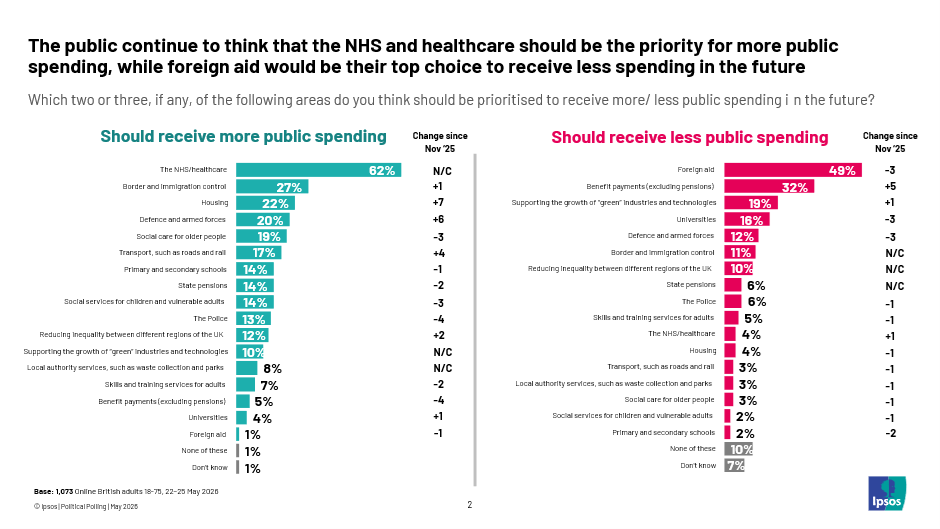
• The NHS remains the undisputed priority for public investment, with 62% of Britons stating it should be prioritised for more spending, followed by border and immigration control (27%) and housing (22%).
• Conversely, foreign aid remains the primary target for reductions, with 49% saying it should receive less funding, followed by benefit payments (32%).
• The public also holds complex views on public efficiency. The NHS is simultaneously viewed as providing both the best value for money (21%) and the worst value for money (22%) from the spending it receives.
• Border and immigration control (18%) and foreign aid (16%) follow closely as areas perceived to offer the worst value.
Strategic priorities for the Armed Forces
When considering where military budgets should be directed, the public views domestic utility and modern capabilities as paramount. Nearly eight in ten Britons view the Armed Forces' capability to assist in civil domestic operations (such as flood or pandemic response) as important for funding (79%), matching the importance placed on cyber warfare capabilities (77%) and conventional equipment like tanks, aircraft, and ships (77%).
Commenting on the findings, Caroline Paskell, Research Director at Ipsos in the UK, said:
Our latest polling underscores the public’s anxiety about the financial realities of funding Britain’s armed forces, showing that while there is an in-principle desire for a strong military, it is not immune from the intense competing pressures facing other public services. For instance, since the peak in March this year there has been a measurable softening in the proportion of the British public who want to see military funding grow, although it remains higher than in 2022.
Britons also remain highly sensitive to direct tax and spend trade-offs, with exactly half (50%) opposing an increase if it results in higher taxes that they personally have to pay, and 45% opposing it if it means spending less on other public services. Of interest, the public heavily favours investment that responds to modern and domestic challenges, with nearly eight in ten viewing cyber warfare capabilities and civil domestic assistance as vital areas for spend.
Nevertheless, 73% still support funding increases if they are explicitly tied to generating civilian jobs and apprenticeships, suggesting that public appetite for defence investment is highly conditional and strongest when it yields tangible economic benefits at home.
Notes to Editors:
• For media queries, please contact Owen Evans at [email protected]
• For the full findings, please visit the Ipsos website.
• Ipsos interviewed a representative sample of 1,073 online British adults aged 18–75. Polling was conducted online between 22–25 May 2026.
• Data are weighted to match the profile of the population. All polls are subject to a wide range of potential sources of error.


