Britons support banning phones in schools, banning children under 16 on social media, and stricter measures on non-consensual AI-driven intimate image sharing – Ipsos poll
New data from Ipsos in the UK shows support across the political spectrum for both banning children under 16 from social media platforms and banning phones from schools altogether. The public also supports making it illegal to create non-consensual intimate images using AI tools, and fining and banning social media companies that allow users to share these images.
Key findings
- Support for banning phones: Over half (56%) of Britons support banning mobile phones in schools altogether, up 8 ppts since September 2024. One in five (22%) oppose it. Seven in ten (71%) support requiring students to deposit mobile phones into a basket at the start of each class, and returning the phones when students leave class.
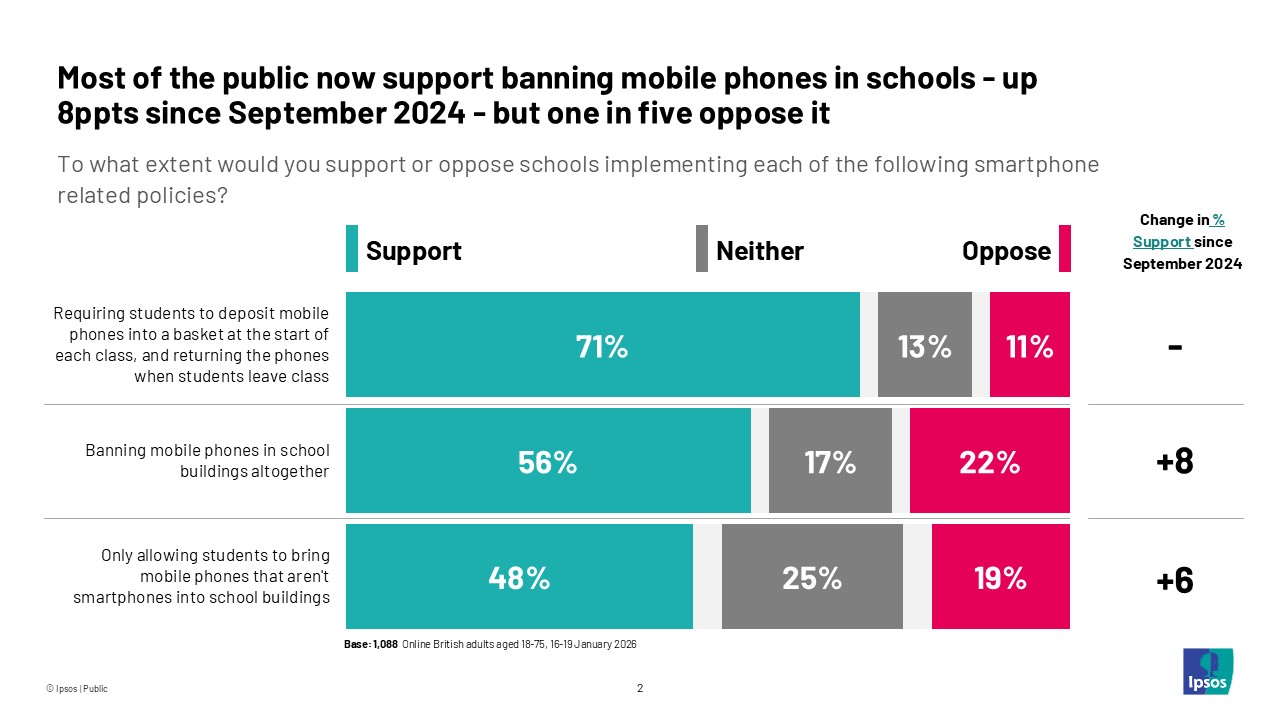
- Cross-party support for banning phones in schools: Support for banning mobile phones from schools is consistent across political lines, with 60% of Reform UK voters, 59% of Labour voters, and 62% of Conservative voters backing a ban.
- Widespread support for banning children under 16 from social media: Seven in ten (72%) would support a law that requires social companies to use age-verification to ban children under the age of 16 from accessing their platforms. Once again, levels of support are consistent across the political spectrum (71% Reform UK voters, 75% Labour, and 77% Conservatives).
- The right age for children to have social media accounts: Around one in three (36%) Britons say 16-17 years old is when it becomes acceptable for a child to have their own social media accounts. However, three in ten (29%) think children under 18 should never be allowed.
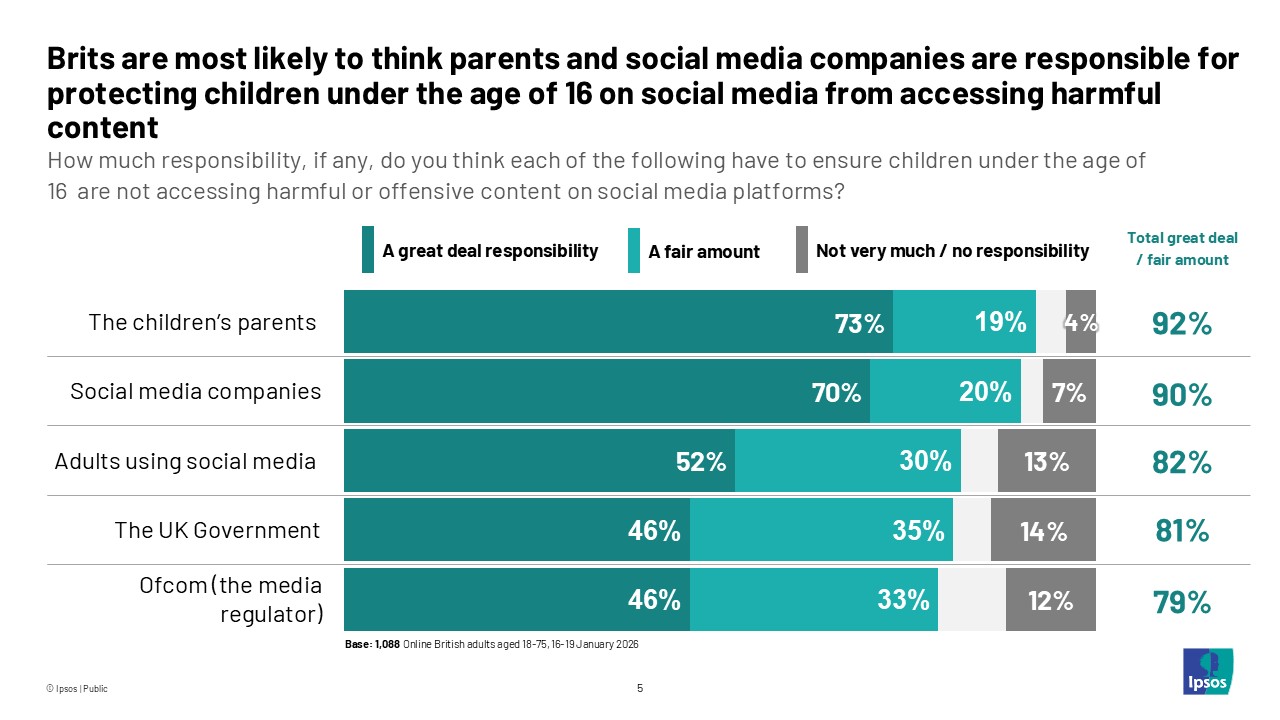
- Who is responsible: Britons are most likely to say that parents (92%) and social media companies (90%) have responsibility to ensure children under the age of 16 are not accessible harmful or offensive content on social media.
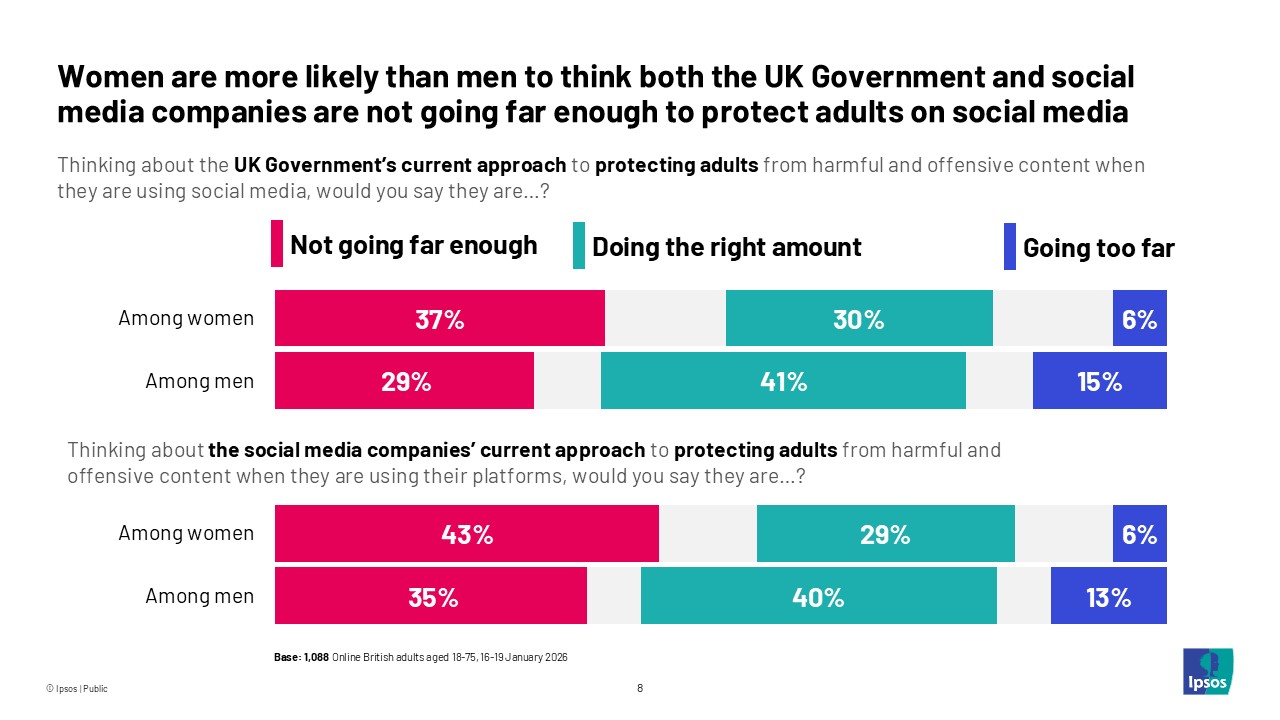
- Doubts about whether the government and social media companies are doing enough: The majority do not think either the UK Government (53%) or social media companies (58%) are going far enough to protect children from viewing harmful or offensive content on social media. The public are split between thinking the UK government is not going far enough (33%) and doing the right amount (35%) to protect adults on social media. Similarly, the public are split on whether social media companies are doing the right amount (35%) or not going far enough (39%) to protect adults.
- A gender gap: There is a clear gender gap, with women more likely to say both the UK Government and social media companies are not doing enough to protect adults, and men more likely to say each are doing the right amount.
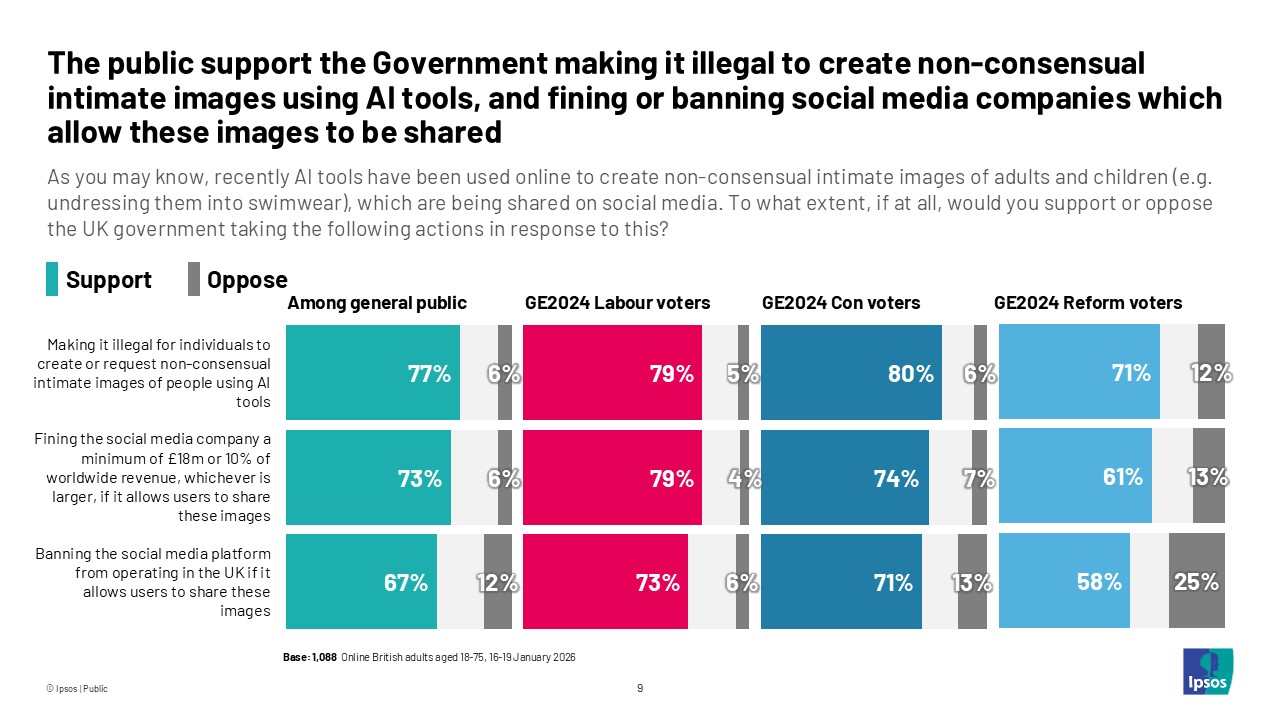
- Non-consensual images: The public support the Government making it illegal to create non-consensual intimate images using AI tools (77% support), and fining (73%) or banning (67%) social media companies which allow users to share these images. Again, we find widespread support across the political spectrum – support for making it illegal to create these images is 79% among Labour 2024 voters, 80% among Conservative 2024 voters and 71% among Reform UK 2024 voters. Women are more likely than men to support banning platforms that allow users to share these images (72% of women support v 62% of men) and making it illegal for individuals to create these images (81% of women support v 72% of men).
Commenting on the findings, Jessica Ozan, Head of Education, Children and Families at Ipsos said:
This data shows the British public are very attuned to the dangers of the digital environment for children in particular, but also adults more broadly. With over half of Britons supporting phone bans in schools and a substantial majority across the political spectrum supporting a ban on social media for under 16s, it's evident that parents and the public alike are seeking greater safeguards. This cross-party alignment highlights a strong national consensus on the need for tighter regulations, not only to protect children online, but also adults.
Among numerous reports of people online creating and sharing non-consensual AI-generated intimate images of adults and children, we find strong support, especially among women, but also men, for legislating against this, as well as fining or even banning social media companies that allow this to happen.
Technical note:
- Ipsos interviewed a representative sample of 1,088 adults aged 18-75 across Great Britain. Polling was conducted online between the 16th-19th January 2026.
- Data are weighted to match the profile of the population. All polls are subject to a wide range of potential sources of error.