
Europe: The State of Public Opinion
In this article I argue that public opinion is important, real, and in the run up to the Maastricht Treaty was mismanaged to the point of neglect. This was also true in relation to the European movement towards the ICG, following after the Maastricht Treaty ratification process Its near failure to be adopted, first in Denmark and then France, when these countries sought approval by their electorates of the actions of their governments, give evidence to this. There were lessons to be learned from the interactions between elites and electorates since the foundation of the European Community, especially in the parallels offered by the extended and elaborate 'marketing' programme undertaken by the 'founding fathers' of the American Constitution more than 200 years ago. The failure of the Conservative Government led by Prime Minister John Major to lead Britain on the country's move to the 'heart of Europe' is seen as a case study in political mismanagement. Finally, and in spite of both the EU and Britain's Conservative Party, the indications are that Britain will endorse Amsterdam, expansion of the EU, the single European currency, and will be in at the birth of the 'United States of Europe' within the next two decades.
Public Opinion
When speaking of "public opinion", it is most often meant to describe the adult population in a one-person-one-vote model which would have been unheard of a century ago. Yet Abraham Lincoln not only used the concepts of extended franchise and democratic involvement, " ... of the people, by the people, and for the people" in the Gettysburg Address, he is also quoted as saying "Public opinion is everything".
Price (1992) defines public opinion in his introduction to the birth of public opinion, saying "The combination of public and opinion into a single term, used to refer to collective judgements outside of the sphere of government that affect political decision making, ... ", yet this is flawed, for it restricts public opinion to the political milieu. We all can observe the impact public opinion makes on business and commerce, industry, fashion, literature, the arts, science, war and on every other aspect where the collective view, expressed or assumed, influences anyone in a position of authority over others.
Necker, Price reminds us, minister of finance in the pre-Revolutionary France of the 1780s, popularised the phrase l'opinion publique, using the term to refer to a growing dependence of the government's status on the opinion of its creditors. He instituted the publication of national accounts and argued that support from the French elite was necessary for success of the government's policies. To that end he advocated full publication of state activities, thus becoming not only minister for finance, but the first to propose systematic governmental public relations, the forerunner to today's government information service, the Number 10 press office, the White House spokesman, etc. "Only fools, pure theorists, or apprentices fail to take public opinion into account", Necker observed in 1792.
Elisabeth Noelle-Neumann (1984) suggests that "Public opinion is an understanding on the part of people in an ongoing community concerning some affect- or value-laden question which individuals as well as governments have to respect at least by compromise in their overt behaviour under the threat of being excluded or losing one's standing in society."
I find either of these definitions flawed, by complexity, in the case of Noelle-Neumann by focus on her important but not overarching "spiral of silence" paradigm, and by excluding the Lippmann "mind pictures" idea. I am convinced that as a tree falling in the forest makes a noise whether anybody is there to hear it or not, so public opinion exists, perhaps unheard until someone listens. It seems to me that a simpler definition will do: 'Public opinion is the view of a [representative sample of a] defined population.' The words in brackets delimit the difference between 'public opinion' and a 'public opinion poll'. Thus, as well as the general public, workers in a factory, of interest to the factory manager, trade union or civic leaders in the plant community; residents of a local community, of interest to civic leaders again, politicians, the local media, pressure groups, industrialists thinking of siting a plant there; students at LSE; 'certain to' voters, of greater interest to many at the last British general election in determining who they thought was going to win, and of greater interest to e.g. The Times, and therefore of greater interest to the broadcast media who diffused the poll findings, and therefore to the political actors whose hold on office or prospect thereof was promised or threatened, and therefore to the public: full circle. Or young people, or the elderly, or women, or Captains of Industry, or institutional investors, or editors, or parliamentarians, or any slice of society that can be defined with precision and replicability.
I define 'views' at three levels, rather too poetically I fear for scholarly adoption, as "opinions: the ripples on the surface of the public's consciousness, shallow, and easily changed; attitudes: the currents below the surface, deeper and stronger; and values: the deep tides of public mood, slow to change, but powerful."
Finally, remember that polls do not measure some abstract 'truth', but people's perceptions, but as Epictitus said in the First Century, 'Perceptions are truth, because people believe them.'
The American Constitutional Model
What are the issues facing Europe today? Single currency, a central bank, federalism v. subsidiarity, the relationship between the parliament and the executive, judicial review, balance of power between larger and smaller states, sovereignty. What does this parallel? The place, America; the time, 1783 -- 1803.
The parallels between the emerging American governmental structure during the period of confederation (1781 -- 1798) and its aftermath in the forging of the United States of America and the period in which we are living are remarkable. Many of the economic and political issues current in America then are current now in Europe. A floating and weak legislature. Then the Confederate Congress met in Philadelphia, Princeton, Trenton and New York. Now the European Parliament's caravan moves on between Strasbourg and Brussels. Then the legislators complained of toothlessness as they do now. So what happened at the 'Miracle of Philadelphia' in 1787?. The drafting of the Constitution of the United States, giving much more power to the central government but reserving the rights not granted in the Constitution to the individual states (subsidiarity).
When Lord Cornwallis surrendered to the colonial (and French) forces at Yorktown in 1781 the 'War of Independence'/'Revolutionary War' was effectively over, although it took two more years to get to the actual peace treaty signed in 1783. During that period, a weak and powerless (and broke) Congress met at the sufferance of the 13 colonial states in Philadelphia, but they had no money to pay troops and the merchants who had financed the war on the promise of eventual repayment.
Acting under the deliberately weak 'Articles of Confederation', first drafted in 1776, the Continental Congress met in a 'talking shop' without powers of taxation, sovereignty or even much influence. Who now remembers who it was that drafted their constitution (John Dickenson), led their deliberations (Charles Thomson, secretary of the First Continental Congress served for a time as its president, probably its most effective was Virginia's Richard Henry Lee, a states righter), their powers (only those delegated by the states), their control (to the state legislatures, not -- as still in Great Britain -- to the people), their site of meetings, their date of ratification (March 1781) and their religion (during the Confederation period, the Anglican Church was disestablished).
During the Confederate period there was a depression (1785), Shay's Rebellion (1787), and a balance of payment's crisis (as specie returned to Europe for payment for imports). During the Confederate period the farmers of New Hampshire, one of the smallest states, did not want their own state to exist, much less a national government. Each state had its own flag, its currency, its system of taxation, laws of slavery and property rights, its legislature, its customs and its alliances and enmities. Georgia and Virginia were the largest Southern states, New York and Massachusetts the largest in the North. Each had their followers, but they were also feared for their power and influence.
Yet by 1781 the predecessor Continental Congress had single executives in charge of war, foreign affairs and finance (George Washington; Robert Livingston, succeeded by John Jay, and Robert Morris). By 1785 Congress determined conditions for the survey, sale and governing the lands in the West and for making treaties with the Indians. The Northwest Ordinance was passed by 1787.
If the Confederacy had not been succeeded by the United States, America would have become a Swiss-like confederation or possibly, some think, split into three or four separate countries, certainly New England, the Southern States, the Mid-Atlantic States, and possibly a Western United States which might even now be considering some sort of post NAFTA Union to include Canada and Mexico.
What happened in the period 1781 -- 1787 was in many ways similar to what has been happening in Europe over the past few years leading up to Maastricht. The European Nation-States have reserved the power to tax, to legislate, to represent themselves in war and peace with other nations, to opt in to alliances, and opt out, to call for and exercise minority rule and to cast vetoes.
It wasn't until Supreme Court Chief Justice John Marshall of Virginia in the case of Marbury vs. Madison determined that the Court would exercise judicial review over the Acts of the Congress of the United States to determine whether acts passed by the congress were in accord or in violation of the United States Constitution that the powers of the three pillars of executive, legislative and judicial government were in place. Then, all executive and legislative power came within the purview of the courts, much as more stealthily, the power of the European Court of Justice has been growing in Europe until now it is estimated that more than half of British Parliament's acts are now subject to such a judicial review.
How was it sold? By a few, well-organised, dedicated men. Alexander Hamilton, James Madison, and John Jay, authors of the Federalist Papers, polemics of a high standard, yet closely reasoned, fiercely argued, widely discussed, over some years, topic by topic, treating the electors, admittedly a tiny proportion of the public yet many unlettered, uneducated by modern standards, without the facilities of modern communication, transportation, infrastructure, political parties (perhaps a blessing), or pressure groups, except as they evolved during the debates.
Majority voting wasn't on the agenda, it was all or nothing, every one of the 13 states had to cede power to the centre, every one had to give up perquisites of office, some, Virginia and Maryland, land for the Federal capitol, some funding, and all sovereignty. Without the Federalist papers, it would not have happened. Without careful political manipulation it would not have happened. Without a figurehead of stature on whom all could agree, a military hero, a rich plantation owner, George Washington, it wouldn't have happened.
Contrast this to the Maastricht Treaty, complex, obtuse, in parts unreadable, with little thought for how it would 'play in Peoria' and apparently no consideration for the adoption process to ensure its passage, ignoring its impact on public opinion. Certainly anyone that was aware of the Eurobarometer findings or who had read the article in the European Business Journal (Worcester 1989) would have chose Denmark, even more reluctant Europeans than the out-of-step British, in which to test the water! No wonder the first referendum result was a defeat for the Danish Government and for the 'managers.' of Maastricht.
Contrast the 'a-management' (as opposed to 'mismanagement') of the Maastricht referendums exercise to the careful manipulation of the trade union ballots forced on a reluctant trade union movement in Britain by Mrs. Thatcher's government's requirement for them to ballot their members to obtain the right to have a political levy. Sauce for Mrs. Thatcher's goose certainly not the sauce for her gander when consulting the public! What happened was that the Labour Party and the TUC and individual powerful trade union barons connived to set up group of Labour supporting trade unionists, the Trade Union Co-ordinating Committee (TUCC) under the chairmanship of Larry Whitty, later to become General Secretary of the Labour Party. This group ensured that the ballots were held first in those trade unions where support for the political levy was highest, to ensure that when the more reluctant memberships were polled they were eighth, ninth, or later in the queue, after resounding majorities had been recorded, and widely publicised, from the more enthusiastic, compliant and political unions. The parallel would have been for the 'managers' of the Maastricht process to have organised themselves to obtain early victories from the countries known to be the most pro-Maastricht, most in favour of European expansion and transfer of sovereignty, perhaps Ireland, Portugal, Netherlands, Luxembourg. Finally, where are the Hamiltons, Madisons, and Jays, in concert in the selling of the concept across the Community?
The Selling of Maastricht
The selling of Maastricht was tracked as it went by the European Commission's regular opinion poll, the Eurobarometer. It and other polls continually showed widespread support for the Community generally and for Maastricht specifically, but during the contest, showed support for Maastricht losing ground across the Community.
If those responsible for the selling of the Treaty had paid close attention to earlier Eurobarometer signals, the last place (save Britain) to have held an early referendum would have been Denmark. For years the twice-yearly Eurobarometer has measured the lukewarm support for the Community among the Danes and the British, while registering strong support in, among others, Italy, Ireland and in the newest members, Spain, Portugal and Greece.
With most of the fieldwork for the final Eurobarometer during the process taking place after "Black Wednesday", it is likely that the chaos in the currency markets following the September 16 realignments will have been the main cause for the sharp drop in support for Maastricht in Britain.
Britain and Europe
In June '92, when MORI first measured Europe-wide attitudes to Maastricht for The European, the British then were marginally in support, 54 percent to 46 percent, leaving aside the 'don't knows'. This was still the case in mid September '92, just before "Black Wednesday", but in a poll taken for The Times in its immediate aftermath that memorable week, MORI found a huge swing against ratification of the Treaty, 62 percent opposed it and 38 percent were in favour. Opposition then widened so that by the end of September some 68 percent were opposed. By the end of October the balance was still opposed, but had moderated to 59 percent opposed, 41 percent in favour. The Eurobarometer figures (after reallocating the undecideds in proportion to those expressing a view) matched those tracked by MORI.
Europe is not by any means the most important issue in the minds of the British public, then or now. Between the British 1992 and 1997 general elections it varied from third place to seventh or eighth as 'top of mind' when people are asked 'What are the important issues facing Britain today?' (Chart 1), and ninth or tenth when asked 'What are the two or three most important issues that will help you to make up your mind on which party to vote for at the general election?' (Chart 2). Chart 2 also not only shows the salience to the issue among the general public, but that it falls to tenth place (from fifth) when put in an electoral context, and that it is only of primary concern to about a quarter of the electorate. Among those, at the time of the last election (April 1997), the Conservatives led on the issue, by 2:1, as the most sceptical of the major parties. (See Chart 3 & 4). It is of greater importance to more men (27% at end September 1997) than women (15%), and middle-class (28%) than working-class people (14%).
Chart 1 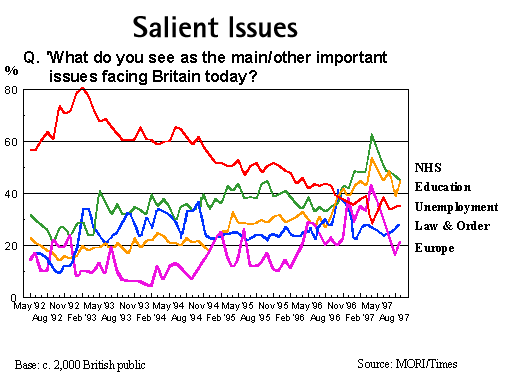
Chart 2 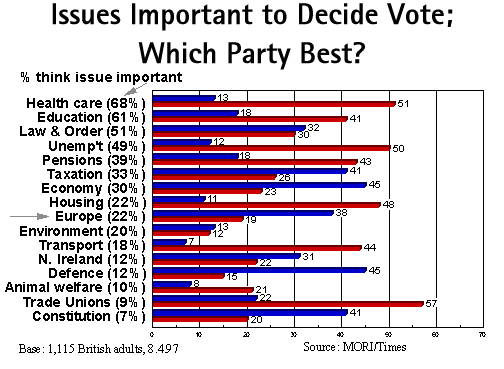
Chart 3 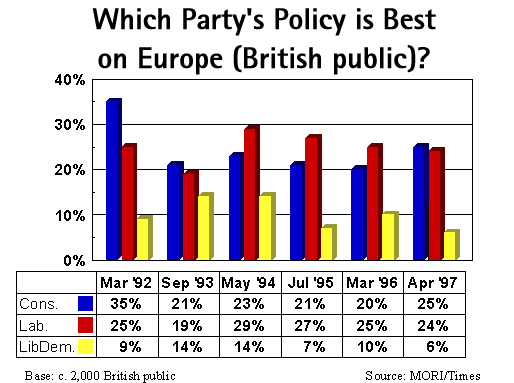
Chart 4 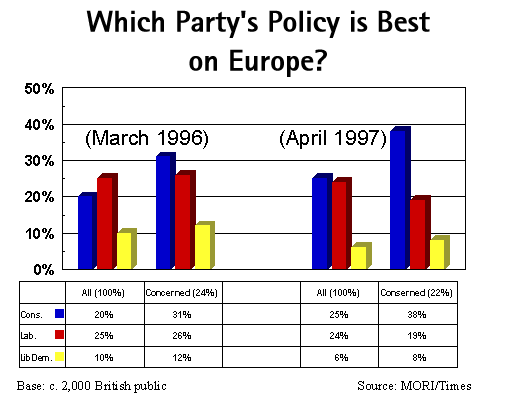
The 'cultural identity' of the British is antipathetic to Europe, with only about a quarter of the British 'feeling' European, according to a survey in late 1994 carried out across Great Britain by MORI's 'values' arm, Socio-consult. See Chart 5. (UPDATE TO COME) Henley Centre's 'Planning for Consumer Change in Europe 1996/97' programme found that while 48% of Italians, 41% or Germans and 30% of the French said they felt as much European as they did a citizen of their own country, this was only true of 12% of the British.
Chart 5 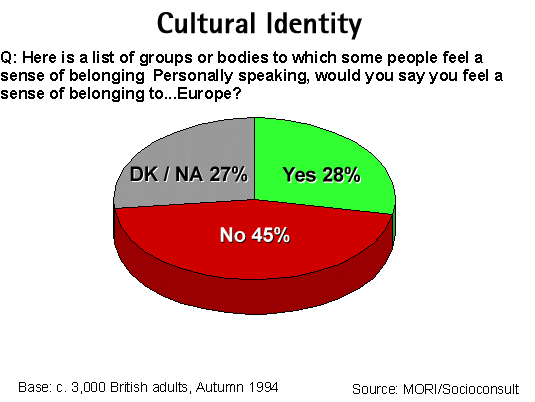
Europeans and Europe
The drop in support for the ratification of the Treaty at the time of the Maastricht debate also took place in Italy (although 85 percent of those with a view say they would vote in a referendum for Maastricht!) and Spain (two to one for Maastricht), both countries experiencing exchange rate problems just before the fieldwork.
Remarkably, Denmark bucked the general trends, with increased support for Western unification (+4), Community membership (+11), perceived benefits of membership (+6) and feeling sorry if the community were to be scrapped (+11) registered in Denmark. That said, the Danes, next to the British, were still the reluctant Europeans. If a second referendum had been held at the time of the fieldwork in Denmark, a majority of the Danes, 53 percent, said they still would have voted "no".
The Italians, the Belgians and the Dutch were the most favourable to the Treaty, with the British the most reluctant (62 percent opposed) with the Danes the only others who were, on balance, more opposed than favourable. In Britain, there were more who said they would have been relieved (28 percent) than said they would be sorry (25 percent) if the EC were scrapped, while 41 percent describe themselves as indifferent one way or the other. Britain's 28 percent who said they would be positively relieved was about double the percentage of other "reluctant" countries' peoples. In Denmark 16 percent said they would be relieved, in France 14 percent and 12 percent of Germans said they would welcome the scrapping of the community.
The levels of the undecideds were large. Only in Denmark (41 percent) and in Ireland (31 percent) did more than three in ten citizens then say they knew much about Maastricht, both countries having held referendums on the issue. Those undecided when asked how they would vote if there were a referendum ("second referendum" in Denmark, France and Ireland), were as high as half of the Spanish, 46 percent of the Portuguese and over a third of the Italians and Belgians. Overall only one in five Europeans say they know much about the Treaty. Despite this, earlier surveys show that citizens of all countries in the Community believe they should be allowed to vote on the adoption, or not, of the Treaty.
Roughly equal numbers of East and West Germans held similar views about the community on most questions, with the East Germans drawing into line with their West German countrymen and women, after having been more enthusiastic in earlier surveys.
The Maastricht debate period narrowed the gap between those across the 12 thinking that their country had benefited from European Union membership to about ten points more than those thinking their country had not benefited, but more recent Eurobarometer surveys, in 1994 and 1995, showed the proportion widening again, to a 57% Benefit, 28% not, recorded in the April-May 1995 fieldwork, the most recent available in their reports. (Eurobarometer #43, Autumn 1995)
The awkwardly captioned 'Eurodynamometer' counter-intuitively and contradictorily to other measures shows that citizens of the UK say by a margin of 47% to 26% that they would prefer Europe to 'speed up', rather than 'slow down'. This compares with 62% to 16% across the 12, an makes Britain second only to the Danes (37% to 32%), as usual, as the 'reluctant Europeans'.
Other recent findings include as average of 57% in support to 16% opposed for a European (Union) Government responsible to the European Parliament and to the Council of heads of national governments. By two to one, people across the 15 were unaware of the 1996 Inter-Governmental Conference, 62% to 31%, with the UK close to the average for the expanded Union. By three to one, 45% to 15%, the British are seen as against increased joint action by other European country's peoples, nearly triple the perception of opposition in any other country. The British view of themselves interestingly matches that of other country's citizens, as 45% of the British say that they are against joint action, and only 23% in favour. Denmark on the other hand accurately rate themselves as against, 50%, compared to only 13% for increased joint action.
As to the wider or deeper agreement, the question asked was a choice between (1) The European Union should stay as it is, (2) The existing member countries should take more joint action in the existing European Union, and (3) New Member states should join. Overall, 53% took the 'more joint action' option, 17% said 'new member states should join, 15% that the EU should stay as it is, and, volunteered, 6% were for scrapping it altogether. In the UK, the scores were 26% for new member states to join, 40% for more joint action, and 20% stay the same. See the charts below.
Chart 6 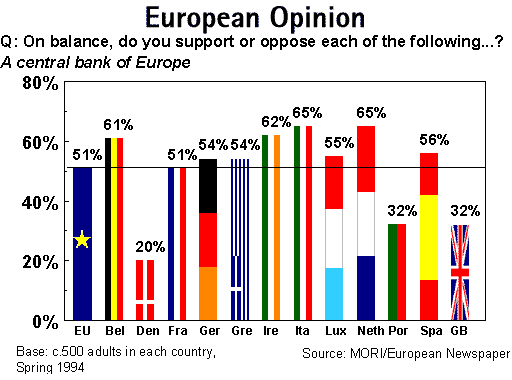
Chart 7 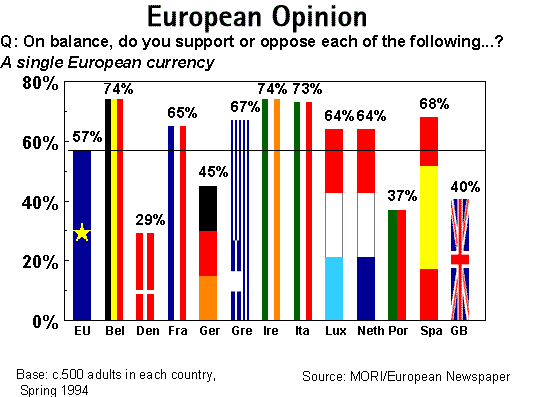
Chart 8 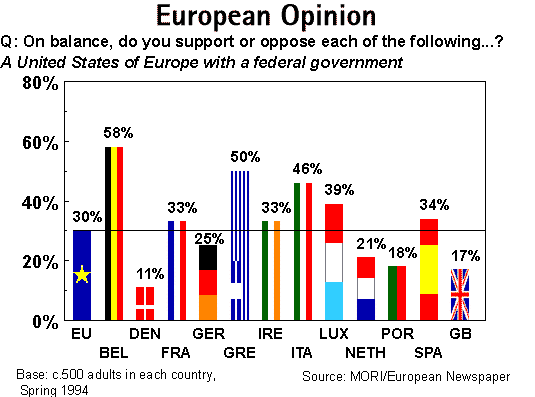
Earlier (European Business Journal, p. 41) I reported the surprising findings from research done in 1988 that then a majority of the British, 58%, supported both a fully integrated armed service and a common legal system, and 52% a supreme Court of Europe. But perhaps most interesting are the recent expectations of Europeans for Europe in 2010: Nearly two in three believe there will be a common economic policy (65%), using a single currency (66%), with a common military and defence policy (65%) and with 56% confident, two to one greater than the 26% who do not believe that by 2010 there will be a common social and employment policy. Even in Britain two thirds, 65%, think there will be a single currency by 2010, and the same percentage, 65%, think there will be a common defence policy for the EU.
Referendum
We are informed about "Referendums" by Butler and Ranney (1978). Referendums are widely used, too widely for my taste in some European countries, and in the United States in some states. They should not be confused with opinion polls, but continually are. While their 'response rate' is not as high often as an opinion poll, they are, for the electorate and the actors, the culmination of an election process that speaks to a certain proposition, have proponents and opponents, are argued in the media, and conclude on a day certain with the end game of a balloting process under the provenance of the state. People treat them differently, with good reason, for the responsibility of the result is theirs', in a way not so in opinion polls.
Thus when the British Government under then Prime Minister Harold Wilson gave into the problems facing his party to provide the British people to vote on whether or not to stay in or get out of Europe, in June 1975 the British people with greater or lesser enthusiasm took part in a referendum campaign which was concluded with a definitive outcome, that Britain was in, and in to stay. Even the most ardent opponents of Maastricht, when arguing for a referendum on that ill-fated treaty, drew back for the most part in proposing Britain's exit from the European Community, for that argument had been well and truly lost, by the vote of 67% to 33% by a vote of the British people.
My own position on referendums is that they do not belong in a well managed democratic society with a representative form of government as we have here in Great Britain, except on a subject of constitutionality and where the loss of sovereignty of the public is concerned. None on hanging, on limiting public spending or on the many issues that plague the California ballot papers and reduce participation in Switzerland.
Yet the view of the British public on wishing to have their say is clear, as we found in our survey of public opinion for the Joseph Rowntree Reform Trust. More than three in four, 77%, of the British favour referendums being obligatory on Parliament on the petition of (say) one million electors.
As has been so clearly seen this past year, the Conservative's political elite in Britain lost touch with its people; it is suffering the consequences. For several years principal Conservative government spokesmen, the Prime Minister, the Chancellor and the Foreign Secretary, argued down any suggestion that the people should have a say on anything, even a single currency. Only after several years was that reversed, and only then with the reluctant conversion of the Chancellor, putting up barriers to the exercise that will now never take place under a Conservative Government. If they had held one on Maastricht in my view they couldn't have lost it, and would have isolated the Eurosceptics who have done so much damage to the image of this government. With all three parties on side, it would have been a replay of the 1975 campaign, with the leaders of the major parties and their senior colleagues in favour, against 'the men with staring eyes.' Had they done so, I dare say they would not have lost the recent general election by so wide a margin.
Europe was not an 'issue-issue' with the British people, it was an 'image-issue', because it was splitting the Tory Party. Even though the most recent measure (October 1997) found nearly two to one (57% to 32%) opposing Britain participating in a single European currency, and by ten to one preferring the British government deciding Britain's economic policy rather than a central European bank (81% to 8%), it is still the case that two thirds of the British expect that they and/or their children will be using a single European currency and coinage by the year 2010. They might not prefer it, but they do see it as inevitable. And while 'only' a third expect to see a United States of Europe by the year 2010, over half, 57%, expect a U.S.E. by 2050, and public opinion is moving in that direction faster than perhaps they know. While only 17% of the British said they supported a United States of Europe with a federal government in 1994, the percentage supporting a United States of Europe doubled, to 34%, in a MORI survey for the Sun Newspaper published in October 1997, so from a net 51% against in 1994, public opinion is now a net 25% opposed, a 'swing' of 13% in just three years towards the concept. It may not be here yet, but it's on the way.
Sir Robert Worcester is Chairman of MORI International, London, and is Visiting Professor of Government (and a Governor) at the London School of Economics and Political Science and in the Department of Marketing at Strathclyde University, Glasgow. He is Past President of the World Association of Public Opinion Research and is an Editor of the International Journal of Public Opinion Research and a member of the editorial board of the European Business Journal. A Member of the Fulbright Commission, he was until recently Senior Vice President of the International Social Science Council / UNESCO.
References
- Butler and Ranney
- Price V (1992) Public Opinion. Newbury Park, Ca: Sage.
- Lippmann W (1922) Public Opinion. New York: Macmillan.
- Noelle-Neumann E (1979) 'Public Opinion and the Classical Tradition: a Re-evaluation', Public Opinion Quarterly (Vol. 43, 143 156).
- Worcester R (1989) 'The Attitudes of Europeans to the European Community', European Business Journal Vol 1, Issue 4, 1989.
- Worcester R (1997) 'The Vital Statistics' Newsweek, February 3)


