

Ipsos Study of 37,000 Gamers Finds In-Game Advertising Significantly Improves Brand Affinity
In-game advertising can normalise brands
New analysis from Ipsos GameTrack (conducted in Q1 2026 with 37,000 video game players across 16 European countries) shows that gamers exposed to in-game advertising are consistently more likely to agree that advertiser brands are ‘for people like me’.
Ipsos compared gamers who had played titles featuring specific brand integrations (the test sample) with gamers who had not played the relevant games (the control sample). Across nine campaigns analysed, the test sample showed an average uplift of +31% for ‘is a brand for people like me’.
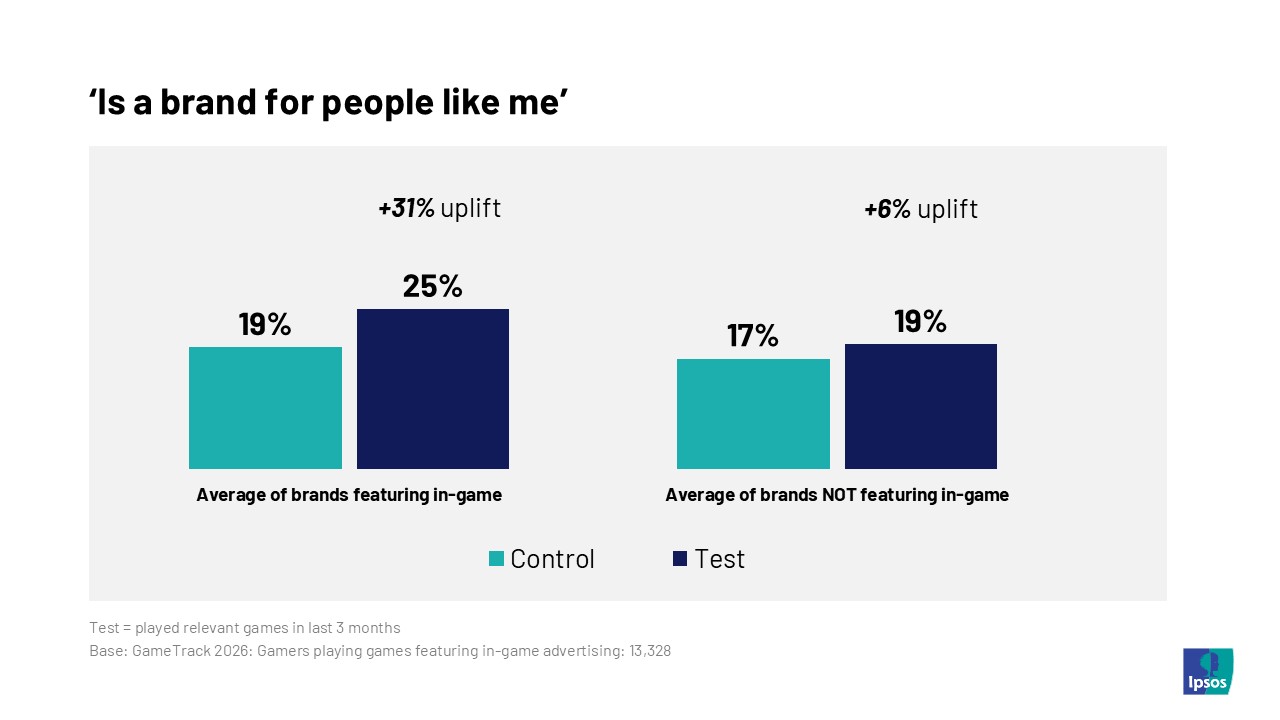
We also took extra steps to ensure that the uplift wasn’t caused by the profile of the gaming audience (i.e. those playing the games that feature in-game advertising). To ensure this was the case, we also asked about brands that were not advertising in the relevant video games and here we only saw a +6% uplift – this is what we would anticipate the uplift to be if there was no in-game advertising.
Looking at individual in-game campaigns, Beats sees results twice that are twice as high (+97% uplift) amongst the exposed (test) sample. High-profile, established brands such as Pepsi (+26%) & Visa (+18%) also see strong uplifts.
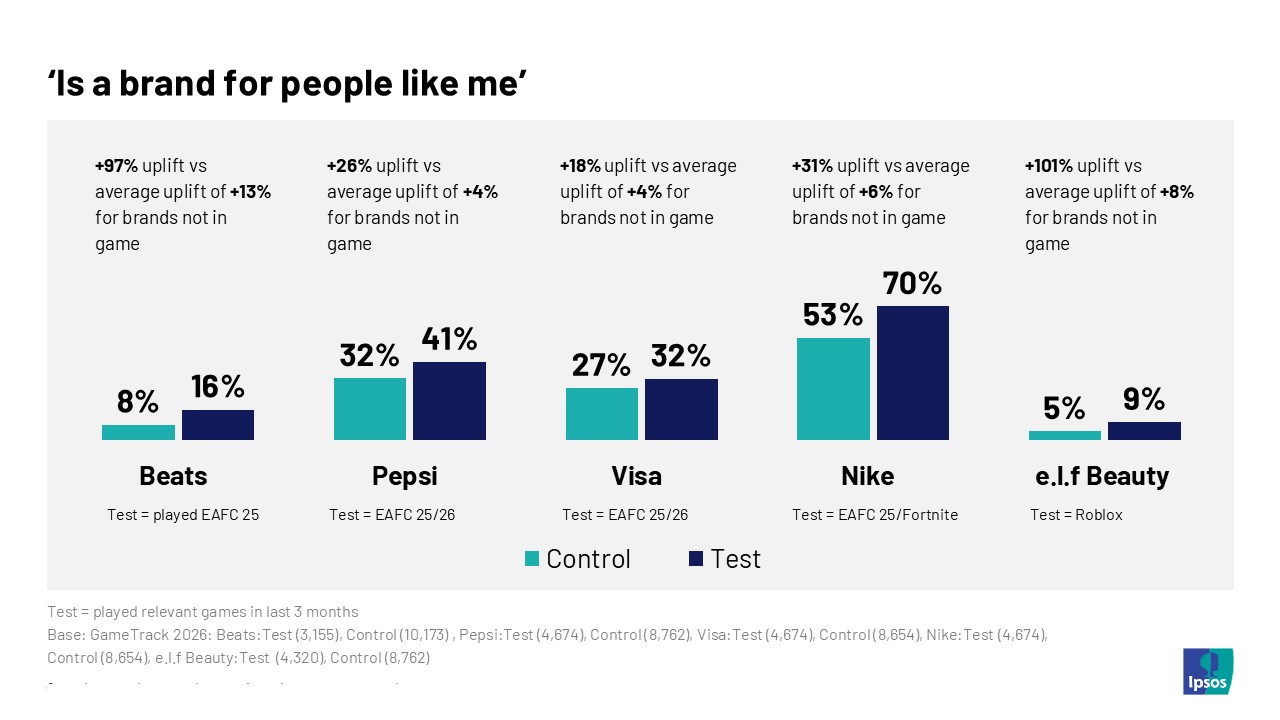
The campaigns fuelling the uplifts seen above include branded EAFC integrations such as Beats-sponsored tournaments, Visa and Pepsi perimeter-board advertising, and Nike's virtual Air Zoom activation – demonstrating how brands can be woven naturally into gameplay environments.
Gamers also recall seeing advertising in-game
Across nine in-game campaigns we also see an average uplift of +96% for prompted advertising awareness amongst exposed games.
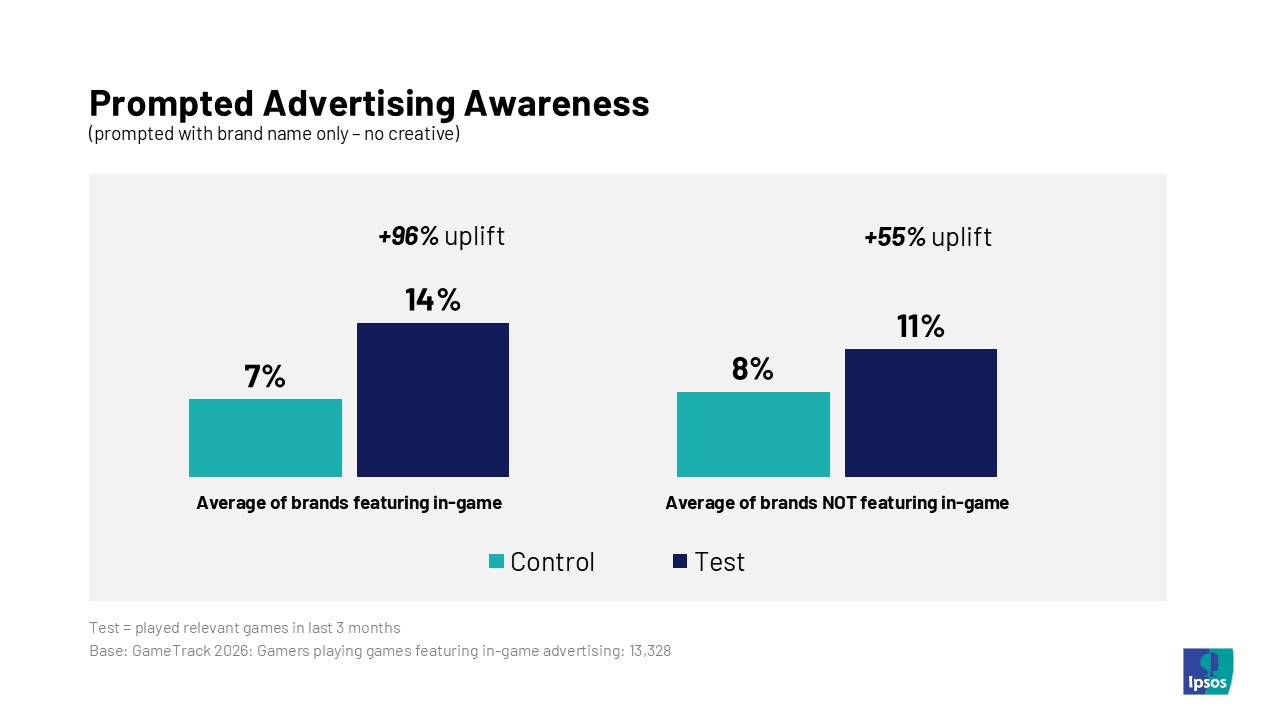
In-game advertising can have a powerful implicit impact, but those exposed to in-game advertising are also more likely to consciously recall it.
Engagement with a virtual world creates real world brand impact
Given the highly immersive nature of gaming, virtual game environments can function as self-contained worlds where players engage with characters, narratives, and other gamers – unlike some other media, gamers are active rather than passive participants which helps keep attention high.
Furthermore, brands can be integrated into games without disrupting the gaming experience. A successful brand integration can have a powerful unconscious impact that influences the audience without them necessarily being consciously aware of it.
In this context in-game advertising is particularly effective at normalising advertiser brands to gamers and making them seem like a natural part of their world. This is a benefit we have seen in other media, such as product placement, where it is again important that the placement fits seamlessly with the content.
Unlock the power of gaming audiences
Ipsos GameTrack (a study of 37,000 interviews in Q1 2026 with video game players across 16 European countries) is used to size the overall video games industry in terms of players, engagement and revenue.
Using GameTrack, we can identify who is playing specific games, and consequently who is exposed vs unexposed to in-game advertising.
If you are interested in measuring your next in-game campaign on GameTrack 2027, our team of gaming and advertising measurement specialists have a wealth of experience, including:
- Conducting ad-hoc studies to understand dynamic in-game advertising
- Profiling the gaming audiences – a key finding has been that the highly competitive nature of gamers can make them an attractive audience to brands. This hyper-competitive nature can spill over into their purchasing habits as they like to own the ‘best’ brands.
Get in touch with our gaming and advertising experts


Technical note
GameTrack is run by Ipsos on behalf of Video Games EU. Results provide an analysis of the demographics of European video game players and their gaming and purchasing behaviour across all platforms and formats, offering a comprehensive view of their gaming habits. Historically, GameTrack has focused on five key European markets: the UK, France, Germany, Spain, and Italy, with online surveys conducted monthly amongst respondents aged 6 to 64 until Q4 2024. From 2025 GameTrack has expanded to include Austria, Belgium, Croatia, Denmark, Finland, Ireland, the Netherlands, Poland, Romania, Sweden, and Switzerland.
Data is collected using a bi-modal survey methodology combined with external sales data. Initially, an offline survey is conducted face-to-face every three years in each market with a sample of 1,000 individuals over the age of 14 or 15 or 16 yrs old (depending on each market) assessing personal video game playing behaviour as well as the video game playing habits of minors aged 6 to 17 yrs old, as reported by parents or guardians. These results are analysed among adults aged 18-75 yrs old and are used to balance and contextualise findings from a more detailed online survey.
The second phase involves a comprehensive online survey conducted amongst c3,000 respondents (c2,000 depending on country) from a nationally representative sample aged 6 to 75 yrs old from each country, with quotas set for age, gender, region, education, employment status, and the presence of children in the household. This ensures national representation of the overall population, including both video game players and non-players. Subsequently, external data from Game Sales Data (GSD) and Sensor Tower is integrated within the online survey data to estimate overall revenue from consumer spending on video game purchases.


