How is the NHS on its 65th birthday?

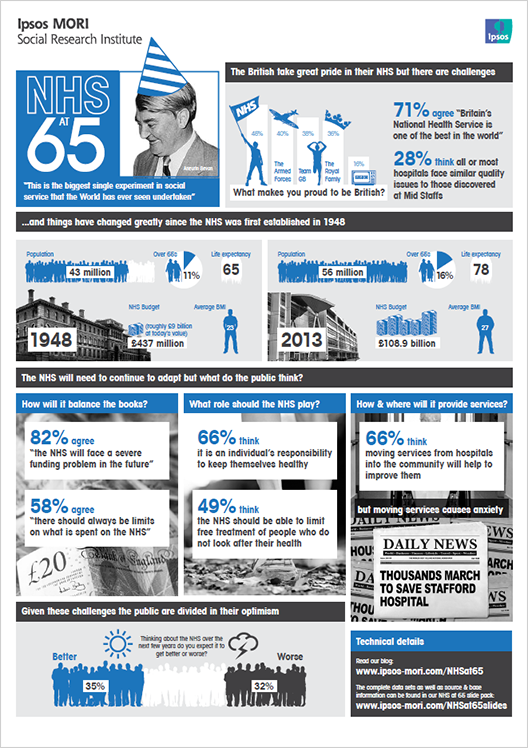
Since its creation in 1948, the National Health Service was the baby of post-war consensus. From the queues for spectacles and false teeth at its inception to programmes for tackling obesity and smoking, the NHS has evolved with public demand and characterises British healthcare. To mark its 65th anniversary, Ipsos has captured the public attitude and what they think the future holds for the service.
When examining how valued the NHS is by the British public, 71% of people think that Britain’s National Health Service is the best in the world, whereas 28% think all or most hospitals face similar quality issues to those discovered at Mid Staffs. When asked what makes people proud to be British, 45% chose the NHS, followed by the armed forces (40%), Team GB (38%) and the Royal family (36%).
It is important to note the demographic changes that have taken place. The population has grown from 43 million in 1948 to 56 million in 2013. As life expectancy has increased from 65 to 78, so has the percentage of the ageing population – in 1948, 11% of the population was over 65 compared to 16% in 2013. Similarly, the NHS budget, which was £37m in 1948, is now at £108.9bn.
Looking ahead, 82% agree with the statement “the NHS will face severe funding problem in the future” and just under half (58%) agree that there should always be limits on what is spent on the on the health service. Given these challenges, the public are divided in their optimism. When asked if people think the NHS will get better or worse, the results were 35% to 32%. The survey provides a cogent snapshot of how the NHS is perceived by the public 65 years on from its birth, and is a reminder of how it has shaped the passing generations.

Designer's Note
by Hannah Williams
The initial challenge with the NHS at 65 infographic was simply selecting the data out of the vast quantities Ipsos have archived on the subject (it’s been at the forefront of the British consciousness and so our social research for many years).
We also knew that beyond the electronic distribution there was desire to have a physical product to send out to clients. This meant that whatever I designed would have to adhere to standard print sizes, the most practical for this application being A3. Designing for print means that there is a finite amount of space to work with as opposed to a web infographic which really only has to deal with a width restriction; you can make them as long as you wish.
With this in mind, I worked closely with the researchers to ensure that the narrative was told as succinctly as possible whilst still communicating the main themes.
Getting the tone right for this can also be a challenge. Whilst I was keen for it to have the gravitas and authenticity an NHS infographic deserved, I also needed to ensure it remained engaging and easily digestible. The combination of real black and white photography alongside the icons seemed to do the trick. I was also keen to include an image of Aneurin Bevan, known as the father of the NHS, to pose the question of what he might think of the developments in the 65 years since the NHS’ conception.