
Nigel Farage improves personal ratings but UKIP's image remains divisive
Nigel Farage improves personal ratings but UKIP’s image remains divisive Tim Farron still to build his public image
Party conference season has begun and Ipsos reveals new polling on the public’s perceptions of the Liberal Democrats and UKIP.
When asked about various qualities of both parties a majority of Britons (55%) believe the Liberal Democrats are ‘concerned about people in real need’, compared to four in ten (39%) who say the same for UKIP. Both parties fare similarly in understanding the problems facing Britain (46% say this for the Liberal Democrats and 43% for UKIP), although this represents a rise for UKIP of 12 points since the election. The public however also see negative attributes in both parties. Neither party is seen to have a ‘good team of leaders’ (16% say this for the Liberal Democrats and 18% for UKIP) or ‘fit to govern’ (17% say this for the Liberal Democrats and 16% for UKIP), and both are more likely to be seen as out-of-date. Seven in ten (69%) believe UKIP to be ‘extreme’ (compared to just 12% for the Liberal Democrats), much higher than any other party.
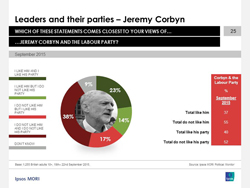
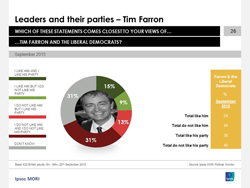
When assessing the qualities of the parties’ leaders more believe UKIP’s Nigel Farage ‘understands the problems facing Britain’ than in April (42% versus 33%). Seven in ten (68%) also see Mr Farage as ‘patriotic’, just behind David Cameron but higher than Jeremy Corbyn and Tim Farron (both with 37%). Yet half (50%) see the UKIP leader as ‘out of touch’. Few also describe Mr. Farage or Tim Farron as a capable leader (28% for Nigel Farage and 18% for Tim Farron) and just one in five (20%) believe Mr Farage would be ‘good in a crisis’ (one in ten (10%) say this for the Liberal Democrat leader). Generally though Tim Farron has yet to build his image with the public as a third (33%) say they ‘don’t know’.
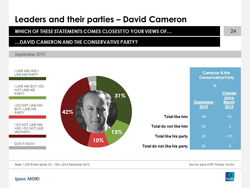
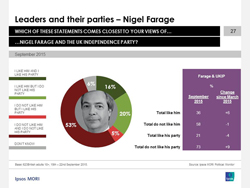
When asked about how the Liberal Democrat and UKIP leaders measure up to their respective parties one in four (24%) say that they like Tim Farron (compared to 31% who said they liked Nick Clegg in March 2015) and 28% say they like the Liberal Democrats, down from 40% in March. Nigel Farage has improved his likability rating to 36% but his party remains the most disliked at 73%, nine points worse than March.
Just two months into his leadership the Ipsos poll finds 22% percent of the public think Tim Farron is doing a good job as leader of the Liberal Democrats while 29% are dissatisfied. Nearly half (48%) however are unsure showing the public are still very much unfamiliar with the new leader. Nigel Farage however has improved his overall ratings and does very well among his own supporters. Nine in ten (88%) of UKIP supporters are satisfied with him doing his job as party leader and just 9% are dissatisfied. Among the public overall, two in five (40%) say they are satisfied with him versus 45% who are dissatisfied, his best score since April 2014.
 (Click or tap the images to enlarge)
Gideon Skinner, Head of Political Research at Ipsos, said:
“As UKIP debates the role they should take in the upcoming European referendum, the party and its leader continue to divide opinion. Nigel Farage still receives extremely strong ratings from his own supporters, and as concern about immigration reaches record highs, growing numbers say UKIP understands the problems facing Britain. However, at the same time the party is more disliked, and seen as more extreme than its rivals. Meanwhile, the public still have to form a clear image of new Liberal Democrat leader Tim Farron, but perceptions of the Liberal Democrats as out of date have increased.”
Technical note
Ipsos interviewed a representative sample of 1,255 adults aged 18+ across Great Britain. Interviews were conducted by telephone 19-23 September 2015. Data are weighted to match the profile of the population. As an interim measure, and to preserve our long-term trends on voting intentions, our headline indicator is now changed to take into account past voting behaviour (do people always or usually vote in general elections, or say it depends) as well as stated likelihood to vote in an upcoming election (those who say they are at least 9 out of 10 certain to vote). As part of our post-election methodological review, we have introduced a new weighting by newspaper readership to improve the representativeness of our sample, using targets derived from the National Readership Survey. As our internal review continues, however, and as we look to learn from the British Polling Council’s own inquiry, we anticipate we will make further refinements to our methodology in the future.

