Scots unimpressed by Holyrood campaigns, but give SNP the edge
- All the Scottish parties and leaders receive a ‘net negative’ rating from the Scottish public, meaning more people have an unfavourable view of them than a favourable one.
- However, the SNP and First Minister John Swinney remain the most highly rated of the Scottish parties and leaders. While most Scottish party leaders have seen their ratings improve slightly over the campaign period, Reform UK’s Malcolm Offord has seen a dip in ratings.
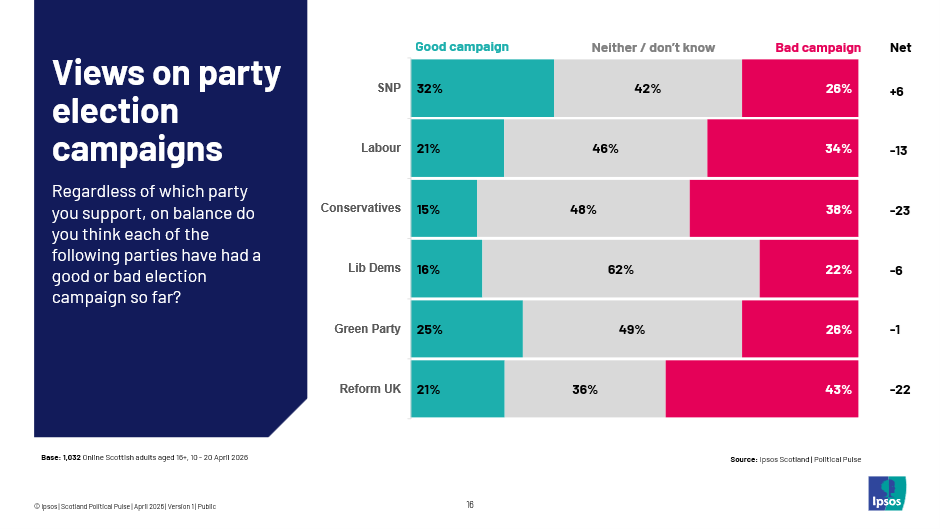
- The SNP is considered to have had the best campaign so far and the Scottish Conservatives and Reform UK the worst, though the public have not, so far, been particularly impressed by any party.
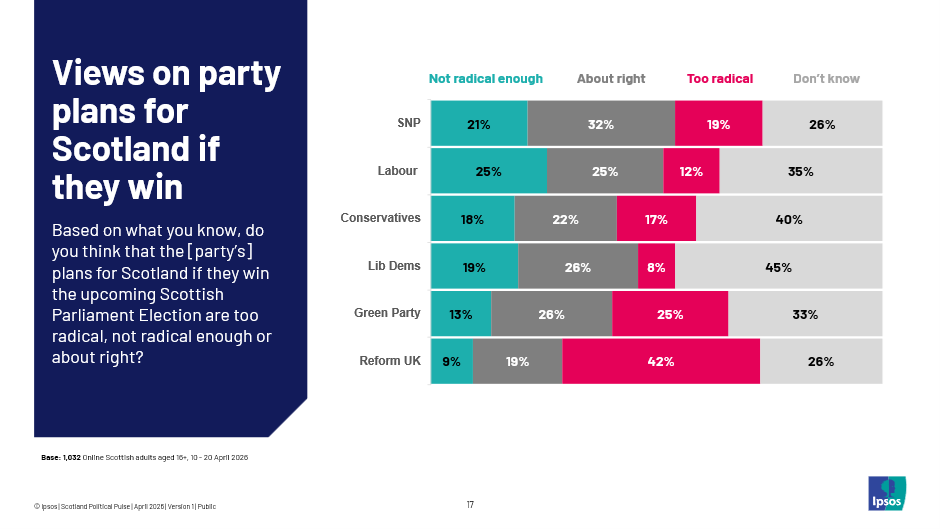
- Reform UK’s plans for Scotland are more likely to be considered too radical, compared to the other parties.
Party ratings
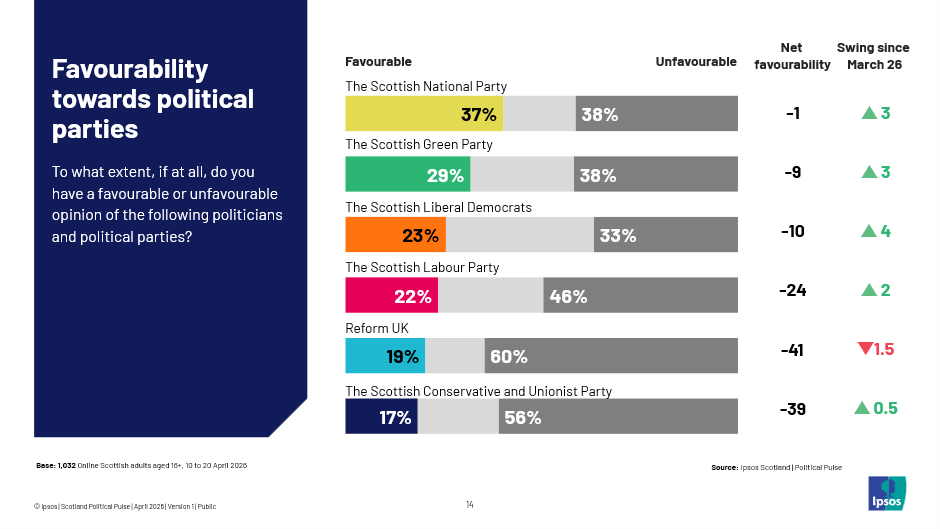
The SNP remains the party with the highest favourability ratings from the public, though none of the parties receive a positive ‘net’ rating. 37% view the SNP favourably and 38% unfavourably, giving them a net rating of -1 (a swing of +3 since March).
The Scottish Liberal Democrats (with a swing of +4), Scottish Green Party (swing of +3) and Scottish Labour (swing of +2) have also seen slight improvements in their ratings since March. However, Scottish Labour continue to trail the SNP in terms of overall ‘net’ favourability (-24), with the Scottish Conservatives further behind still on -39, and Reform UK on -41.
Meanwhile, Reform UK’s ratings have fallen slightly, with 19% of the public favourable towards the party and 60% unfavourable and a net rating of -41 (-1.5 swing since March).
Leader ratings
Again, none of the Scottish party leaders are viewed positively, on balance, although some have improved their ratings since campaigning got underway.
First Minister John Swinney continues to top the rankings. He has seen a boost to his overall rating compared with Ipsos’ previous poll, taken in March, with 35% viewing him favourably and 36% viewing him unfavourably – a ‘net’ favourability rating of -1 (an upward swing of +5.5). Scottish Labour leader Anas Sarwar’s net rating is also slightly up, from -26 in March to -21 now (21% favourable, 42% unfavourable, a swing of +2.5).
In contrast, Reform UK Scotland leader Malcom Offord is down from -36 in March to -42 (13% favourable and 56% unfavourable, a swing of -3). He is the only Scottish leader to see a dip in ratings and is the lowest rated Scottish party leader overall.
Election campaigns
The public’s awareness of the election has increased in recent weeks, with 69% saying they have closely followed news about it (up from 59% when Ipsos last asked the question, in March). However, Scots have not been particularly impressed by what they have seen of the parties’ campaigns so far.
The SNP are the only party whose campaign receives an overall ‘net’ positive rating, indicating that more people say they are having a good campaign, regardless of whether they personally support them, than say they are having a bad one (32% vs. 26%, a net rating of +6).
Reform UK and the Scottish Conservatives are thought to have had the worst campaigns so far: 43% say Reform have had a bad campaign, as do 38% for the Conservatives, with just 21% and 15% respectively saying they have had good campaigns, giving them net ratings of -22 and -23).
A significant proportion of the public, however, seem to be indifferent or uncertain about how well the parties’ campaigns are going. Between 35% and 62% for each party say either that their campaign is ‘neither good nor bad’, or that they do not know enough to say.
Plans for Scotland
Ipsos’s recent polling has highlighted a clear appetite for change among the electorate. However, Scots have mixed views on whether the parties are offering the level of change Scotland needs. We asked whether people thought each of the main parties’ plans for Scotland were too radical, not radical enough, or about right.
Again, the SNP appear to be most in tune with the electorate, with 32% considering their plans to be about right – higher than for any other party. However, over a fifth (21%) feel their plans are not radical enough, while 19% feel they are too radical and 26% are not sure.
Views on Scottish Labour’s plans are more evenly split, with 25% considering them to be about right, 25% considering them not radical enough, and 12% too radical. Over a third (35%) do not know enough about their plans to rate them.
Reform UK’s plans are most likely to be considered too radical (42%, the highest of any party). 19% say they are about right, 9% that they are not radical enough, and 26% are not sure.
(Note: At the time fieldwork started for this poll, Reform UK and the Scottish Conservatives had launched their manifestos, while the SNP, Scottish Labour, Scottish Greens and Scottish Liberal Democrats launched theirs during fieldwork).
Expectations of the next government
With voting intention polls pointing to the SNP being the largest party, and Labour and Reform UK both in contention for second place in terms of vote share and number of MSPs, we asked people about their expectations in the event the next Scottish Government was led by each of these parties.
Overall, the public do not have particularly high expectations for the next Scottish Government, regardless of which of these three parties leads it. In particular, most people think it is unlikely the next Scottish Government will be able to reduce the cost of living, regardless of who leads it: 61% said it was unlikely an SNP-led government would do so, as did 64% for a Scottish Labour-led Scottish Government, and 67% for one led by Reform UK. There is also considerable scepticism about whether the next Scottish Government will be able to grow Scotland’s economy.
However, people are more likely to feel an SNP-led government with John Swinney as First Minister will deliver for Scotland across a range of areas than to expect the same of a Labour or Reform UK-led Scottish Government. For example, 47% expect an SNP-led Scottish Government with John Swinney as First Minister to act with integrity, compared with 37% for a Labour-led Scottish Government with Anas Sarwar as First Minister, and just 21% for a Reform UK-led Scottish Government with Malcolm Offord as First Minister.
Direction of the country
In a campaign that has yet to inspire the Scottish public, there are some signs that people are becoming a little less negative in their views on the outlook for Scotland as a whole. Although 46% think things in Scotland are heading in the wrong direction, this is down 5 points and is the lowest result for ‘wrong direction’ that Ipsos has recorded since it was first asked in October 2022.
Rachel Ormston, Research Director at Ipsos Scotland, commented:
Now the campaigns are in full swing, the Scottish public is paying more attention to the May election. However, so far, their reaction is fairly lukewarm. While views of most of the parties and leaders – with the notable exception of Reform UK – have improved slightly, this was from a very low base, and all continue to receive ‘net negative’ ratings overall. The SNP receives the most positive ratings overall and is seen to be having the better campaign. However, after almost 20 years of government, expectations of what they might achieve if – as the polls predict – they lead the next Scottish Government are muted. In particular, the public is extremely sceptical that the next Scottish Government, whoever leads it, will be able to shift the dial on the cost of living – an issue consistently in the public’s top three priorities for Scotland.
Notes:
- Ipsos interviewed a representative sample of 1,032 adults aged 16+ across Scotland. Interviews were conducted online between 10th-20th April 2026.
- Data are weighted to match the profile of the offline population. All polls are subject to a wide range of potential sources of error.
- Where results do not sum to 100%, this may be due to computer rounding, multiple responses, or the exclusion of “don’t know” categories.