Majority of people want borders closed as fear about COVID-19 escalates

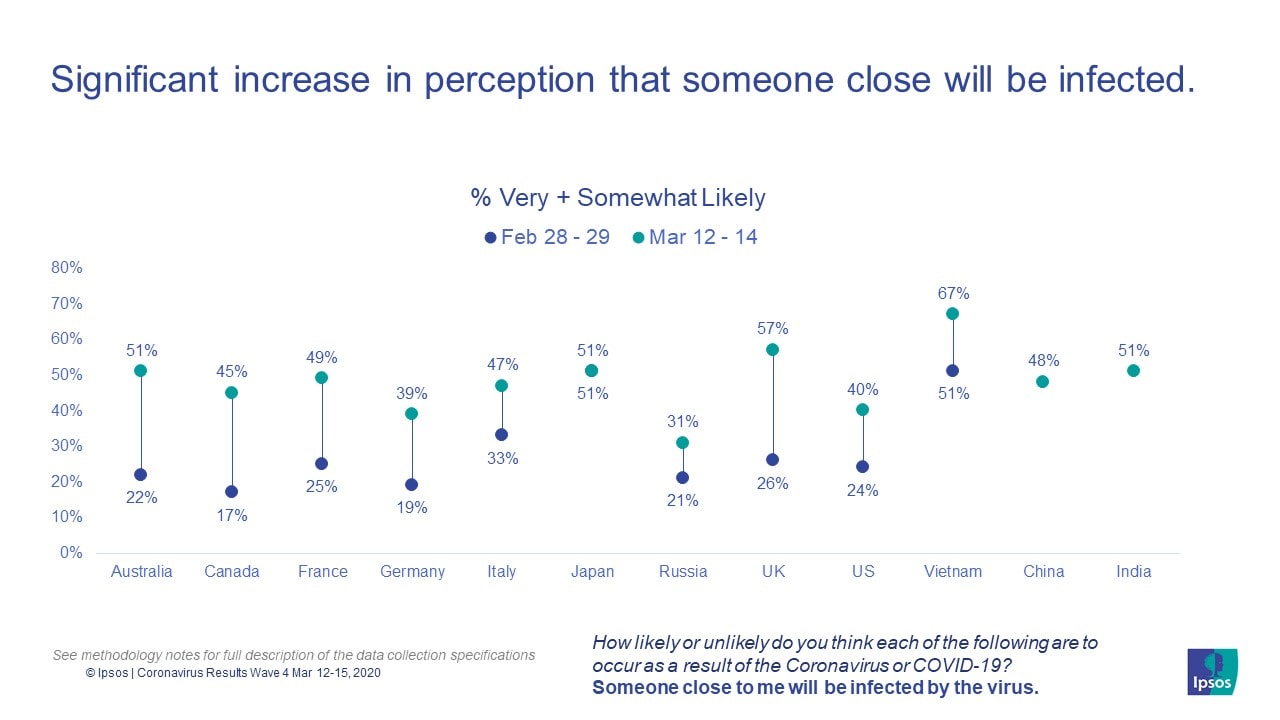
More of us now believe someone close to us will be infected by the coronavirus pandemic.

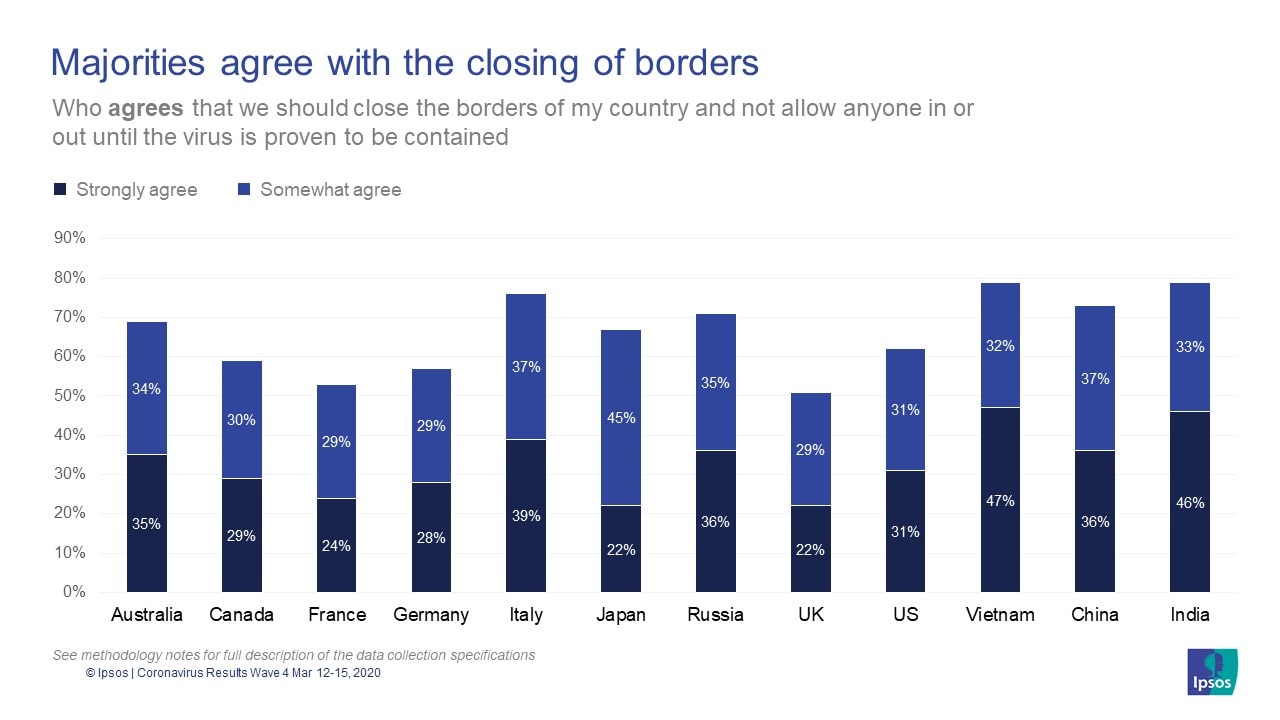
A majority of people across 12 nations think the borders of their country should be closed until the coronavirus outbreak is contained, according to the latest Ipsos survey.

In a survey of 12,000 people across 12 major countries from March 12 to 15, countries in the Asia-Pacific region are most supportive of border closures – led by India (79%) and Vietnam (78%)  ̶ which is not surprising, given where the disease was first encountered.

More than 3 in 4 people in the world’s other hot spot, Italy (76%), are also in agreement of this drastic measure followed by those in China (73%), and Russia (70%).
Majorities agree with the closing of borders | COVID-19 | Coronavirus | Ipsos

A significant driver in the growth for concern about COVID-19 is that more of us now believe someone close to us will be infected by the virus. The majority of people in Vietnam (67%), the United Kingdom (57%), India, Australia and Japan (51%) think someone close to them will get the coronavirus.

Meanwhile, the countries that saw the biggest jump in this measure from a previous poll conducted on February 28-29 are all developed markets – the U.K. (+31 points), Australia (+29), and Canada (+28).
Significant increase in perception that someone close will be infected | Covid-19 | Coronavirus pandemic | Ipsos

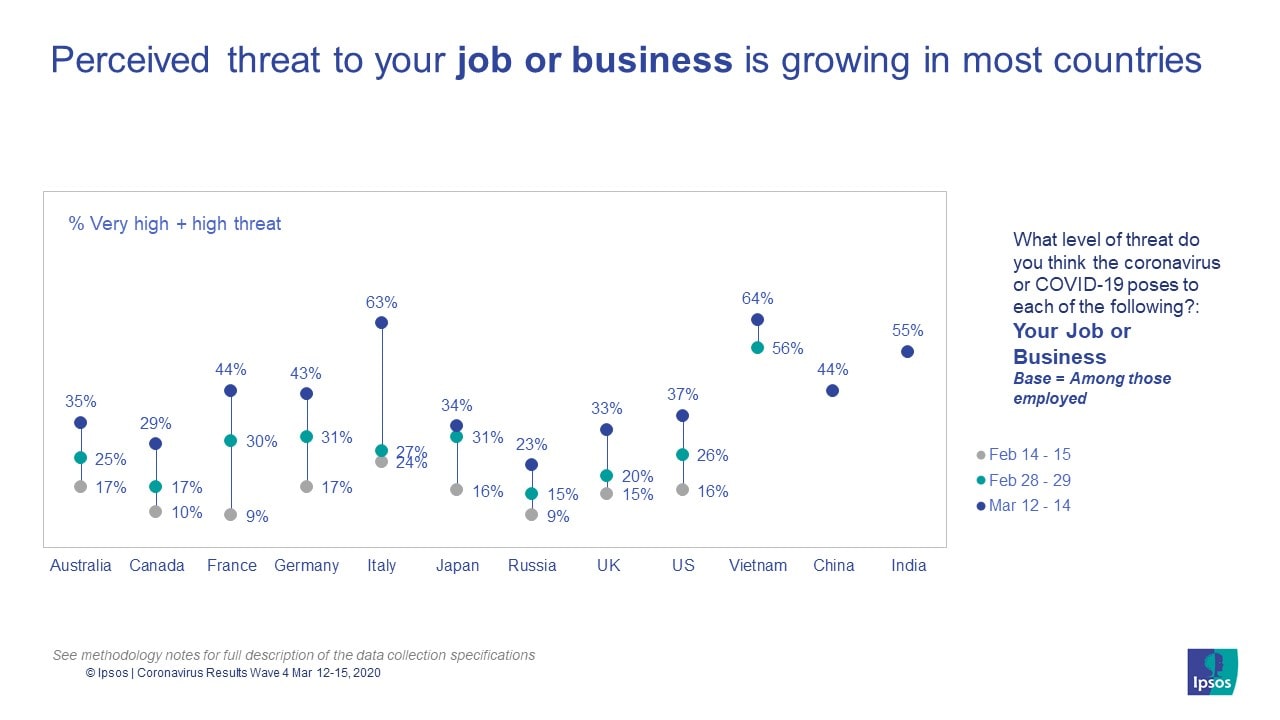
In addition to this, there’s been an increase of people who think their job is under threat as the pandemic spreads. There’s been a significant rise on this measure from previous polling done in Italy (63%, up 36 points)  ̶ considering closures in its economy, followed by France (44%, up 14 points) and the U.K. (33%, up 13 points).
Perceived threat to your job or business is growing in most countries | COVID-19 | Coronavirus | Ipsos

Overall, the perception of the threat the pandemic poses to a country has increased with a majority of people citing it as least as a high threat in all countries, except for in Canada (32%), Russia (37%), the U.K. (45%) and Australia (46%).

These are the results of an Ipsos survey conducted March 12th to 14th, 2020 on the Global Advisor online platform among 10,000 adults aged 18-74 in Canada and the United States and 16-74 in Australia, China, France, Germany, Italy, India, Japan, Russia, Vietnam and the United Kingdom. Where available, tracking results from Wave 3, conducted February 28-29, February 14-15, and February 7-9 are presented. Sample sizes are consistent wave to wave.

The author(s)

Related news

  • Welsh Senedd polling
    Politics Survey

    Plaid Cymru has slight lead over Reform UK in new Ipsos Wales Senedd poll, but half of voters may change mind

    New polling data from Ipsos in the UK, conducted 2–8 April 2026, reveals a complex political landscape in Wales ahead of the Senedd elections. While Plaid Cymru has a slight lead in voting intentions, Reform voters are more committed, and many voters say they may still change their mind. The research also highlights widespread public frustration with the performance of the Welsh Government and a significant lack of trust in any single party to address the nation's top priorities.
  • Ipsos Scotland Political Pulse
    Scotland Survey

    Scots unimpressed by Holyrood campaigns, but give SNP the edge

    With just two weeks to go until the Scottish Parliament election on 7th May, new data from Ipsos’s Scotland Political Pulse shows that, while voters are not particularly impressed by any of the parties, the SNP have the edge, with views on both the party and their leader improving since last month.
  • Money jar

    Economic optimism falls to record low as concern over inflation rises

    The latest Ipsos Economic Optimism Index (EOI) reveals that net economic optimism in Britain has fallen to the lowest levels ever recorded since Ipsos began collecting this data in 1978. In the latest data, collected 8-14 April 2026, 78% of Britons expect the economy to get worse over the next 12 months (up 3ppts since last month), the highest level recorded since the Index began.