Reform UK holds slim voting intention lead over Labour but Andy Burnham preferred as PM to Nigel Farage and Kemi Badenoch
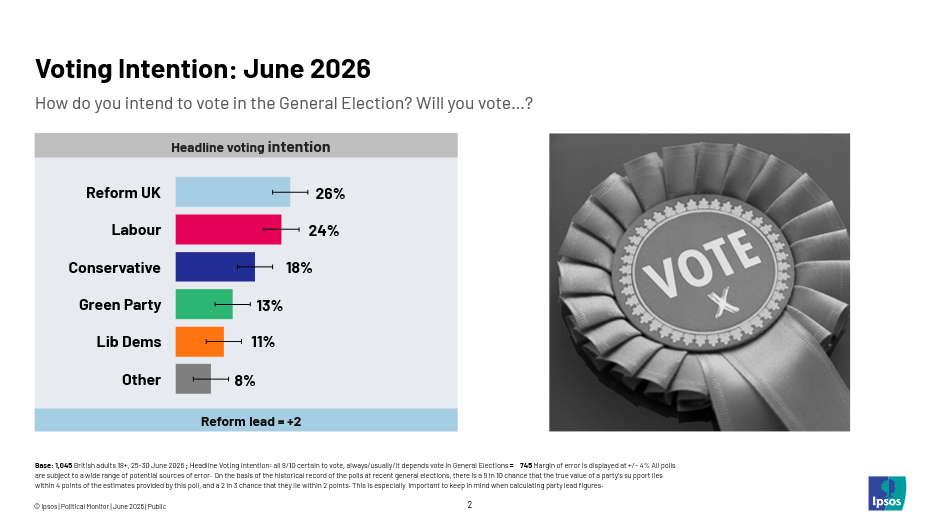
- 26% of British adults would vote for Reform UK if a General Election were held tomorrow, leaving them two points ahead of Labour (24%).
- More than 3 in 4 Britons (76%) report being dissatisfied with the job Keir Starmer is doing as Prime Minister following his resignation announcement, marking the lowest ever recorded for a departing Prime Minister.
- 3 in 10 (30%) select Greater Manchester Mayor Andy Burnham as their preferred choice for Prime Minister, leading rivals Nigel Farage (16%) and Kemi Badenoch (13%).
While the Labour Party has narrowed the gap following the Prime Minister’s resignation announcement, Reform UK retains a marginal lead in headline voting intention. The public are dissatisfied with the current government but are sceptical alternatives are ready to replace them. Andy Burnham is preferred as PM to Kemi Badenoch and Nigel Farage but the jury is out on whether his (presumed) incoming government will deliver on voter priorities.
Labour closes the gap with Reform UK but current government is unpopular
- 26% say they intend to vote for Reform UK (-1 point from May), while Labour has risen 4 points to 24%. The Conservatives stand at 18% (-1), the Green Party at 13% (-1), and the Liberal Democrats at 11% (-1).
- Labour has recovered some of its core support, retaining 52% of its 2024 general election voters, compared to 44% recorded last month. This comes as the proportion of 2024 Labour voters saying they intend to defect to the Greens fell sharply from 19% to 8%.
- However, wider public opinion on the administration remains broadly negative; just 14% are satisfied with the way the government is running the country, compared to 78% who are dissatisfied.
- Furthermore, 63% of the public disagree that the current government is competent, and 52% disagree that it deserves to be re-elected.
Starmer leaves office weighed down by key issue failures
Public perception of Starmer’s policy achievements since July 2024 is overwhelmingly negative, particularly on domestic and financial pressures.
Government Performance Ratings on Core Issues:
- Dealing with the cost of living: 79% Bad Job vs 11% Good Job
- Managing the economy: 72% Bad Job vs 16% Good Job
- Managing immigration: 69% Bad Job vs 20% Good Job
- Improving the National Health Service: 63% Bad Job vs 23% Good Job
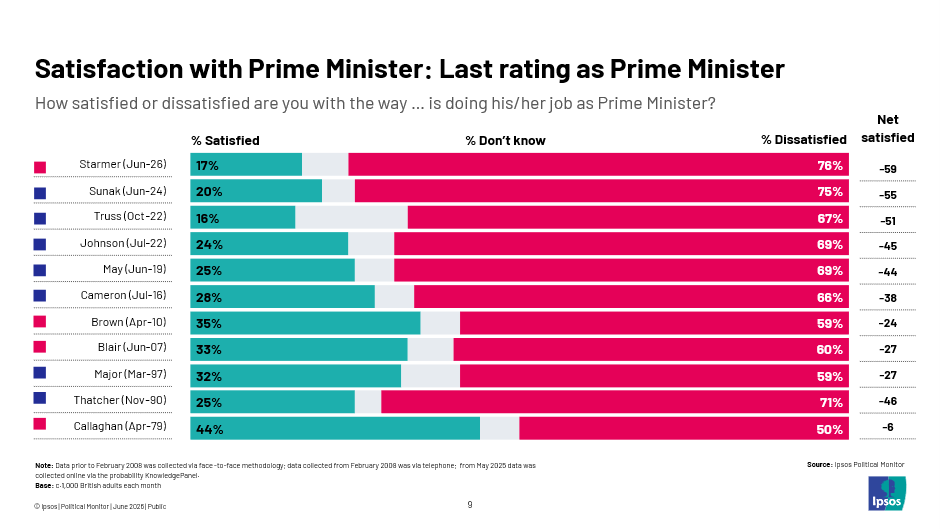
Keir Starmer will leave office with 17% of the public saying they are satisfied with the job he is doing as PM, compared to 76% who are dissatisfied, giving him a net score of -59, which is the lowest final rating we have seen for a PM at Ipsos before they left office (going back to 1979).
Opposition leaders fail to capitalise as dissatisfaction rises
While the government faces intense public criticism, opposition leaders have yet to secure a definitive personal breakthrough with the British electorate.
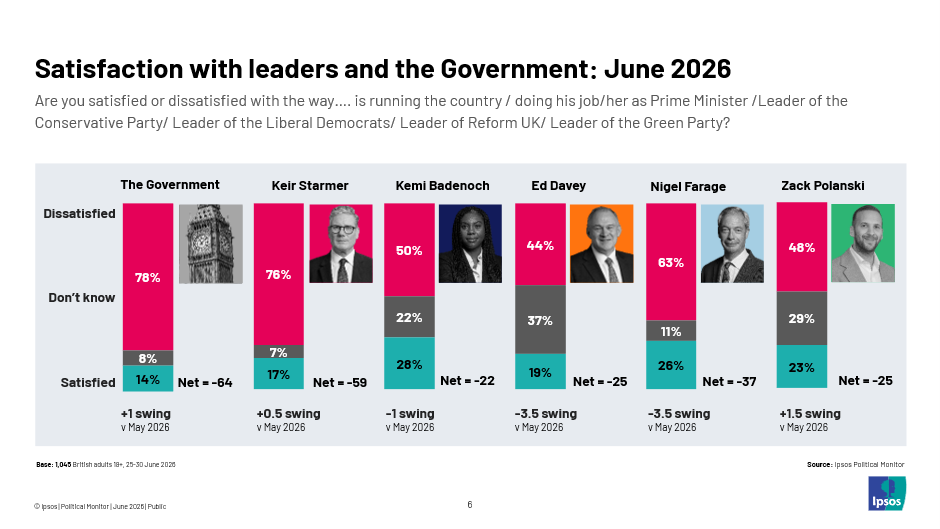
- Kemi Badenoch registers the highest individual satisfaction among the leaders asked about at 28%, with 50% dissatisfied, yielding a net score of -22 (no change from May).
- Nigel Farage has 26% of British adults satisfied with his performance as Reform UK leader, but 63% report being dissatisfied (+6ppts vs May).
- Zack Polanski and Ed Davey follow closely behind, with 23% and 19% satisfaction respectively, giving both a net score of -25.
- The public is sceptical of how ready the opposition parties are for government. Only 1 in 5 British adults (21%) believe Reform UK is ready to form the next government —a drop from 25% in January and 29% last September. 62% currently disagree Reform UK are ready (+9 points from September).
- Similarly, just 19% agree that the Conservative Party is ready for government, though this is up from 14% in January. 58% disagree but this is down from 64% in September.
Andy Burnham leads preferences for Prime Minister, but the jury is out on whether a Burnham government would deliver in office
- In a forced choice on who would make the most capable Prime Minister, 30% say Andy Burnham, nearly doubling the 16% who choose Nigel Farage and the 13% who select Kemi Badenoch. This marks a major shift from May, when Farage led the field at 18%, followed by Starmer at 16% and Badenoch at 15%.
- Nearly 3 in 10 (28%) agree that Burnham has "what it takes" to be a good Prime Minister, while 33% disagree. This net rating of -5 tracks considerably ahead of Badenoch (-23) and Farage (-41).
- However, the wider public remains conflicted over his readiness for national office. While 29% agree he is ready to be Prime Minister, 39% disagree, with the remainder undecided.
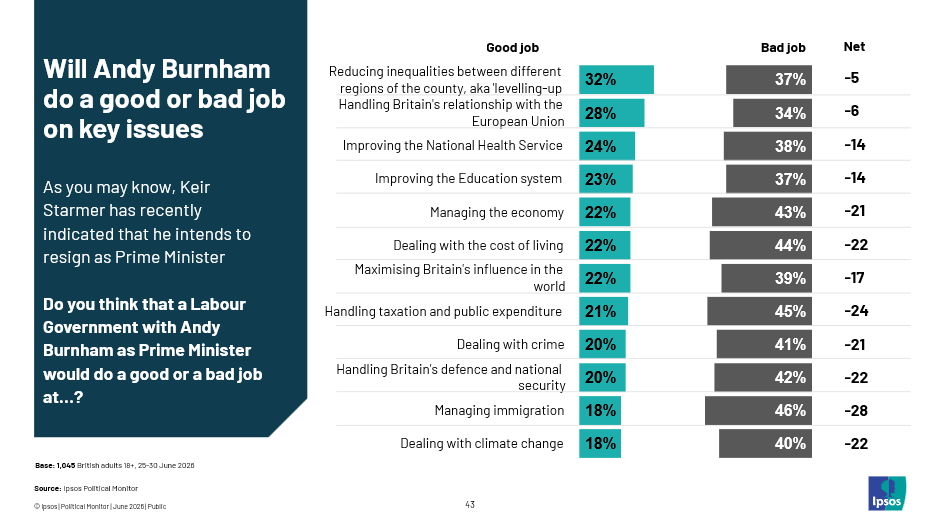
- Hypothetically, a Burnham-led government receives its warmest reception on "levelling up" and reducing regional inequalities, where 32% expect he would do a good job.
- Yet even on this flagship issue, public expectations remain net-negative, with 37% predicting a bad job. Across all core policy metrics, between a third and 40% of respondents state they "don't know" how a Burnham administration would perform.
Commenting on the findings, Keiran Pedley, Director of Politics at Ipsos in the UK said:
With Labour narrowing the gap with Reform UK, public doubts over whether Reform UK or the Conservatives are ready for government and Andy Burnham preferred as Prime Minister to Kemi Badenoch and Nigel Farage, Labour will be more optimistic about the future than they were a month ago. However, the jury is out with the public on whether Burnham himself is ready to be Prime Minister and whether a Burnham government will deliver in office. Which suggests he will have to start well to convince a sceptical public his government can succeed where others are perceived to have failed.
Notes:
Ipsos interviewed a representative sample of 1,045 British adults aged 18+ via the Ipsos UK Knowledge Panel. Polling was conducted online between 25–30 June 2026. Panel members are recruited via random probability sampling, by sending letters to randomly selected addresses, which invites them to join an online panel. This approach means every household in the UK had a known and non-zero chance of being selected to join the KnowledgePanel. Those who are digitally excluded are provided with a tablet and free, restricted data connection. A sample of 2,188 adults aged 18+ were invited to take part in the survey. The sample was stratified by nation, age, qualifications and vote at the 2024 general election (as collected immediately after the election). The achieved sample was weighted in two stages:
- Design weights were applied to correct for the unequal probabilities of a person being selected for a survey, notably residents in smaller households have a higher chance of being selected.
- Calibration weights were applied through rim weighting to correct for differential non-response. Data was weighted to the adult population profile on age and gender, Government Office region, ethnicity, qualifications, work status and work sector (public sector/other), social grade (office coded), number of cars in household, constituency type, and newspaper readership (print and digital). Population targets were obtained from the 2021/22 Census, ONS population estimates and other large-scale probability surveys.
- All polls are subject to a wide range of potential sources of error. On the basis of the historical record of the polls at recent general elections, there is a 9 in 10 chance that the true value of a party’s support lies within 4 points of the estimates provided by this poll, and a 2 in 3 chance that they lie within 2 points. This is especially important to keep in mind when calculating party lead figures.
- Note that this is a new methodology implemented since June 2025. It involves a new form of data collection (online random probability panel instead of quota telephone survey), an updated voting intention (which involves prompting for Reform UK), and an updated weighting scheme. This is based on our learnings during and since the 2024 General Election. This means that comparisons with previous waves need to be made with caution.