Teachers Critical Of Government Performance
Fewer than one in three teachers is satisfied with the government's performance on education. The research by MORI, conducted in Autumn 2003 as part of the MORI Teachers' Omnibus survey, found that just 30% of teachers are satisfied with the government's performance on one of its key election pledges. One in two (51%) of those surveyed are dissatisfied, including one in six teachers (17%) who say they are very dissatisfied.
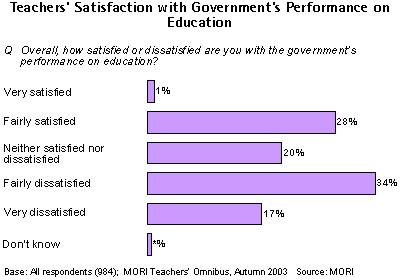
Moreover, dissatisfaction increases with experience: teachers with six or more years' teaching experience -- and particularly those who have worked in the profession for 16 or more years -- are significantly more likely to be dissatisfied with the government's performance than less experienced colleagues, especially Newly Qualified Teachers (NQTs). Around a third of NQTs (32%) are dissatisfied, compared to 53% of colleagues with at least six years' experience.
There are indicative signs, too, that this disillusionment sets in fairly rapidly: nearly half of NQTs (47%) say they are satisfied with the government's performance on education, but this drops sharply to around just one in four teachers (27%) with 1-5 years' experience.
Coming at a time when the Government is facing stiff opposition from the teaching unions in relation to national tests, the school workforce agreement and teachers' pay proposals, and as recruitment and retention problems continue to dog schools, the survey suggests that the problems already facing Charles Clarke and his ministers may increase over the next Parliamentary session.
Technical details
The Teachers' Omnibus survey was carried out by MORI Social Research Institute between 8 October -- 7 November 2003.
From a sample of 3,998 state primary and secondary schools in England and Wales (with probability of selection proportionate to size as a proxy for the number of teachers per institution), 984 teachers who were representative of the total population of teachers by sex, age, phase and Government Office Region, were interviewed.
Minimum quotas were also set on subject specialism (for secondary teachers), teaching experience and most senior level of responsibility to ensure that a broad range of teachers were interviewed.