
Assessing post-pandemic stickiness of product subscriptions
 Product subscriptions have gained a new relevance during the pandemic, a time when in-store shopping has faced concerns around health and safety. However, when we move beyond the pandemic will this behavior stick?
There are two types of product subscriptions: replenishment, which is the restocking of essentials such as household supplies and personal care products aimed at offering convenience. For example, Amazon Subscribe & Save. The second form is box subscriptions, which allow users to try new products with a new variety curated and shipped at a regular interval. For example, HelloFresh.
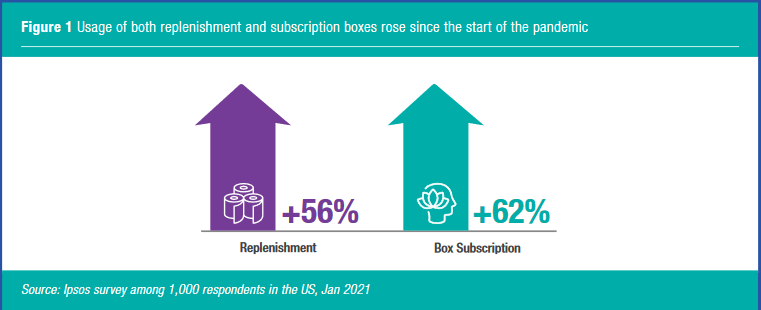
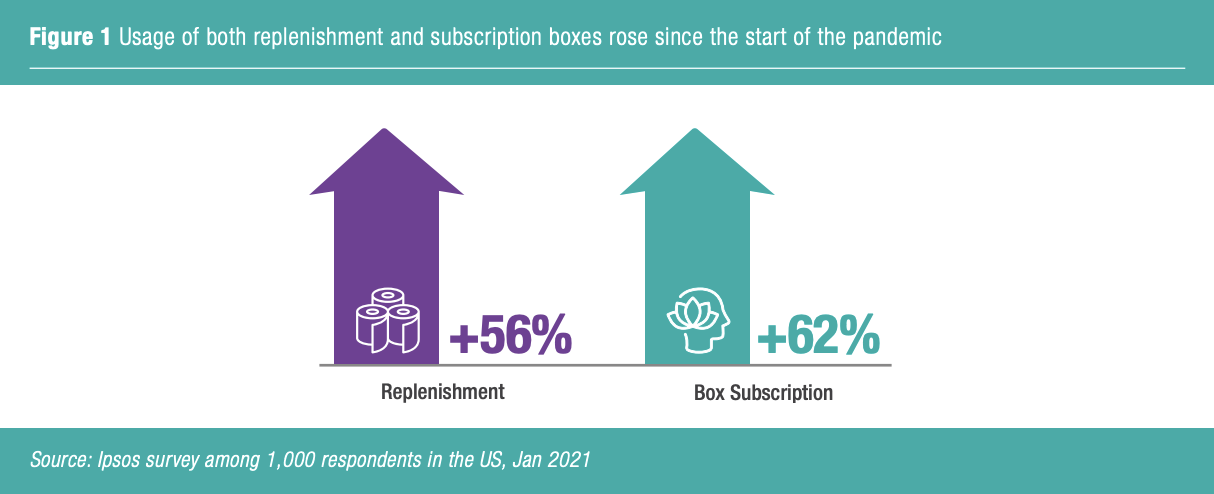
Product subscriptions have seen an increase in usage since the beginning of the pandemic, with Replenishment services rising by 56%, while box subscriptions rose 62%.
Our research found the primary driver for consumers to sign up to product subscriptions was the convenience of home delivery at 44%, up from 14% prior to the pandemic. Similarly, 32% signed-up because it is a safer way to shop, 28% for the free shipping and 22% so they’d know exactly when the product would arrive.
To learn more of what our research uncovered and understand what this means for subscription models, read A casual flirtation or a committed relationship: Assessing post pandemic stickiness of product subscriptions.
A SHIFT IN CONTEXT
Back in 2019, when we first started Unpacking Product Subscription Models, one in five consumers in the US said they had tried a product subscription. In December 2019, Forbes stated that “the subscription box industry has lost its initial sizzle – seven-year-old Blue Apron, for instance, had lost 95% of its stock value since its 2017 IPO”, but the author added that this “hasn’t translated to the sector’s demise” and so considered that this business model “shouldn’t be counted out just yet".
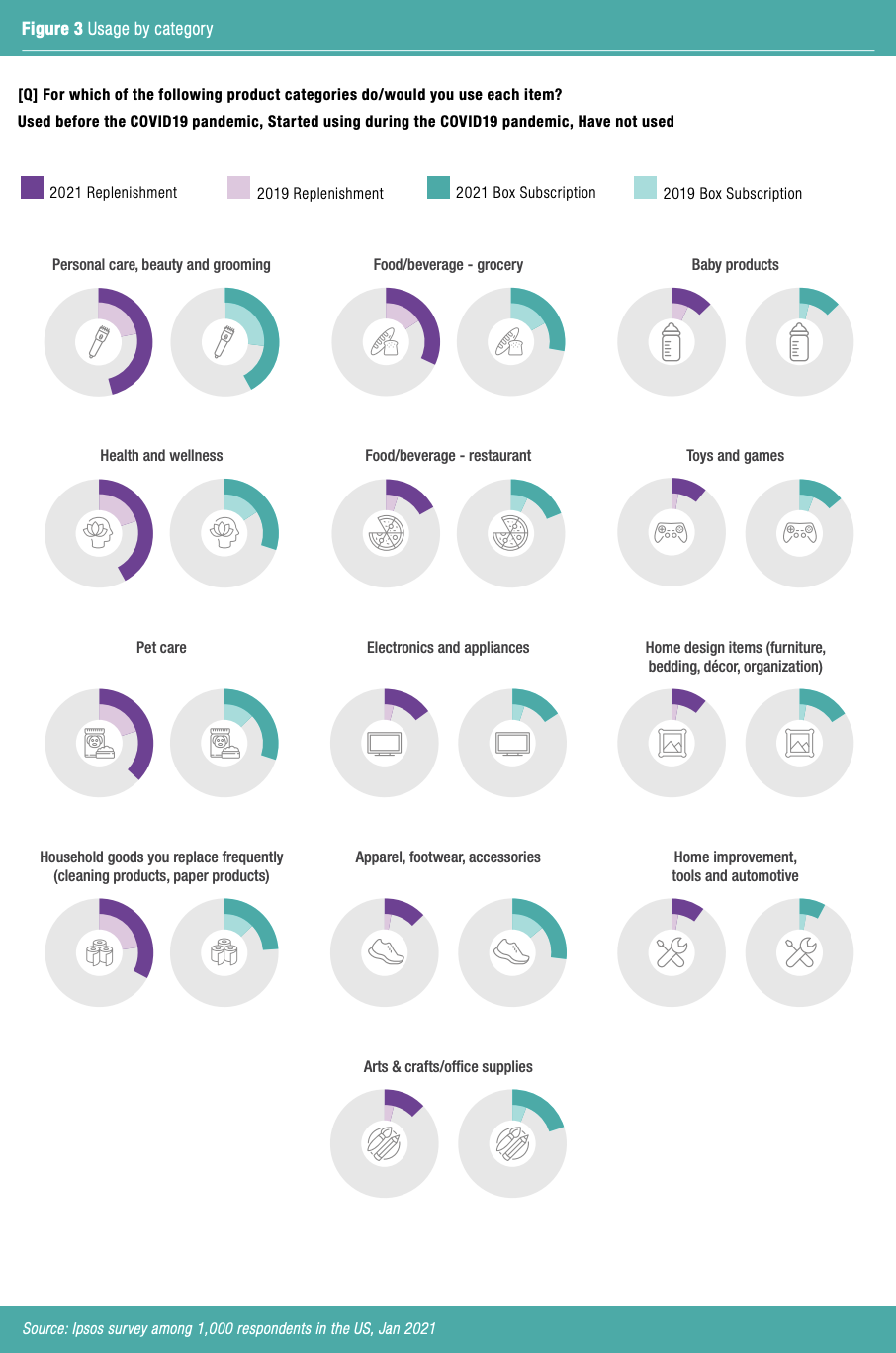
Seven months later, the same source observed that “subscription growth is reportedly on the rise across industries and verticals.” Our US survey in January 2021 confirmed that product subscriptions, which were slowly fading away, received a new lease on life during the pandemic with a 50-60% increase in usage (see figure 1). Some categories benefited more than others (see figure 3). Forbes noted: “This was certainly true for CBD company Equilibria. Demand for their subscription-based offerings shot up 100% beginning in March. Grounds & Hounds Coffee Co., which offers coffee subscriptions, also saw an uptick during the pandemic. Their monthly subscribers grew by 35% when shelter-in-place mandates went into place.”
Fueled by early fears of essential products going out of stock or simply to find joy by treating themselves, people turned to new ways of buying products, not just necessities but also nice-to-haves. Even as of December 2020, 42% in the US said they continue to avoid shopping at physical stores and 39% were stockpiling food and essentials.
DECODING IMPACT
The effects of the pandemic were felt in every sphere of life – economic, social, and emotional. How people feel has a ripple effect from the obvious downturn in certain businesses like food services (where and when they remained open) to how companies monetize their products, or their business models. Businesses responded to consumer needs in the moment, reinventing their channel strategy and extending themselves to find new ways to connect with consumers. They started to offer services such as subscriptions, rapidly shifting priorities to learn new ways of working.
The pandemic served as an accelerator to consumer behavior change. Leaving us to ponder the obvious question – will it stick? Or will the availability of vaccines and slowly dissipating fears lull us back into our status quo? Is this business model enjoying a temporary high only to find itself lying on the bathroom floor nursing a hangover when all is said and done?
To answer that question, we must untangle the actions driven by the current context from the deep-seated motivations that will stand the test of time. Context such as the pandemic in the last year can certainly accelerate adoption, but the core motivations underneath the acceleration, remain in-charge of the fate of this business model.
PRODUCT SUBSCRIPTIONS
The subscription model has two prominent forms it takes for products shipped to your home – replenishment and box subscriptions. Understanding the difference between these is key in untangling consumer motivations.
Replenishment, as the name suggests, is the restocking of essentials such as household supplies and personal care products aimed at offering convenience. E.g., Amazon Subscribe & Save allows you to place a recurring order for a product at your chosen frequency. Nespresso coffee capsule subscription is another example, available in many parts of the world.
Box Subscriptions, allow users to try new products with a new variety curated and shipped at a regular interval. E.g., HelloFresh ships recipes and ingredients in pre-packed portions to subscribers for them to cook themselves at home. Between July and September its sales rose to €970 million, up 120% on the same period in 2019.
THE NEED OF THE HOUR
In our survey, the leading reason to sign up among subscription users was the convenience of home delivery at 44%, up from 14% prior to the pandemic. Similarly, 32% signed-up because it is a safer way to shop, 28% for the free shipping and 22% so they’d know exactly when the product would arrive. Sign-ups were clearly propelled by the limitations of the shelter-in-place mandates.
Categories across the board benefited. Some of the biggest winners were personal care, beauty, grooming, health & wellness, pet care, household goods, food & beverage, electronics & appliances, apparel, and arts & crafts (see figure 3).
While both types of subscriptions – replenishment and box subscriptions – benefited from convenience and a safe way of shopping, the underlying motivations for each are not the same.

DEEP ROOTED MOTIVATIONS
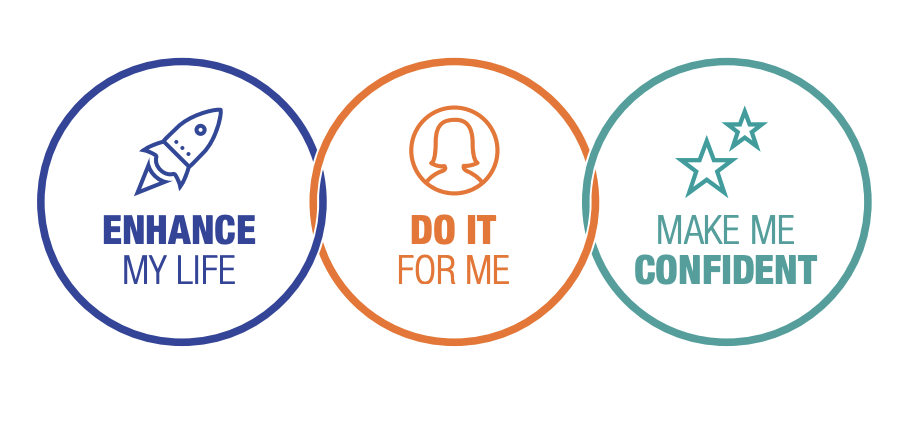
As professionals in the innovation space, we are constantly surrounded with new ideas - products, services and business models. We’ve witnessed technology enable changes in consumer behavior at a much faster pace than we have ever seen in the past. This made us curious to dig deep and understand the motivations behind the adoption of digital innovation and what makes them stick. This led us to the three key principles of behavior change:
1. Enhance my life - Simplify a process that is loaded with friction to make it easy and seamless, so I can focus on my priorities – family, health, and well-being.
2. Do it for me - Solve a problem or meet a need all the way i.e., provide solutions, not just content.
3. Make me confident – Allow me to see every step of the process from the point I place an order until it arrives on my doorstep, inspiring confidence.
The fact that these principles are focused on consumer behavior, rather than any specific innovation, make them a versatile tool that can be used to evaluate any type of innovation – product, service, or business model. We used these principles to unpack product subscription models in 2019 and we leverage them again to see if the motivations have changed over time.
ENHANCE MY LIFE
The key benefit of product subscriptions is to enhance your life by making it easy to get the products you need or want so you can focus on other things. In our research 70% find the replenishment model convenient and 52% agree that it allows them to focus on things they care about.
People also understand how the subscription box model is geared towards enhancing their lives with 59% finding it convenient.
Performance of both replenishment and box subscriptions remains strong on this dimension given the inherent benefits align with the need of the hour. However, as the pandemic restrictions lift, the needs will also change with less emphasis on convenience for some categories and more on the overall experience of shopping for others. While people may continue to subscribe to household goods, categories like home design which benefit from an in-store experience will likely suffer from lower subscriptions unless the virtual experience is enhanced further.

DO IT FOR ME
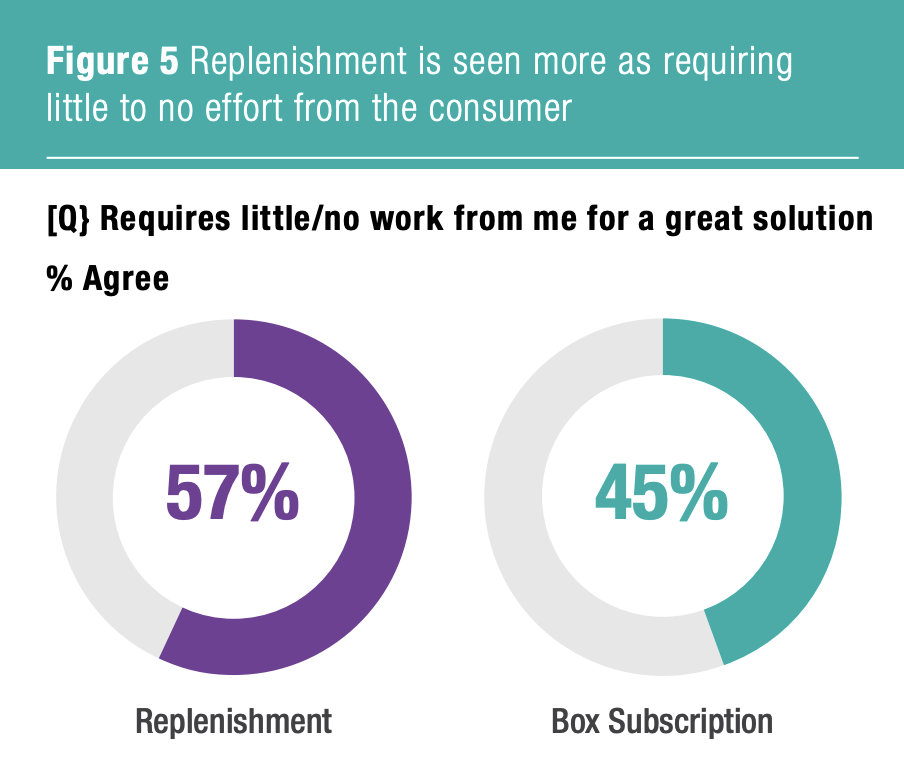
Replenishment models inherently deliver on “do it for me” by ensuring products are available when you need them. 57% believe replenishment requires little to no work from them for a great solution. On the flipside, 17% have not used a replenishment service due to concerns of storing too many products. Overstocking concerns can be alleviated with smart technology that replenishes based on usage. Many companies including Amazon are pushing forth with this strategy with products like the Dash Smart Shelf.
Box subscriptions are powered by curation or careful selection of just the right products. Technology-enabled curation elevates the experience, allowing companies to understand your preferences to help you explore new possibilities. Netflix, Spotify and other entertainment companies curate content based on your choices and ratings. For physical products, curation may take the form of new recipes with ingredients tailored to your dietary preferences, delivered to your doorstep or new personal care products based on your likes.
Only a third believe that box subscriptions will get better with use. The lack of confidence in curation we noted in the past, remains as-is, along with the perceptions of box subscriptions being unnecessary and gimmicky. Despite being convenient, time-saving, and useful overall, the box subscription model still fails to convince consumers of its’ value proposition and is considered "Trendy". As pandemic restrictions lift and people return to stores for experiences like consulting with a make-up artist, box subscriptions will likely see a decline in usage.

MAKE ME CONFIDENT
Inspiring confidence is an entry requirement for technology and experience-led innovation. Often this is achieved by creating visibility into the process; e.g., the ability to see a delivery driver on a map. People understand how replenishment services work, but confidence is also strongly related to the money you pay - knowing you’ve paid a fair amount and haven’t been charged unnecessary fees. Overall, these barriers remain in place with 32% concerned about extra fees and 19% concerned about the price they would pay. However, there is also a sign of a subtle shift occurring in consumer behavior – the number of people pointing to the inability to compare prices dropped from 19% to 8%. There could be several reasons for this shift – increased transparency offered by companies at sign-up, people caring less about bargain shopping in the current context or simply giving up due to the overwhelming availability of options.
Regardless of the underlying reasons, concern about price has lowered for subscriptions boxes from 32% to 23%. In addition, 47% consider subscription boxes a safer way to shop during the pandemic. They are still however, not willing to give up control on selecting their own products (steady score of 69% vs. 68% previously). The inherent experience of surprise and delight remains less valuable to people than confidence gained from selecting their own product. The need for confidence trumps the possibility of delight, giving replenishment models an edge over box subscriptions. Our data shows the likelihood of continued use beyond the pandemic is 41% higher for replenishment services than subscription boxes.

THE WAY FORWARD
In our experience, successful innovations achieve all three principles – “enhance my life”, “do it for me” and “make me confident”. Excelling on only one or two rarely leads to success. While the pandemic has accelerated usage of subscription models, the deep-seated motivations show little change.
Replenishment and subscription boxes continue to be challenged on value. Value is the magical balance between benefits perceived by the consumer when weighed against the price. Achieving the right balance is much harder for companies that need to report profit to their shareholders, which is not a concern for start-ups. While people may have moved past the need for comparison shopping – possibly temporarily, a long-lasting relationship requires trust. 75% in UK trust their delivery drivers, the same level of trust they place in care home workers. Can they place the same level of trust in your subscription offer? Trust that they will not be charged hidden fees, that they will pay a fair price and the products they receive will deliver on their expectations, all with a seamless experience.
The need for convenience during the pandemic has allowed a new lease of life to product subscription models, but convenience alone will not be enough to sustain them in the future. As the previous declines indicate, people will cancel their subscriptions. Subscription models in services such as entertainment and financial services enjoy higher retention once they have established a user base with auto-payments in the background. Retaining a new user base for a product subscription will be much more challenging as the arrival of a box at your doorstep each month is a significant reminder of the money going out of your bank account.
Now is the time to revisit the value proposition and strengthen consumer confidence, and to listen attentively to consumers while you have their attention. Understand the user experience and the deep-rooted emotional context. Shopping is not a simple act of acquisition. In general, it is associated with satisfaction, happiness, social connections, excitement and even a sense of achievement. A subscription model may not be able to deliver on all of these, but it helps to think about what customers are seeking, to create emotional connections through memorable experiences. For replenishment models, this involves understanding the shopping journey for your product in context of a shopping trip. While a smart device with auto-replenishment can solve for one product, it may not eliminate the need for a shopping trip. Will consumers spend the money on that smart device if they can easily replenish during the necessary shopping trip? For subscription boxes, it is time to elevate the experience. To infuse emotions beyond just surprise and delight into the experience, to retain subscribers as we return to less restrictions and less distance between people and products.


