
Bringing the patient voice to the fore
 Empathy in doctor-patient relationships has been debated and examined for a long time, with an understanding that the better the relationship, the better the outcome for patients.
Research has shown empathy and compassion to be associated with better adherence to medications, decreased malpractice cases, fewer mistakes, and increased patient satisfaction. Its role in improving our health and wellbeing is an important one. However, with the increasing demand on doctors’ time, finding the space and time required to build rapport with patients is not getting any easier.
Add in the move towards consumerization of health and supervised self-care, with patients wanting to take more control over their health, alongside a push towards virtual care and more digitization of healthcare services (accelerated by the pandemic), then the goal of an ideal empathetic relationship between doctors and patients seems like a long shot.
To learn more about how social data can unlock the empathy gap in doctor-patient communications, read our latest paper.
A CASE STUDY IN USING SOCIAL DATA TO UNLOCK THE EMPATHY GAP IN DOCTOR-PATIENT COMMUNICATIONS
Empathy in doctor-patient relationships has been debated and examined for a long time, with an understanding that the better the relationship, the better the outcome for patients. Research has shown empathy and compassion to be associated with better adherence to medications, decreased malpractice cases, fewer mistakes, and increased patient satisfaction.1 Its role in improving our health and wellbeing is an important one. However, with the increasing demand on doctors’ time,† finding the space and time required to build rapport with patients is not getting any easier.
Add in the move towards consumerisation of health and supervised self-care, with patients wanting to take more control over their health, alongside a push towards virtual care and more digitisation of healthcare services (accelerated by the pandemic), then the goal of an ideal empathetic relationship between doctors and patients seems like a long shot.
WHAT IS EMPATHY?
Empathy is:
- Being aware of another person’s feelings
- Understanding, or trying to understand, another person’s perspective
In healthcare, empathy extends far beyond a patient’s medical history, signs, and symptoms. Empathy encompasses a connection and an intuition that includes understanding a patient’s potential emotional concerns that can come alongside their physical complaints.
Working alongside our partner Reach3 , a global social impact organisation comprised of healthcare professionals (HCPs) and industry professionals, we’ve identified insufficient empathy as a key challenge in healthcare and wanted to further explore to what extent this is an unmet need between patients and their HCPs. This topic has become particularly relevant given the rapidly changing healthcare environment, both as a result of the pandemic, changing societal trends in our attitudes and approach to healthcare, and our relationship with doctors.
For example, the Ipsos Global Trends 2020 report shows that although consumers are becoming increasingly conscientious about their health, our data records a note of scepticism entering public views of vaccinations, even as the global push to vaccinate against Covid-19 is well underway.4 Better understanding reasons for vaccine hesitancy in the dialogue between patients and physicians could be a key empathy challenge in the near future.
WHERE ELSE IS EMPATHY CRITICAL BETWEEN HCPs AND PATIENTS IN THE 21ST CENTURY?
Within the Reach thought leadership network, we hypothesised that gaining a better understanding of the attitudes and behaviours that are key to successful patient outcomes is incredibly valuable to physicians. With increasingly limited time to meet and speak with patients, and the move towards virtual care, being able to anticipate how needs might evolve throughout the (changing) patient journey can help physicians pre-empt important questions and concerns. This can help bring more empathy back into the HCP-patient conversation and maintain strong relationships in challenging healthcare systems.
In some countries, particularly those with stretched public health systems, the window of opportunity for HCPs to build rapport and create empathy is becoming narrower as time with a doctor is increasingly reduced.
In the UK for example, the space for HCPs to build rapport and create empathy is becoming narrower as time with a doctor is increasingly reduced. NHS Digital recorded that the average number of patients registered to one GP in 2019 had increased to 2,087. However, the number of full-time equivalent fully-qualified GPs fell by 441 between March 2018 and March 2019. These physicians are under increased pressure to accommodate a growing case load and reduce waiting times, but this often leaves very little time per consultation. Currently, the average length of GP consultations in the UK is 9.2 minutes, one of the lowest amongst economically advanced nations. However, doctors believe most appointments should last at least 15 minutes according to the Royal College of GPs, which has called the current system “unfit for purpose”. In self-pay systems like the US, consultation times are typically longer, but the move to virtual care is still very much in evidence.
The project was not only important to demonstrate the numerous situations and settings in which an empathy gap can be created (helping inform how to create solutions to deal with this), but also how social data, where people interact and share authentic, real-time experiences, can provide rich data in terms of both quantity and quality.
THE APPROACH: SOCIAL INTELLIGENCE ANALYTICS
We used Social Intelligence Analytics (SIA) to mine consumer generated content on social media (Twitter, Instagram, YouTube and Facebook) as well as various public online forums. Then, using humanised machine learning and qualitative analysis frameworks, we were able to discover insights and create engaging stories.
Using social data worked across multiple levels for this study as a way to pull together many of the different ingredients that are influencing healthcare today; the digitisation of health and availability of information online, the increased use of social media and online platforms to share experiences of healthcare, in addition to the push towards virtual consultations and increased experience of using digital platforms to converse with doctors.
We know from experience that people use different social media sources for different reasons. For example, forums are often used to share and gain advice, whereas Instagram and Twitter are often used for shorter form posts and a way to contact others and boast or share about their lifestyle.
We used Synthesio, an Ipsos-owned social monitoring tool, to harness patient stories from those different sources.
With the mind-blowing volume of internet traffic generated on a daily basis via websites, public forums, social media etc. (around the world there are 4.14 billion active social media users and they spend an average of 2 hours and 24 minutes every day on social media and messaging apps), the scope of the query is important to generate the most relevant content.
To refine our approach, we focused specifically on the US as a self-pay healthcare system, using this market as an example (based on level of content and size of market) to understand the patient-doctor relationships in this type of environment.
Our team of SIA experts ensured posts including relevant terms, such as ‘my GP’, ‘my nurse’ or ‘my doctor’, were included to provide a relevant collection of data where people discussed personal experiences involving a medical professional.
We applied a bottom-up topic modelling approach to first identify key themes emerging from the data. Within this data set of 18,000 posts in the US (ranging from general health forums, specific disease related forums, health and wellbeing forums, mum and baby groups, Facebook and Yahoo), approximately thirty topics emerged from the bottomup approach. The next stage focused on diving into the revealed topics, with human analysis supported by analytical frameworks to unpick the emotions and motivations behind the themes, and identify emerging trends.
WHAT IS DRIVING PEOPLE ONLINE TO SHARE THEIR HCP EXPERIENCE?
To understand the context of these conversations fully, our first question was ‘what’s driving these conversations online?’ Everyone in the dataset had been in contact with a HCP, but still looked for the advice or opinion of others. Across all 30 topics emerging from the topic model, we identified five core themes showcasing unmet empathy needs: uncertainty, availability, validation, sharing and belonging.
UNCERTAINTY
With health-related issues there is often uncertainty, confusion, or questions that arise at any time when someone does not have access to a HCP. People, therefore, are seeking answers from others online to help put their mind at ease or look for reassurance.
AVAILABILITY
Unlike the physician’s office, the internet is always on, and social networks are open 24-7. People look for quick answers to relieve their worries and questions that might keep them up at night, using forums, networks and blogs, allowing them to seek out others who share their concerns.
VALIDATION
Finding peers who share or understand our concerns creates a sense of validation that we are not alone, particularly when people feel their concerns were not heard or understood by a HCP. This helps people feel listened to and fulfils this emotional need.
SHARING
Many people choose to share their experiences online for the benefit of others who may have struggled to find answers while going through the same health challenges. Often the HCPs we speak with are unlikely to have experienced the same situation compared to others having the same health issue.
BELONGING
Group thinking and behaviours can also be a powerful driving force, especially when checking symptoms to determine what’s normal or what needs attention. Knowing what others are thinking, saying and doing helps us navigate our own difficult or uncertain journey.
THE EMOTIONAL PATIENT NEEDS BEHIND CONVERSATIONS
From our analysis, we explored significant emotions that dominated the dataset, the main ones being worry, confusion, fear and sadness. Seeing supportive examples of how these feelings can arise between patients and their HCP and identifying where empathy can help close the gap.
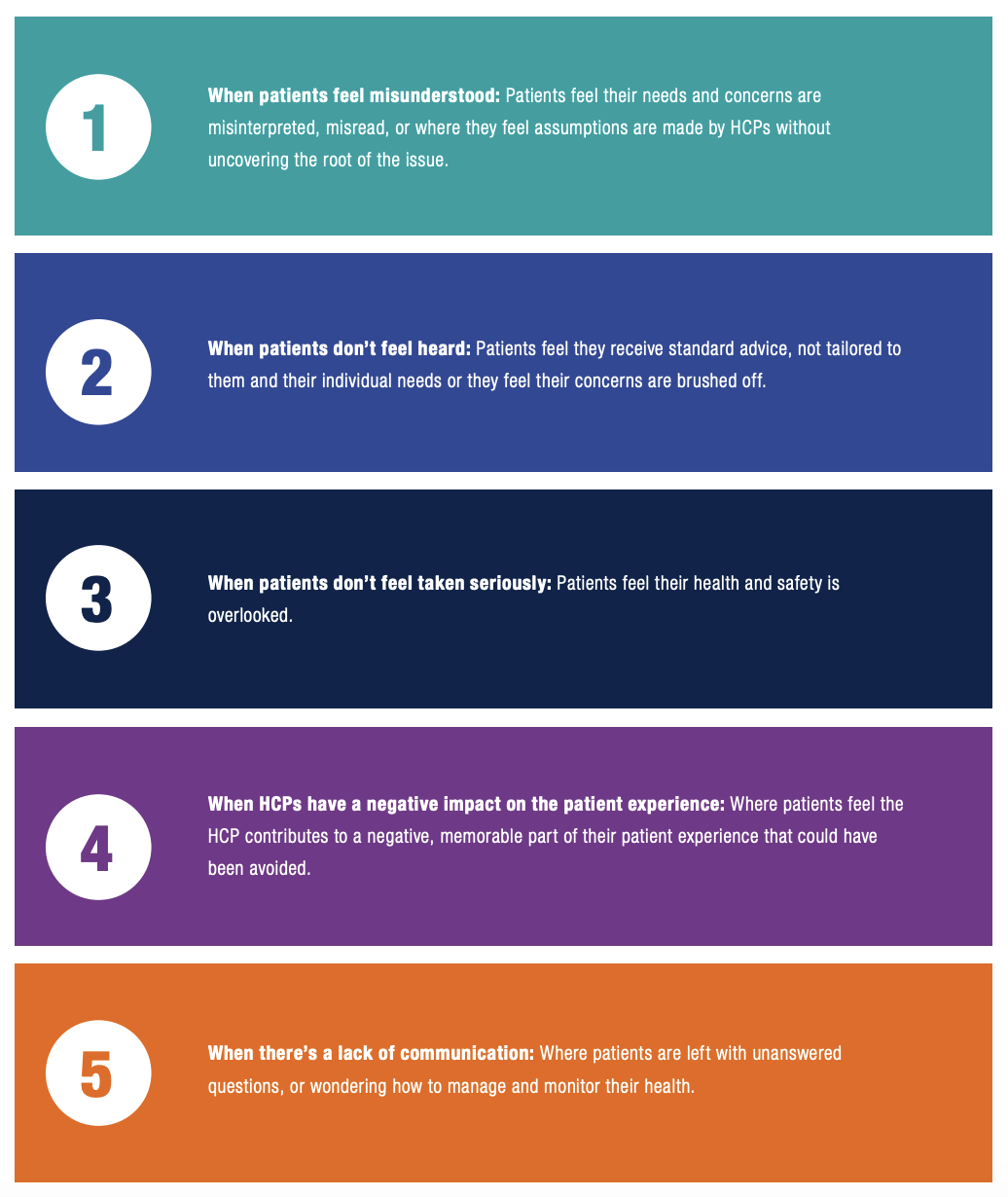
These situations result from a lack of empathy as to how a patient is thinking or feeling and can compound problems for the patient (and therefore the HCP). A feeling of disconnect or unmet expectations leaves the patient feeling disappointed in the care they are receiving.
WHY AND HOW SOCIAL INTELLIGENCE HELPS TO UNDERSTAND THE EMPATHY GAP OVER OTHER RESEARCH METHODS
Social content provides real-time authentic thoughts and feelings from consumers and HCPs, allowing us to unpick these through the analytical frameworks described. SIA provides an efficient way to mine insights using the existing resources.
By utilising text analytics and human qualitative analysis, we are able to effectively analyse ‘big data sets’ but still understand the emotion and sentiment involved (which historically was the domain of small-scale qualitative research). This demonstrates the intersect between where the conversations are happening, healthcare becoming more ‘digital’ and gaining real insight, plus quantity of data.
WHY IS SIA IMPORTANT FOR THE FUTURE OF HEALTHCARE RESEARCH?
The patient journey is changing. How we interact with healthcare systems and providers and how we manage our own health is evolving as the world continues to change. Our health will be monitored more and more outside of the doctor’s office via digital devices, virtual care and digital therapeutics. Doctors will only see and hear some of these experiences. The pandemic has also thrust even more people online to search for answers and discuss with each other, so now is more important than ever to be understanding what people are saying online to know how patient groups can be better supported.
We’ve seen that people are turning to the internet to share experiences and express their feelings on many topics including health, treatments, perceptions of disease and experiences. This authentic, in-the-moment data source will drive increased understanding of patient journeys, customer profiles, unmet needs, influencer mapping and market landscapes, which in turn allows healthcare business partners to create the best products, tools and services to support them on their journey.

![[WEBINAR] TOAST 2026: Under Pressure - Fewer, Fragmented, Fought-For](/sites/default/files/styles/list_item_image/public/ct/event/2026-07/thumbnail-templates_1_0.png?itok=MxL-wPJW)
