
Framing With Competitive Context
It is an exciting and wildly growing field of study, with many implications for society, institutions, business and even our personal lives.
Integrating BE into your concept testing will help you make better decisions on which products have the greatest potential because you are more realistically reflecting the way that consumers make decisions in the real world. In this brief article, we will discuss how traditional approaches to concept testing ignore one of the most important findings in BE, the implications of ignoring it, and how Ipsos' approach to concept testing best applies this key principle of BE.
The Framing Effect
One of the key pillars of BE is called the framing effect1. Essentially, how you say or ask things - the context in which the question occurs - is hugely important in determining the response. The classic example of this is two different descriptions of the exact same thing, which are both 100% true:
Q1. Would you like to buy a hot dog that is 90% fat free?
Q2. Would you like to buy a hot dog that is 10% fat?
As you might expect, the vast majority of consumers would endorse a 90% fat free hot dog, while only a small fraction would endorse a hot dog that is 10% fat. But these are the same thing. As noted by Lichtenstein and Slovic, individual choice depends on the context in which choices are made2.
Clearly, framing has a huge impact on consumers' decision making, and marketers intuitively "get" the whole notion of framing as they position their products. If marketers are adept at using the framing effect to help sell their products, why aren't we as researchers using the framing effect to improve our data to better reflect how consumers actually make choices?
Ignoring the Framing Effect
Unfortunately, most approaches to concept testing completely ignore the framing effect, its impact on consumers taking the survey, and its ramifications for results and business outcomes. Let's consider how consumers make choices for new products: first as it relates to concept testing, and then, in the real world.
In the world of concept testing, consumers see a new product idea in isolation. Consumers indicate their willingness to purchase an item without any reference to other available products or to the product(s) they might currently use to fulfill that need. Those results are then typically compared to a database of other concepts in that category (all of which were also evaluated in isolation without any reference to existing products) to determine whether or not the results are "good."
In the real world, consumers aren't evaluating products in isolation, and they certainly aren't comparing it to a database of concepts. When they see a new product on the shelf, they are comparing it to the product(s) that they are currently buying.
In the world of concept testing, the absence of any framing is conspicuous. In the real world, the presence of framing is ubiquitous. For proof, just take a look at the shelf the next time you are at the store.
Avoid Wrong Decisions
To understand the impact of ignoring the framing effect and to illustrate how framing with alternatives impacts consumer preference, let's start by looking at a classic BE study3 evaluating music dictionaries:
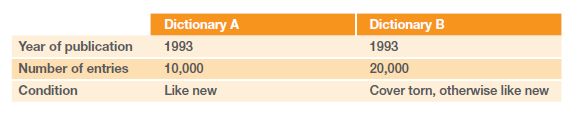
When the dictionaries were evaluated in a monadic design (two groups of respondents each of whom see only one of the dictionaries), the results clearly indicate that respondents prefer Dictionary A over Dictionary B. However, when Dictionary A was evaluated in competition with Dictionary B, respondents overwhelming chose Dictionary B. The monadic evaluation, without explicitly framing the choice of an available alternative, provided the wrong decision.
Now, we will apply that same thinking to a concept test for a new line of single serve yogurt:
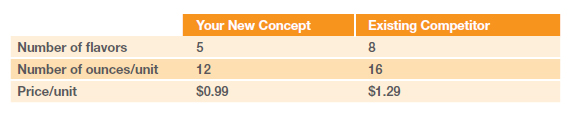
In a monadic evaluation, your new concept could do just fine and you would move the initiative forward with additional investment of time and money. But that evaluation is based on a comparison to a historical database of concepts, not real-world products. What if the comparison was framed around the current, existing competition? Would you get the same results? How many times has one of your concepts passed through and launched, but ultimately had lackluster results in market because it didn't beat your competitors?
One historical approach to this issue of competitive context is to include a "benchmark" concept of one of the current market leaders. While this is admirable as an attempt to understand a concept relative to a competitor, it ultimately fails for two reasons: 1) these are still typically conducted monadically, lacking an explicit comparison to the competition, which opens oneself to errors like in the music dictionary and yogurt examples, and 2) across almost every category, the competitive context is so diverse that any single benchmark only represents a meaningful comparison for a fraction of the respondents.
Finally, some might argue that - even in the absence of an explicit comparison - consumers intuitively compare your concept to what they are using today. To that, I would say (and which is very well documented within BE), humans are cognitive misers: unless we have to, or are directed to, we use the least amount of our brains' processing power as possible. So many, if not most, consumers would not be making that comparison. Even if some of them are comparing your concept to what they are using today, you do not know which ones or what percent of them are doing so.
Framing with Competition - The Ipsos Way
The Ipsos approach to concept testing, by explicitly framing evaluation around the competition, ensures that your concept test is reflecting the reality of pre-existing behavior and context of choice. It also reflects the reality of diverse categories, loyalty and individual behavior - essentially, each respondent is providing his or her own individual benchmark.
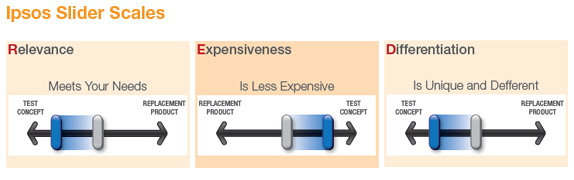
Now, let's go into a bit more detail about the approach. After consumers are exposed to the concept (and before providing any ratings on the concept), they are explicitly asked to think about what they might be currently using to fulfill the need addressed by the concept:
After priming consumers to think about the product they are using today, we ask consumers to evaluate the concept relative to that product, explicitly framing their evaluation against the exact competition you will be facing for each individual respondent . This mirrors the real world decisions that consumers will make once your product is launched. Examples of this type of question can be seen to the right, but note that "test concept" and "replacement product" are replaced by the actual concept name and current product name for each individual and that anchor placement is rotated.
After collection, we compare your results to our robust database, which contains tens of thousands of such relative comparisons. So, not only are you best reflecting consumer choice by applying the BE principle of framing, you can also have quantitative confidence in the chances your product will succeed in market.
Conclusion
Addressing the framing effect should be part of any concept test. By explicitly creating a competitive frame of reference, one can feel more confident that their results are accurate because they mirror the reality of human decision making and choice. Unfortunately, most other concept testing approaches (including the one most widely used today) come up woefully short by blatantly disregarding the impact of framing and opening themselves up to the type of error seen in the music dictionary and yogurt examples.
While this paper has focused on concept testing and the importance of framing, providing an appropriate context isn't only important when testing concepts. Framing plays a role in all consumer research, even when we don't intentionally provide that framing for the consumer. That's why it's always important to think consciously about the context you're providing to consumers. As more than amply documented in decades of BE research: choice depends on the context in which choice is made.
Learn more about framing your concept tests by joining me for a complimentary webinar on December 10.
1 Kahneman, D. (2011). Thinking, Fast and Slow. Farrar, Straus, and Giroux, New York. 2 Lichtenstein, S. & Slovic, P. (2006). The Construction of Preference. Cambridge University Press. 3 Hsee, C.K. (1996). The evaluability hypothesis: An explanation for preference reversals between joint and separate evaluations of alternatives. Organizational Behavior and Human Decision Processes, 67, 247-257.

![[WEBINAR] TOAST 2026: Under Pressure - Fewer, Fragmented, Fought-For](/sites/default/files/styles/list_item_image/public/ct/event/2026-07/thumbnail-templates_1_0.png?itok=MxL-wPJW)
