
Will we grow food in the future?
What happens in a world where we can create food ingredients normally found in plants and animals?
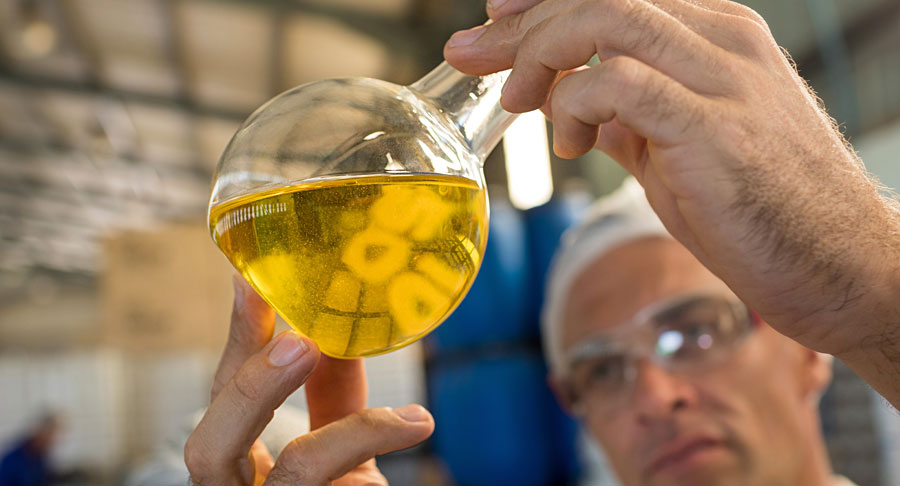
Casey Lippmeier is moving us toward that future at Conagen, a synthetic biology company that uses precision fermentation, like the process used to make beer or yogurt, to expand the possibilities of our food system. That technology has applications for innovation, sustainability, reducing food waste and more. When he thinks What the Future, he’s thinking way beyond just re-creating things that already exist in nature.
Matt Carmichael: In terms of regulation and labeling, to what extent is your work considered “natural,” since you’re synthesizing botanicals and things found in nature?
Casey Lippmeier: “Natural” is a funny term. There’s a colloquial definition, there’s a scientific definition, and there’s a political definition. That can make it confusing. There is no legally codified definition for “natural” as it applies to food products. It’s more driven by advertising and marketing and consumers themselves, by what they’ll accept. In our experience, and other industries seem to agree with this position, if it’s made with biology, then you can call it natural.
Carmichael: I was reading about how you’re synthesizing rosemary for use in sausages and as a preservative. If you need to grow less of a thing to get the ingredients or the flavor or the benefits out of it, that seems positive for the environment, right?
Lippmeier: It absolutely is. And it’s a big part of the selling point to synthetic biology. If you start doing the math, the valuable molecules that are derived [in the lab] from rosemary take up less than 0.001% of the total biomass of the original rosemary plant. That [saves] a lot of land to make very little product. Synthetic biology is great for being able to source things that are extremely rare. We can supply rosemary’s rosmarinic acid as a 99% pure product for use as a replacement for artificial preservatives. And it’s one that by industry agreement we can refer to as natural.
Carmichael: Are we at a point where the line between food and “supplement” starts to blur? Can we make superfoods where we take a probiotic or an antioxidant or a vitamin and include those in, say, lasagna?
Lippmeier: The short answer is yes. Most vitamins are made by synthetic biology these days, rather than by extraction from a source organism, like a plant. It’s probably going to appear in a component of lasagna, in the cheese or in the pasta or something like that. You already see that, right? All flour in the world is fortified with folic acid.
Carmichael: Does your work lead us toward a future where food allergies are a thing of the past or at least greatly reduced?
Lippmeier: Infants aren’t born with their own immune systems. They acquire their immune systems from their mothers and over the course of the first 1,000 days of their life. We have molecules we’re working on right now to specifically address that food-allergy problem, and even more specifically to do so in those early stages of life.
Carmichael: How do you convince people this is all safe?
Lippmeier: Food is difficult. It’s not like pharmaceuticals where everything is driven by clinical evidence, and you accept that there are sometimes nasty side effects. We don’t tolerate side effects in food, unless you’re talking about alcoholic beverages, I guess. We use science to drive the ingredient creation. We use science to drive the food formulation itself. But when it comes to what people are reading on the back of the label, they want to feel comfortable by it by their own metrics.
Carmichael: Since what you do is essentially fermentation with cooler toys, is it something that eventually becomes sort of home-brewable?
Lippmeier: It already is! There’s a group called the Baltimore Underground Science Space. It is a fully staffed, fully equipped synthetic biology lab that is community funded and has its doors open primarily to young student investigators.
I mentored some students that were very tuned in to the problem of pollution from the textiles industry. They wanted to come up with a sustainable, nonpolluting dye for blue jeans to replace indigo. They made a bunch of fabrics out of it, and they showed it at New York’s Museum of Modern Art.
Carmichael: As someone who is not in this space, is there something cool going on that I’m not asking you about that I should be?
Lippmeier: There was an inspiring paper recently from Google. It refers to something called the AlphaFold project that basically used Google’s massive computing power to unleash an artificially intelligent algorithm onto the problem of predicting the structure of proteins. [Lippmeier excitedly nerds out for a while explaining this.]
Carmichael: Is that a time- or a money-saving moon landing? What does the ability to predict the protein structure change for you?
Lippmeier: Instead of having 10 Ph.Ds dedicating 20 years of their lives to figuring out how the enzymes of a certain mysterious biochemical pathway work, we have Google saying, “Oh, it works like this,” in five minutes or less.
Carmichael: Right. That is a time saver.
Lippmeier: But then what is the next step? There are chemistries out there that are hypothetically possible. We have no way to arrive at them in a practical way. But with the ability to predict these structures and then extrapolate an activity from them, you could imagine that this AI could work in reverse.
You ask it, “Hey, here’s a chemistry [experiment] that I would like to perform to design an enzyme that doesn’t exist in nature.” That tool shouldn’t be so far away. That opens a universe where suddenly we can do any chemistry that anyone could ever imagine, on demand by computer prediction, basically. That will open a wild, new frontier. We will have mastered a level of control over the environment that was just unimaginable.
Carmichael: And then what happens?
Lippmeier: What happens when we’re masters of the universe? I don’t know. I mean, at that point, we’re going to have to start getting into beaming our consciousness across space and time. I mean, that’s the only thing I can imagine beyond that.

![[WEBINAR] TOAST 2026: Under Pressure - Fewer, Fragmented, Fought-For](/sites/default/files/styles/list_item_image/public/ct/event/2026-07/thumbnail-templates_1_0.png?itok=MxL-wPJW)
