
Back-to-Screens Accelerates Opportunities
Recent school closures amid COVID-19 have caused screens to replace not just books, papers, and homework, but also the physical teacher-and-student learning environment. This seismic shift in education systems already has increased at-home screen time —
both for education and entertainment — opening a new chapter for creative content and brands as they compete for the attention of children and co-viewing families. As back-to-school will mean back-to-screens for many kids this fall, we expect this growth opportunity for content and brands to continue, if not accelerate.
Online learning is becoming the new norm
A 10-year longitudinal study, the Ipsos Kids and Family Study indicates that this past spring’s quarantine accelerated a trend towards online learning among kids. Over the past three years, the proportion of kids ages 6 to 17 using the internet to do schoolwork increased from 38% to 41%, and that growth jumped to 47% by May 2020.
Already, almost a third of kids ages 12 and under have education apps on their phone, rivalling social media and video chatting. Among kids who listen to podcasts, nearly one in four listened for education/information content in spring 2020, up from 18% in fall 2019.
Now that screens are increasingly the primary source of education for millions of children and teens, digital content platforms have a growing audience eager for quality content to fill the gap left by an educational system struggling to adapt to a COVID-19 world.
School-from-home presents new opportunities for entertainment
Beyond the jump in educational screen-time brought on by the pandemic, the added time at home increases kids’ and families’ desire for entertainment. The Ipsos Kids and Family Study shows that during the pandemic lockdown, families watched an average of seven hours of streaming video a week: a full hour more than a year before.
There was also a substantial, though less dramatic, jump in consumption of live TV and video-on-demand content. As homes are converted once again into virtual schools and workplaces this fall, we expect to see a spike in video co-entertainment consistent with the uptick that followed COVID’s emergence in the spring.
Families gather around screens, but kids control the remote
The pandemic brought families together around screens like the campfires of old, but the new relationship between parents, kids, and screens will persist in the post-COVID world.
Notably, over the last year, 50% of families consistently participated in shared media time watching the same content, Ipsos Kids and Family research shows. This co-viewership remained strong through the pandemic, and kids increasingly drove the family’s content choices.
During this spring’s lockdown, parents were significantly more likely to pay for entertainment and educational content for their children than they were the year before.
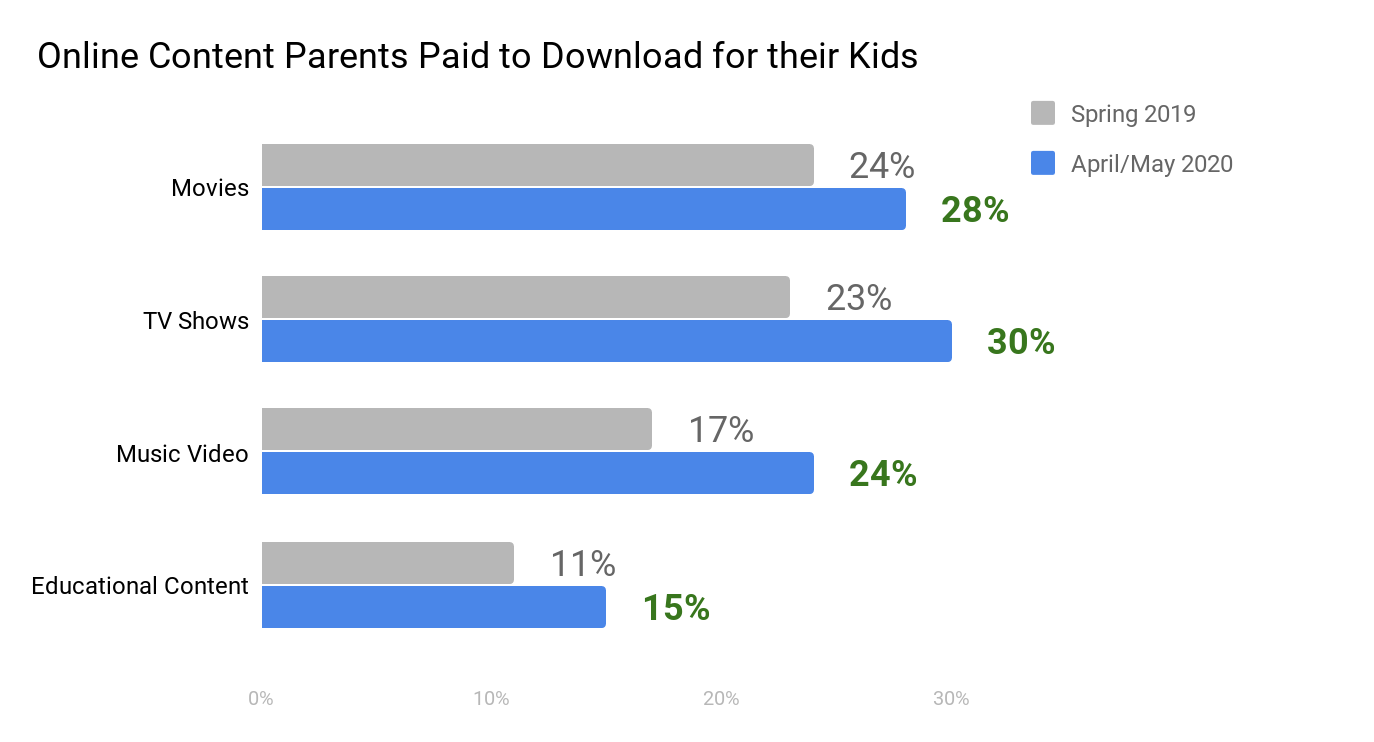
Green = higher than the previous wave at the 95% confidence level
Furthermore, 72% of parents said they frequently purchase products their kids request after seeing an online ad.
With kids staying home this fall, we anticipate their influence on content choices and purchase decisions will continue to grow. This presents an opportunity for brands to distinguish themselves with content that meets the needs of co-viewing parents and their kids.
Kids are turning to short-form videos and cartoons as families watch together
So, what type of content will kids seek out? Kids ages 6 to 17 prefer streaming short-form content, topped by funny videos (66%), followed by music videos (44%) and video game videos (39%). Cartoons on streaming sites are popular with 38% of kids.
With co-viewership on the rise, these platforms will need to emphasize content that appeals to both parents and kids. Programs that bridge the gap between education and entertainment will be especially important in alleviating parents’ concerns about growing screen time.
Responsible content and advertising are critical
During COVID-19 lockdowns, for many parents, permissiveness has given way to comfort with this increased screen time.
Since both parents and kids have demonstrated their desire for enriching entertainment and educational programming, for brands, this is a golden opportunity. However, it is critical that brands approach content and advertising both responsibly and authentically.
“Situational relevance in advertising communications can go a long way to connect with parents and kids. Acknowledge that families are adjusting day-to-day and understand how that impacts the way parents and kids engage with and purchase your brand,” adds Virginia Lennon, senior vice president, media development.
Parents’ oversight and attention to the content their kids are consuming will likely increase as families move inside for the colder months and co-viewership becomes the norm. Brands will need to be thoughtful in the content and advertising they are presenting to kids, focusing on content that parents and kids can enjoy together.
![[WEBINAR] How winning brands are making themselves essential in a tight economy](/sites/default/files/styles/list_item_image/public/ct/publication/2026-09/thumbnail-templates%20demo_3.png?itok=0YmowUKN)

