
Ipsos U.S. Hispanics: the future is here and it’s not acculturated
Seeking to understand U.S. Hispanic groups brings with it its share of challenges. It is important not to just think about Hispanics through the traditional cultural lens. Within each of the disparate groups, there is a unique history and inter-connection to earlier generations that influences an individual’s engagement in American society today. This is further enriched because it is intertwined with a unique generational point of view tied to generational mores and norms. Understanding U.S. Hispanics is multi-layered and complex.
As an example, in the case of Millennial and GenZ U.S. Hispanics, relevance isn’t only viewed through a Latino cultural lens. The desire for inclusive content and communications may start from their own cultural identity, but then goes beyond just reflecting “me,” and more towards reflecting their larger generational and friend groups. As we outlined above, Latino consumers draw influence from the various cultures in their lives (thus the name hypercultural).
In an Ipsos study among Millennials, we found Latino consumers were most influenced by U.S. Latino culture and were more likely than non-Latino Whites to be influenced by their generational and online social cultures as well.
Understanding the diverse U.S. Hispanic groups is complex and not to be underestimated. Download our latest paper for insights exploring exciting changes that have led to a new future outlook and the need for marketers to root their engagement in the reality of today’s hypercultural Latino.
As one of the world’s pre-eminent market research companies, Ipsos conducts research across a range of countries, population groups and industries. In the U.S., this includes a continuous dialogue with multicultural consumers to ensure our clients’ diversity and inclusion efforts are rooted in cultural insights to foster effective brand activations. One of the most interesting consumers to engage with is the U.S. Hispanic community.
THE FUTURE
Much has been written about U.S. Latinos as a vibrant consumer group.
The promise they hold for marketers is consistently told through future growth projections, e.g., “Hispanic Americans will account for more than 40 percent of all population growth in the next 60 years” signaling that in the years to come, Latinos will increasingly be an important consumer target.
What’s interesting here is that the above is a quote from a 1992 New York Times article! The demographic has been highlighted as an opportunity for years and to a large extent, the case has proven out.
Growth has been and will continue to be realized NOW!
Consider some of the following facts:
The number of Hispanics in the US exceeds 60 Million and accounts for 19% of the current U.S. Population.
- This is a larger group than the total populations of whole countries like Spain (46.5M), Canada (37.7 M) and Australia (25.7 M)
U.S. Hispanic buying power in 2018 was $1.5 trillion.
- This is larger than the GDPs of Mexico & Australia and bigger than the economies of all but 14 countries in the world
This group is also the youngest racial or ethnic group in the US. Latinos had a median age of 30 in 2019. Whites had the highest median age nationally – 44 in 2019.
- Asian and Black Americans had median ages of 38 and 35, respectively. U.S. Latinos represent the largest portion of the youngest demographic group- 38% of 0 – 21-year-olds in the US are of Hispanic descent. At 28% of the total population, 0-21-year-olds are the largest demographic group in the U.S.
U.S. Hispanic population growth and buying power projections from over the past 30 years have proven true. While the stats speak for themselves, when it comes to U.S. Latino self-identification and representation, the NOW looks a bit different than many might have predicted.
THE FUTURE IS NOT ACCULTURATED
Back in 1992, Latinos in the U.S. were typically expected to be on a road towards acculturation… some began their journey of acculturation by immigrating, many others by being born in the U.S. to immigrant parents. U.S. Hispanics would travel a straight, but often bumpy road which led to their becoming an “Acculturated American”.
But the straight road to becoming “American” began to change. The length of the journey got shorter. The end point “Americanism”, actually started to erode as traditional U.S. culture began to reshape itself, influenced by Black, Latino and other cultures. The journey to “Acculturation” became a little smoother for Latinos because their own cultural representation continued to increase.
The once thought-of straight road now included cross streets. A series of intersections formed, and a majority of U.S. Latinos chose to embrace different paths on their life journeys. A path where their identity as Latinos was fully embraced from the start, through retro acculturation, or through holding on to their primary Latino culture. This was the road to pride, to activism and to a demand for better reflection and representation.
As if a symbolic celebration of this changing reality, 20 years ago singer Ricky Martin blew the lid off at the Grammys. He was certainly well known to U.S. Hispanics, but fairly unknown to the rest of Americans. He stunned with his performance of La Copa de la Vida (the theme song to the 1998 World Cup in France, and something at the time mostly only Latinos could tell you). This rousing anthem sung in Spanish on live English-language TV spoke to the shift that was happening in US culture.
THE FUTURE IS HYPERCULTURAL
Today’s U.S. born Latino is not yesterday’s U.S. born Latino. Millennials and GenZs in particular feel empowered to draw influence and give influence based on the duality of their cultural identity. And while most feel that speaking Spanish is an important part of U.S. Hispanic culture, it is no longer a primary determinant needed to identify with their culture. In fact, according to PEW, 81% of U.S. born Hispanics say that it is not necessary to speak Spanish to be considered Latino.
So, the future is here, but it is certainly a little different from how marketers might have thought about in the past. Now is the time for brands, marketers, and storytellers to be activating strategies that recognize today’s reality and embrace the current opportunity these consumers offer.
Seeking to understand U.S. Hispanic groups brings with it its share of challenges. It is important not to just think about Hispanics through the traditional cultural lens. Within each of the disparate groups, there is a unique history and inter-connection to earlier generations that infl uences an individual’s engagement in American society today. This is further enriched because it is intertwined with a unique generational point of view tied to generational mores and norms. Understanding U.S. Hispanics is multi-layered and complex.
As an example, in the case of Millennial and GenZ U.S. Hispanics, relevance isn’t only viewed through a Latino cultural lens. The desire for inclusive content and communications may start from their own cultural identity, but then goes beyond just reflecting “me,” and more towards reflecting their larger generational and friend groups.
As we outlined above, Latino consumers draw influence from the various cultures in their lives (thus the name hypercultural). In an Ipsos 2018 study among Millennials, we found Latino consumers were most influenced by U.S. Latino culture and were more likely than non-Latino Whites to be influenced by their generational and online social cultures as well.
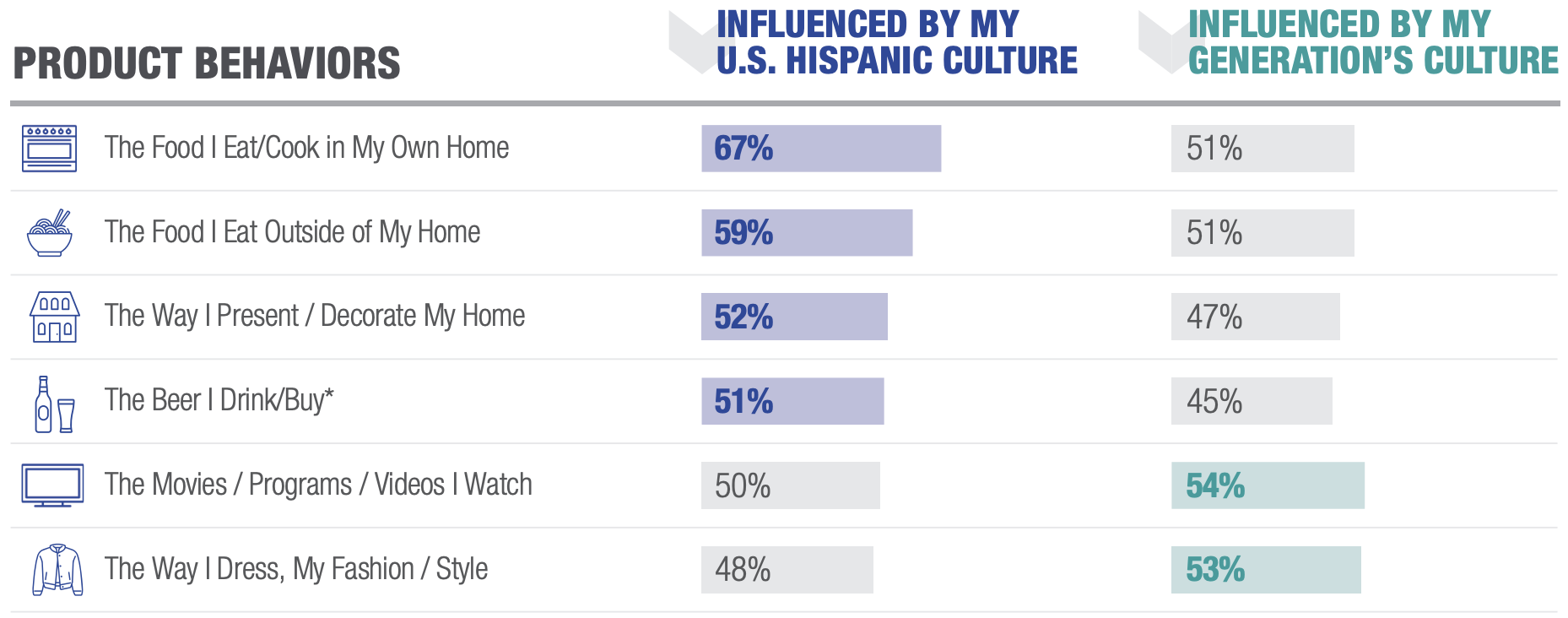
What’s more, if we look specifically at a sample of consumer categories, we can see how this influence can differ. For food, Latino culture is in the driver’s seat. For content viewership, both ethnic and generational cultures have similar influence on Latino Millennials viewership behavior.
Latinx Millennials are Hyper Cultural
Influence You Personally on a Daily Basis
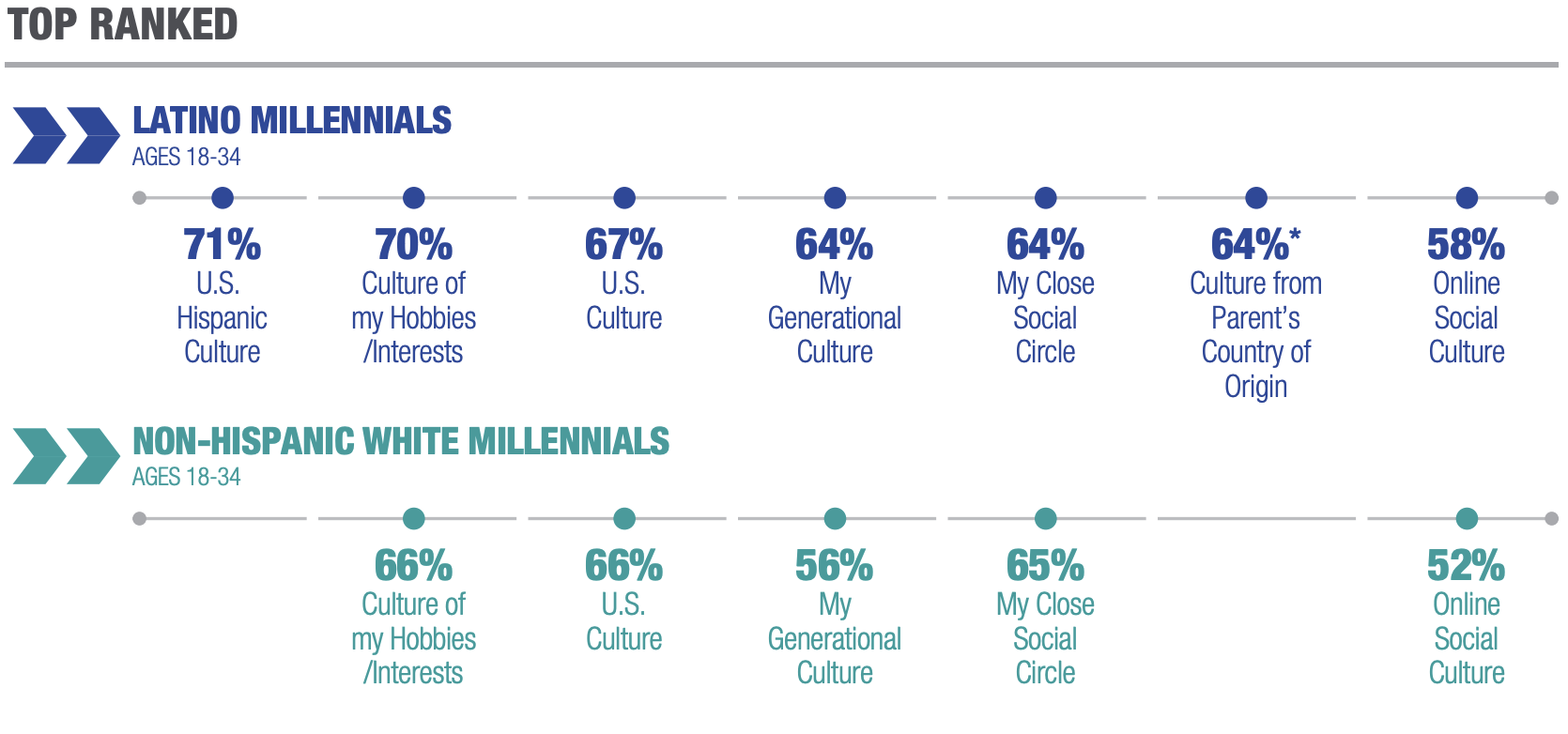
For Latinx Millennials, Looking at Influence Through One Cultural Prism Alone May Not Be Enough
In this example, both their generational and ethnic cultures drive category choices.
The Future is here.
U.S. Hispanics offer a vast and rich opportunity for brands and marketers. Understanding the diverse U.S. Hispanic groups is complex and not to be underestimated. In this white paper, we explored the exciting changes that have led to this future and the need for marketers to root their engagement in the reality of today’s hypercultural Latino. In a subsequent white paper we plan to highlight some of the interesting research challenges posed by this group.

![[WEBINAR] How winning brands are making themselves essential in a tight economy](/sites/default/files/styles/list_item_image/public/ct/publication/2026-09/thumbnail-templates%20demo_3.png?itok=0YmowUKN)
