
Addressing the Sustainability Say-Do Gap
 We know that people care about the environment and feel a sense of responsibility to live in a more sustainable way – Ipsos survey data shows this time and time again. For example, we recently found that 72% of individuals across 30 countries believe that they will be failing future generations if they do not take personal action to combat climate change.
At the same, we are seeing limited and stagnated behavior change in real life. This represents a “say-do gap” when it comes to sustainability – the dilemma that reported concern about an issue is not always followed up with action.
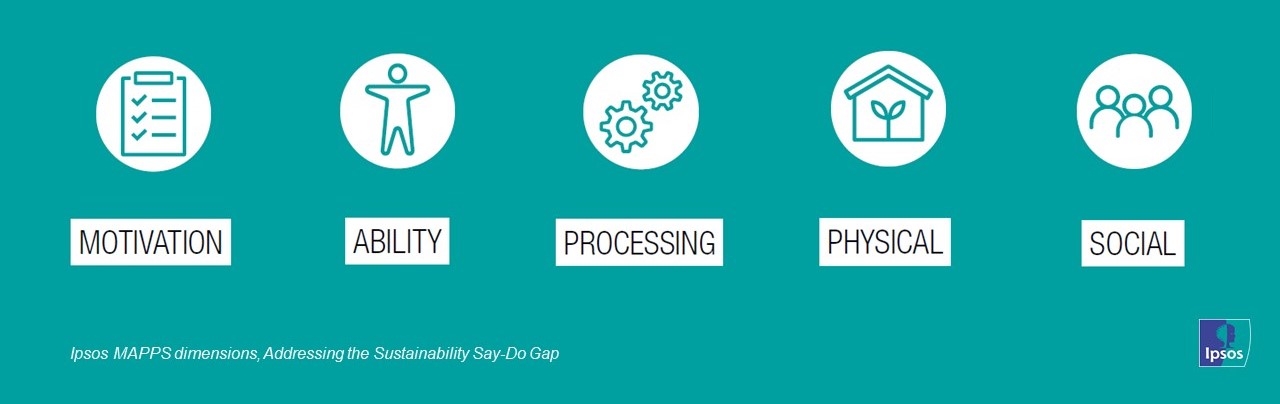
There are many factors to consider as we try to make sense of this. In this paper, we outline some of the key barriers to acting in more sustainable ways, such as recycling or making better product choices. These are grouped according to the key dimensions underpinning our behavior; motivation, ability, processing, physical and social (according to our behavioral science framework MAPPS).
Crucially, action is not only up to the individual. People expect government and brands to take a leading role in tackling climate change and environmental issues. In this way, organizations should act on their duty to close this say-do (or believe-true) gap. We believe this involves gaining a deeper understanding of behavior and encouraging people to take actions that they are already inclined to do.
Read more in: Addressing the Sustainability Say-Do Gap.
THE SUSTAINABILITY DILEMMA
Time and time again, Ipsos polling shows that consumers care about the environment and that sustainability continues to be a priority. On average, 70% globally say they are more worried about the environment now than a year ago and 72% agree that if ordinary people do not act now to combat climate change, they will be failing future generations.1 But are people prepared to act? Much is discussed about the “say-do gap”, the paradox that while stated concern about the environment is high, this does not always translate into action in our day-to-day lives (see Figure 1). Efforts to try to account for this discrepancy are unable to lead us to any satisfying conclusion. And focusing on this dilemma can impede progress on the very issue that we hope to tackle. However, one way forward is to use behavioural science to access a more nuanced understanding of sustainability behaviours. This can lead us to concrete actions and long-lasting solutions. ‘Sustainability behaviours’ refers to a broad spectrum of actions such as recycling, choosing products with environmentally-friendly packaging, driving less, reducing energy use, minimising meat and dairy consumption, and avoiding air travel. Of course, these actions are varied and their relationship with sustainability is complex. Just in packaged goods, for example, a ‘sustainable’ decision could reflect where the product is produced, recyclable packaging, or sustainable production. And each has its own say-do gap. Such decisions and behaviours entail their own challenges, and they are influenced by a variety of factors that must be appreciated. Beyond the say-do gap, consumer behaviour may be influenced by the “believe-true gap” – which points to a lack of understanding about the issues in question.2 In terms of environmental impact, for example, we know that people underestimate high-impact actions such as taking flights and overestimate lower-impact actions such as avoiding excess packaging. After years of seeing limited – and stagnated – engagement with sustainability behaviours despite high and increasing levels of public concern, it seems that more needs to be done to encourage or enable large-scale shifts in behaviour that will more urgently address the climate emergency.

IMPETUS FOR ACTION
Before Covid-19, concern was spilling onto the streets across the world with Greta Thunberg’s youth-led climate protests a strong reflection of this rallying cry from people around the world for action on climate change. While the global public remain divided on whether to prioritise climate change in the Covid-19 recovery, there is strong agreement across countries that industry and government will be failing consumers and citizens if they don’t act now to combat climate change. Our annual Earth Day study shows agreement with this statement holding at two-thirds (68% in 2020 and 65% in 2021, global country average). There is increasing pressure on brands to reduce their environmental impact in a number of ways (e.g. supply chains and investments) but one of the most visible and popular areas of focus is their packaging. Brands are also stepping up to leadership roles in this area. For example, Procter & Gamble’s fabric care brands, including Ariel, Lenor and others across Europe, aim to reduce plastics use in their packaging by 30% by 2025. Reducing packaging is a sensible approach to the sustainability question as avoiding products with a lot of packaging is often recognised by consumers as an action they can personally take. It is a tangible and straightforward task, but even the question of packaging and recycling can be fraught with confusion. Consumers have to navigate over 87 different eco labels in the UK alone, for example.

There are a range of behaviours that have significant environmental impact. But there has been little change in the public’s intentions to take action on these since 2014 (see Figure 3). This situation, when people’s reported concern about a topic is at odds with their behaviour, is the very discrepancy we refer to as the ‘say-do’ gap, and the challenge that we are looking to better understand and overcome.

EXPLAINING THE ‘SAY-DO’ GAP THEORETICAL FOUNDATIONS
Often the explanations of the ‘say-do’ gap within psychology provide a view of humans as fundamentally fragile or unreliable in nature. One of the most common explanations for the say-do gap prioritises the ‘do’ over the ‘say’. Revealed Preference Theory4 holds that consumers’ preferences can be revealed – assuming no economic barriers – purely by what they choose. Many economists adopt this perspective and suggest that “preference can be most reliably inferred not from the answers given to questions in surveys, but from the actual decisions which they make and the actions which they carry out.5” For some, the gap between what people say and actually do means that, in fact, this group of people do not really care about the environment as much as they say they do.6 Another related explanation is that a range of automatic behaviours are shaping our behaviour which we are not aware of. Dual Process Theory, as popularised by Daniel Kahneman7 suggests much of our behaviour is based on the automatic processing of information, and only rarely do we engage in more deliberative processing. From this perspective, addressing the say-do gap would require little more than tapping into these more automatic processes through ‘nudges’ or reforming habits. (More on Ipsos’ take on this later on). A third explanation from evolutionary psychologists suggests that we are, among other things, fundamentally selfish and focused on the present. An individual is the embodiment of thousands of selfish genes trying to self-perpetuate in the here and now. As such, self-preservation drives our behaviour, over what may be the best course of action for the greater good of society in the future. Therefore, given the impacts of climate change are often discussed as a future problem, acting now will not return any immediate reward. These different lines of explanation all provide a bleak depiction of human nature: people can’t be trusted, their thinking is flawed, and they are ultimately selfishly focused on their immediate needs. But these perspectives do neglect the more positive aspects of human behaviour, whereby people are self-reflective, able to manage complex tasks, and can be motivated in pro-social ways. Behavioural approaches that focus on enabling actions that people are already inclined to make can perhaps more effectively facilitate the adoption of sustainable behaviours. Indeed, attempts to close the say-do gap by tapping into automatic processing do not appear to be very successful. One explanation for this failure is that such measures, such as nudges or sanctions, do not ensure that new behavioural norms are internalised (Mols et al., 2015). While nudges could produce unthinking compliance, they cannot secure behaviour changes that need sustained commitment to a new course of collective action. This means that we need to look more broadly at the range of processing that impacts behaviour, and how these processes are impacted by a range of influences.
OVERCOMING THE BARRIERS
To identify and understand the barriers to behaviour, Ipsos uses our behavioural science framework, MAPPS, which stands for Motivation, Ability, Processing, Physical and Social.
This is helpful for three key reasons:
- It is a holistic framework of the dimensions underlying behaviour. So the model considers the ‘internal’, motivational and capability aspects of behaviour,
as well as the ‘external’ influences from the wider physical and social/cultural environment, and how they work together. - This allows us to examine all the different influences on behaviour.
- The different categories of the MAPPS framework link through to ‘intervention building blocks’ which look at how to design the solutions. This helps us to practically deliver on the principle that people are motivated to act, but need support to do so.
Using this framework, we have identified some of the key barriers to enacting sustainability behaviours, and ways in which we can address them.
MOTIVATION
One of the most common barriers relates to a sense of responsibility: if people don’t feel personally responsible, this can hinder their motivation to act. When it comes to taking action to combat climate change, we see that individuals shoulder a great deal of personal responsibility. As mentioned earlier, 72% of individuals on average across 30 countries feel that if they do not act now to combat climate change they will be failing future generations. However, individuals often think they are doing more than their fair share compared to industry and government. (See Figure 4). Despite their strong sense of personal responsibility in relation to climate change, consumers do not consider themselves to have primary responsibility vs. the government and private companies. Related to responsibility and motivation is the important aspect of identity. There is a significant body of work that highlights the importance of identity in shaping decisions. In short, the sort of person that we consider ourselves to be shapes what we do. So, if we don’t see ourselves as someone who particularly takes environmentally friendly actions, we would be less likely to do them. There are many examples of using identity to bolster pro-environmental behaviours. For example, in 2006, the South East Queensland region of Eastern Australia experienced a significant drought which led to concerns about water shortages. To address this, the Queensland Water Commission (QWC) launched a campaign aiming to lower average water consumption from 180 litres per head per day to 140 litres. This campaign achieved its targets because it not only offered information, but also targeted people’s identity as ‘Queenslanders’. Using social identity, it redefined a good Queenslander as someone that saves water and is ‘Water-Wise’. Water consumption levels dropped to 129 litres a day and stayed below the target 140 litres even after the restrictions were lifted. (See Mols et al., 2015).

ABILITY
Our ability to carry out a desired behaviour is a consideration that is often overlooked. In this respect, sustainability is a complex area. Even seemingly straightforward behaviours related to recycling and packaging can be complex to navigate – and there is a need to move beyond these actions to have a real impact. The myriad sustainability considerations (e.g. fair trade, organic, carbon impact, packaging used, and waste generated) is certainly a test for our capabilities. An approach to reducing this confusion and enabling action is ‘schema management’. Any new information a person receives must fit into an existing schema; a framework for how we organise and understand the world. In this way, people are guided to integrate conflicting information into their existing views of the world. This can be done by developing guidance informed by mental mapping and reference point evaluation, which helps people to critically evaluate the variety of information they encounter and spot whether it represents poor quality or out-of-date guidance.
PROCESSING
As we move beyond a binary understanding of cognitive processing, as reflected in Ipsos’ Dynamic Decision-Making Model (DDMM), there is a need to look at how the nature of adaptive processing can create barriers in how people think about sustainable behaviours. Specifically, adaptive processing can impact how much people recognise the risks, causes and urgency of climate change or environmental issues. DDMM places an emphasis on how processing occurs across a continuum from automatic to deliberative processes, which is governed by adaptive processing. As some people can consider climate change to be a long-term and uncertain risk, this issue is demoted in terms of urgency and does not have strong ‘availability’ in the mind.For example, climate change already displaces more people than conflict but only a minority know this, and as few as one in 25 know that each of the last six years were among the hottest on record (Ipsos Environmental Perils of Perception 2021). As a result, the risks of climate change do little to create a disruption in adaptive processing, meaning people can rely on their more automatic processes when making decisions rather than more deliberately thinking through how their choices are contributing to climate change risks. Further, even as people adopt more sustainable behaviours, more automatic processes like loss aversion – our tendency to focus on avoiding losses over making gains – may make it difficult to make change because of the perception of losing out, especially when the alternative option lacks clear benefits. Even when people are more reflective of the benefits of different sustainable behaviours, there is still a considerable misunderstanding around which behaviours are most impactful. For example, the public tend to say that eating local meat rather than imported plants would have a larger bearing on their carbon footprint than switching to a plant-based diet, but the opposite is true (Ipsos Environmental Perils of Perception, 2021). The existence of the believe-true gap is a component of the say-do gap that is often overlooked, but critical for industry and government to address. There is a need to establish clear ways to navigate the different benefits of sustainable behaviours.
PHYSICAL
While we may want to live our lives in a more sustainable way, and indeed have the ability to do so, it may be that certain situations we find ourselves in are not conducive to this goal, or even discourages it, causing us a problem. Looking at recycling again, there are a range of ways in which our environment may not facilitate it, such as space for storage and collection facilities. Indeed, if you live in an apartment you’re 50% less likely to recycle. In these cases, work can be done to examine how the environment can be restructured to facilitate the behaviour. Beyond the structural environment, costs and availability are factors that have an impact in a physical sense. Often, the more sustainable option incurs a greater financial cost and aren’t as readily available compared to less sustainable options. Many individuals cite this as a barrier to adopting more environmentally-friendly behaviours.
SOCIAL
The social element of our framework reflects our perception of what other people are doing. If we believe our behaviours are at odds with a group norm, we’ll be far less likely to enact them. After all, if nobody else is making careful sustainable behaviours (including brands and governments), what is the point of me doing it? Reinforcing the norm of environmentally-conscious behaviour is therefore critically important. One successful avenue here is signalling that you care about sustainable living through tote bags, which also reduce the amount of plastic used for shopping at an individual level. Often working alongside interventions such as regulations to ban or reduce plastic, these sorts of actions help to shift what is deemed socially acceptable or desirable. Interestingly, the frequency of stating that you care for the environment in your online dating profile, known as ‘Thunberging’, has increased by 240% in the last two years, reflecting this change in norms.
CONCLUSIONS: DRIVING SUSTAINABLE BEHAVIOUR CHANGE
Our survey data shows that, in the main, people want to live in a sustainable way and do their bit towards environmental protection. However, a range of barriers can mean that, despite their best intentions, they do not always act in ways that work towards these goals. The question remains: what can we do about it? In this paper, we have pointed to how our MAPPS framework can help to identify and overcome behavioural barriers and support the dimensions that shape positive outcomes. Applying this in a way that is based on the science underlying behaviour change9 enables tangible solutions to be developed in a fast and flexible way - through our Sustainability Change Labs, for example. It is easy to dismiss consumers who say one thing and do another as irrational or limited in their capacity to self-reflect. The reality is that this is a misunderstanding of the challenges. Positioning consumers as a problem to be managed and controlled runs the risk of generating interventions that do not work, and can even alienate them. Instead, consumers need to be supported to enact sustainable behaviours. This requires an approach that analyses what exactly is preventing the desired behaviours and develops interventions that overcome the barriers, which may be internal and/or external to the individual. Critical to this is also for industry and government to act on their duty to help consumers/citizens to close the say-do gap and not place the onus on these individuals. Industry and government should be leading, instead of waiting for consumers to catch up. This is a shift from acting as an enforcer of an issue to a facilitator, that provides supportive examples. In understanding that behaviour is multi-faceted, and requires a range of interventions to tackle different aspects of it, behavioural science offers some effective tools to think forensically about what underpins behaviours. Considering both the short- and longer-term influences on behaviour also helps to build a more holistic view. In combination with market and social research methods, it is possible to address the key barriers and strengthen the supporting dimensions that facilitate desired behaviours. This is a step towards bringing about the large-scale changes that are urgently needed to create a more sustainable future.


![[WEBINAR] Know America at 250: Public Opinion Update](/sites/default/files/styles/list_item_image/public/ct/news_and_polls/2026-09/250_0.png?itok=7pwykKmG)
![[WEBINAR] Ipsos Global Trends 2026: The U.S. Edition](/sites/default/files/styles/list_item_image/public/ct/event/2026-09/thumbnail-gt-26.png?itok=AbsiS6xk)
![[WEBINAR] AI in Higher Education: How AI is Reshaping Teaching and Learning](/sites/default/files/styles/list_item_image/public/ct/event/2026-10/How%20AI%20Is%20Reshaping%20Teaching%20and%20Learning.png?itok=XYdLaI-4)