
Race and Identity in a Changing Nation
Just one year ago, protests swept the nation following the murder of George Floyd, spotlighting questions of race and justice, past and present. Renewed conversations around the historic legacy of race in America, particularly around the violent policing of the Black community, made many Americans aware of how further the country needs to go to live up to its prerogative of justice for all.
Nearly six months later, a new wave of social unrest began when a mob broke into the U.S. Capitol in an attempt to subvert the results of the 2020 election. The largely white group rioting at the Capitol expressed a now familiar message of both grievance and loss, in addition to false fears about the election having been rigged.
These disjointed events highlight complicated truths about America today:
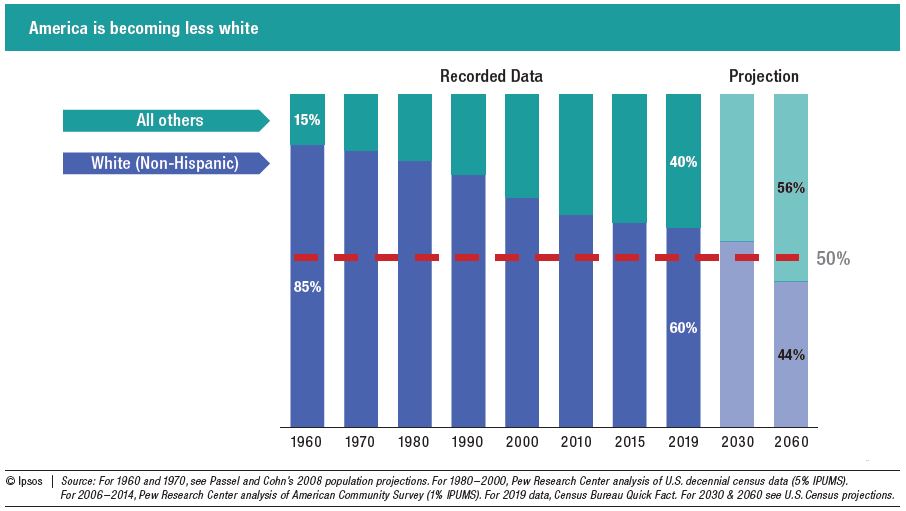
- America is changing. Census data projects that by the middle of this century, there will be no racial or ethnic group that makes up a majority of the population. Social norms will continue to evolve as younger, more diverse generations grow older.
- Those in the older dominant groups feel adrift amid these changes.
- Tension is growing as some groups push for further change and others attempt to forestall it.
Download our latest paper exploring how people across the country relate to their own race, their racial history of America, and where they feel the country is headed. For more insights on these trends, please download our detailed POV.
Race and Identity in a Changing Nation
An Ipsos America the Uncertain POV
Last year America saw a wave of protests and demonstrations, the likes of which have not been seen in generations. These civil rights and social justice protests, sparked by the murder of George Floyd, focused the nation’s attention on issues of race and injustice. They elevated awareness of historic inequality, particularly the legacy of violent policing of the Black community, and made many Americans aware of how much further the country needs to go to provide equal opportunity. Then, only a few months later, a mob broke into the U.S. Capitol trying to disrupt the presidential election certification and extend the presidency of Donald Trump. This mostly white protest echoed Trump’s rhetoric about the election being stolen and mimicked his language of grievance and loss. These seemingly disparate events are connected by a fundamental truth of America. The face of America is changing, with the nation of tomorrow looking dramatically different than the country of yesterday. Census data projects that by mid-century, there will be no racial or ethnic group that consti-tutes a majority of the population. Women now make up the majority of higher education students, and Americans with a post-high school degree will soon outnumber those with only a secondary education. As these demographic shifts happen, many who identify with older dominant groups feel their world slipping away, and they act to hold onto that life. Changing demographics are reshaping America. We look at several of those changes here.
AMERICA IS CHANGING
The America of 1960 and 2021 are very different places. The Leave it to Beaver vision of American life, with a white, stay-at-home mother, a patriarch who has a stable job not requiring a college degree, and 2.5 children, is no longer a reality. More Americans now hold a college degree, women make up a majority of the college-educated workforce, and the U.S. birthrate is now about half of what it was in 1960. The Census Bureau projects that by 2060, the non-Hispanic white population in America will have slipped from 60% today to 44%. As these demographic shifts occur, how the country understands itself is also changing. The future is looking less and less like the past. These demographic and cultural changes drive U.S. politics, business, and how Americans relate to each other.
Historic racial inequities present today
The past year was a microcosm for how the country is changing. While many protested and were sympathetic to protests about the indiscriminate killing of Black Americans, other parts of the public moved in the opposite direction. Underlying this tension is a fundamental disagreement over America’s history with racism, the role race plays in the country today, and how to move forward. The pandemic also shone a harsh light on inequality in America, from the unequal health and financial burdens Black and Hispanic communities bore to the discrimination and harassment of Asian Americans. This confluence of events has led to (1) differing perceptions of fairness by police and the judicial system and (2) differing reported experiences of the pandemic.
Experience with the law enforcement and the judicial system
Black Americans report a demonstrably different experience with the police than white people do, often harsher or more extreme.
Policing and criminal justice systems
After being pulled over, Black Americans are three times more likely to have police draw a gun or taser in their presence than white people at a vehicle stop, Axios/Ipsos polling indicates. This is true, even as Black Americans are less likely to be pulled over because of lower rates of car ownership. Once pulled over, both Black and white people report being told to step out of their vehicle at roughly equal rates. Black Americans, though, are far more likely to experience police actions escalating beyond that. For example, Black people are twice as likely to have had additional police officers called onto the scene.
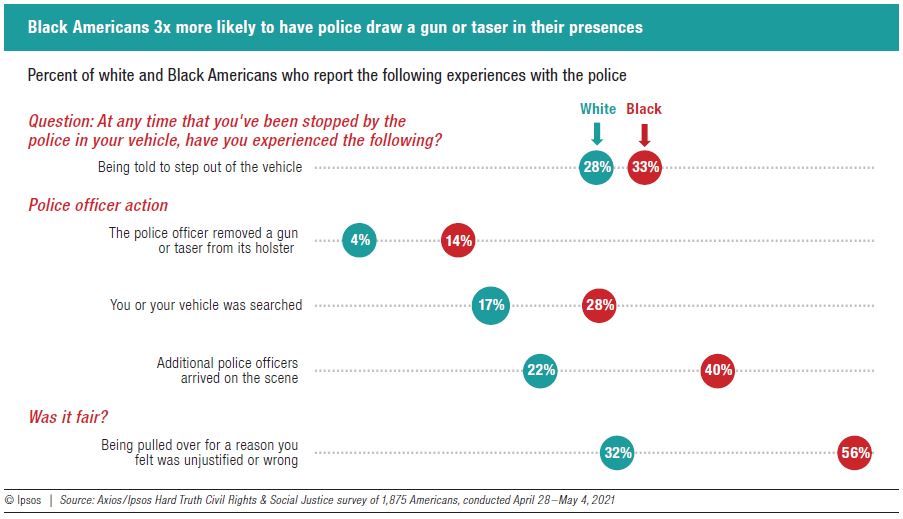
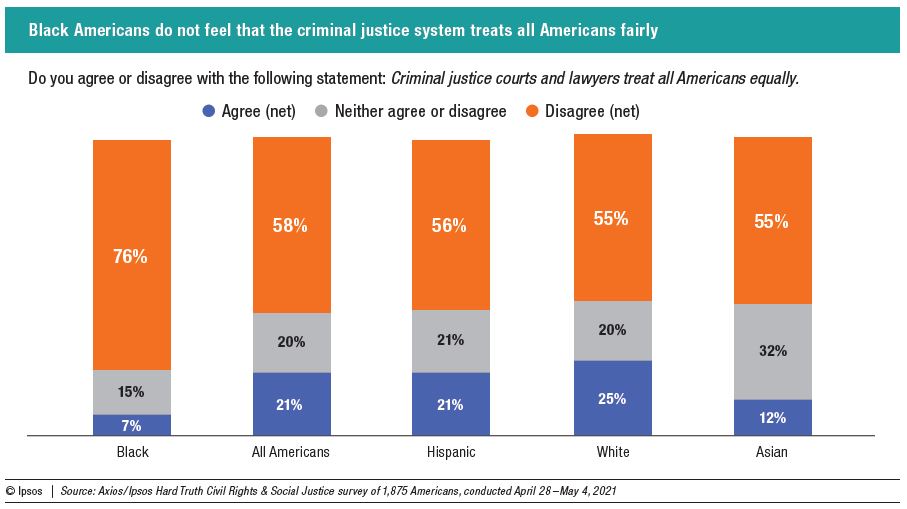
This experience with the police informs other parts of life for Black Americans. Most Black parents (60%) have had a conversation with their children about what to do if they are stopped by the police. That’s about 20-points ahead of white parents. Taken together, this unequal experience with policing influences the unfairness Black Americans feel from actors, like the police and the criminal justice system, more broadly. More than half of Black Americans who report experiencing a vehicle stop believe that there has been a time when they were pulled over for a reason they felt was unjustified or wrong (56%), 24-points ahead of white Americans on this question. In the judicial system, Black Americans are also more likely than white Americans to feel the criminal justice apparatus—its courts and lawyers—do not treat all people equally, 20-points ahead of Hispanic, white, and Asian Americans.
Race and the pandemic
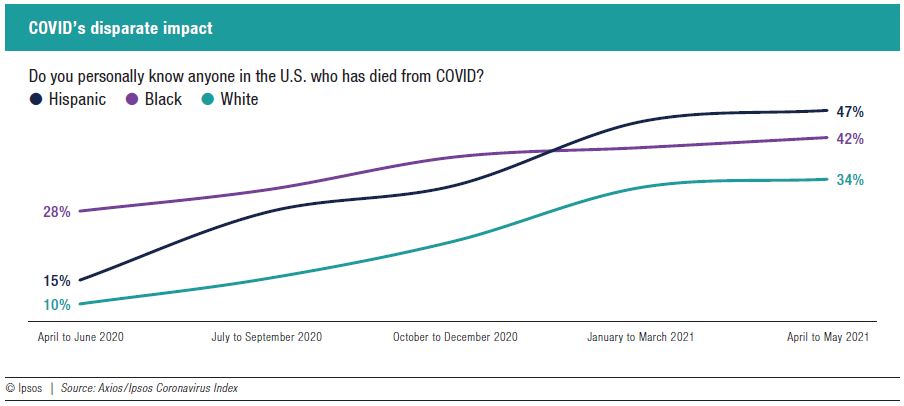
COVID-19 did not affect all Americans equally. Black and Hispanic people were often harder hit by the pandemic from both a health and economic perspective. The coronavirus has claimed the lives of nearly 600,000 Americans as of early June 2021. As a result, the overall U.S. life expectancy dropped by a year, according to the CDC. People of color were worse affected by these sobering statistics. Average life expectancy fell 2.7 years for Black people, 1.9 years for Hispanic people, and 0.8 years for white people between 2019 and the first half of 2020. Claiming the lives of so many in the U.S., millions of Americans now have personal experience with loss. One in three Americans says they personally know someone who has died of COVID. But among Black and Hispanic Americans, the number is higher, at around two in five, according to Axios/Ipsos Coronavirus tracking data.
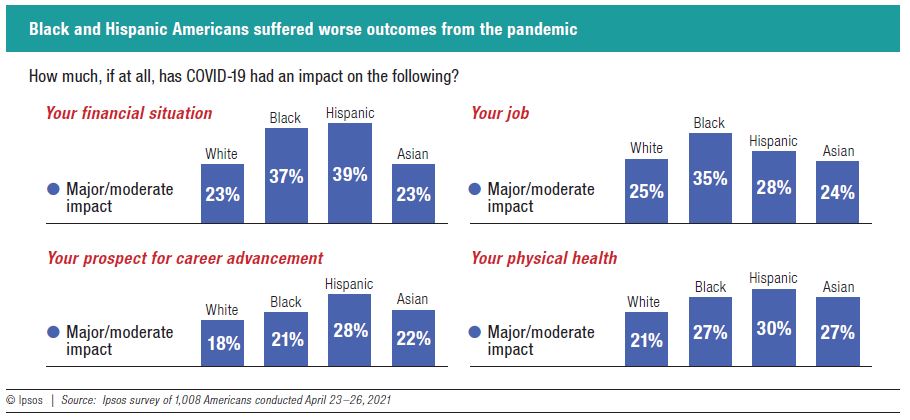
Beyond these disparate health outcomes, the economic recession following the pandemic placed a more significant financial burden on Black and Hispanic people due to systemic inequities which predate COVID. The racial wealth gap gave families of color less of a cushion to ride out the pandemic. As an Ipsos survey conducted in late April found, Black and Hispanic people are more likely than white and Asian Americans to indicate that COVID-19 had a major or moderate impact on their finances, careers, and physical health.
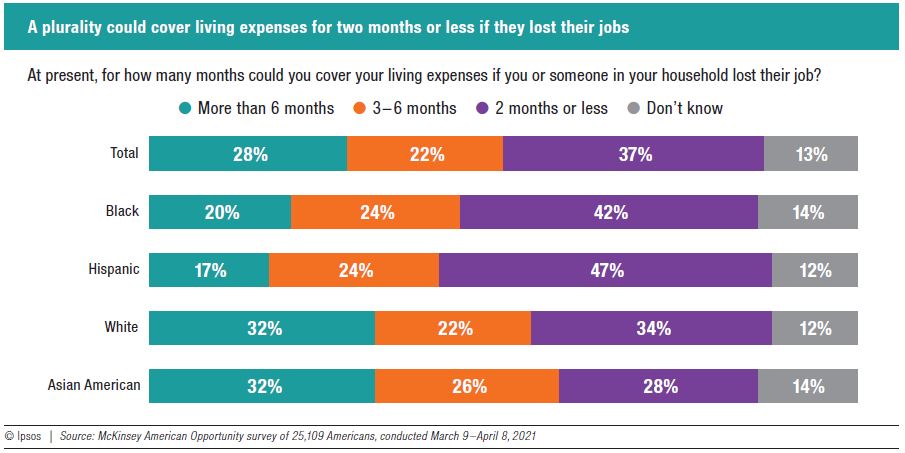
And, coming out of the crisis, Black and Hispanic Americans are most likely to express doubt about their ability to stay afloat financially if they or someone else in their household were to lose their job. Close to half of Hispanic Americans (47%) and two in five Black Americans (42%) say they would only be able to cover two months or less of living expenses in the event of job loss, according to the McKinsey American Opportunity report, conducted with Ipsos. This underlines the financial precarity many Americans are living with.
ASIAN AMERICAN EXPERIENCE WITH HARASSMENT DURING THE PANDEMIC
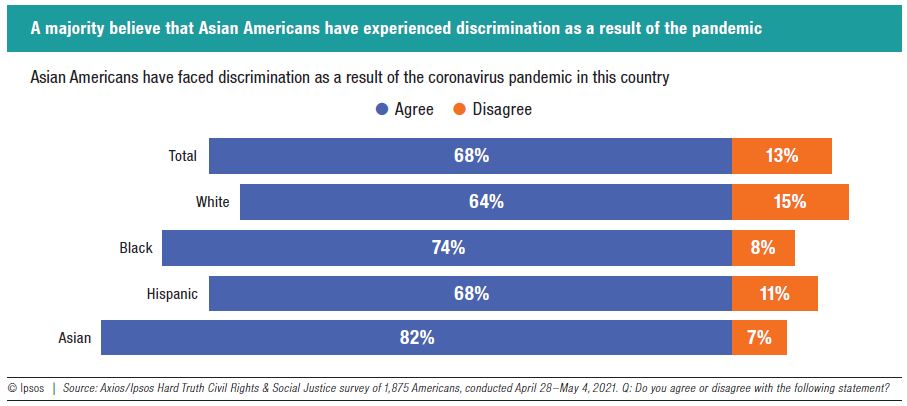
Nearly all Asian Americans believe Asian Americans, as a group, have faced discrimination as a result of the coronavirus pandemic. Decisive majorities of Black and Hispanic people also believe that Asian Americans have faced discrimination related to the pandemic. For white people, attitudes and views around this topic diverge based on partisanship. Only about half of Republicans (48%) agree that Asian Americans have faced discrimination due to the coronavirus pandemic, while nearly all white Democrats (89%) believe this to be the case.
Where Americans feel they stand in a changing country
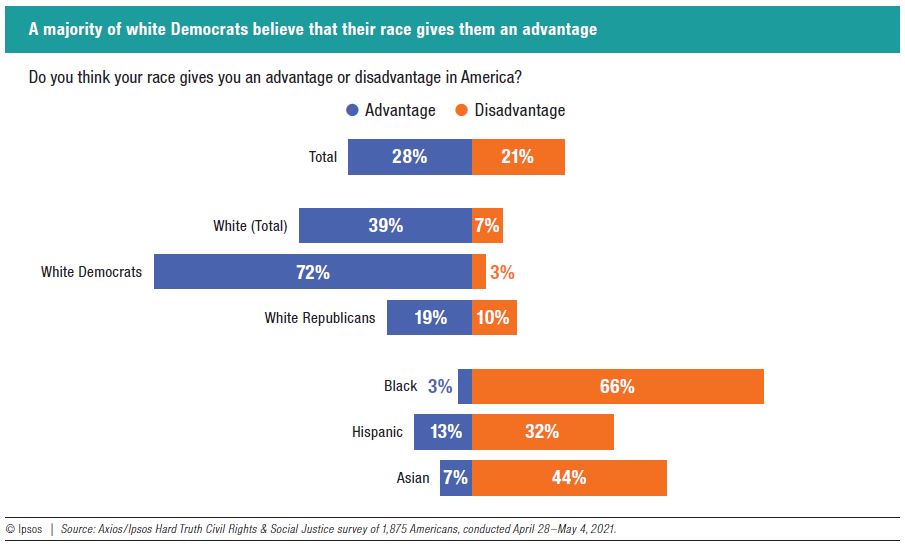
As the makeup of America changes, people who identify with older shrinking groups show clear signs of anxiety and alienation. These forces and insecurities are in part what led to the election and continued popularity of former President Trump, who plays to the trope of restoring American “greatness.” Underlying this national conversation are these questions: who is an American, what is America, and who does it work for? Understanding race The way Americans understand race is vastly different across racial and ethnic lines. Just a tiny fraction of non-white Americans believe that their race gives them an advantage in this country, at 3% of Black Americans, 7% of Asians, and 13% of Hispanics. Among white Americans, the picture is more complex and mediated by partisanship. While seven in ten white Democrats agree that their whiteness grants them an advantage, just 19% of white Republicans agree.
Fractured white identity
The divide between white Democrats and Republicans about whether their race gives them an advantage underscores a larger point—white Americans are not monolithic. On many measures, particularly around race, justice, and a broader sense of belonging, white opinion fractures across partisan lines.
Many feel threatened in America today
Many Americans do not believe that their race gives them an advantage but instead feel that their racial or ethnic group is “under attack,” according to Reuters/Ipsos polling. Where Americans stand on this issue correlates strongly with partisanship. Three in four white Republicans feel that white people are under attack in this country, compared to just one in four white Democrats. Yet, many other Americans see things differently. Six in ten Americans instead believe that racial minorities are “under attack,” including eight in ten Black Americans and white Democrats.
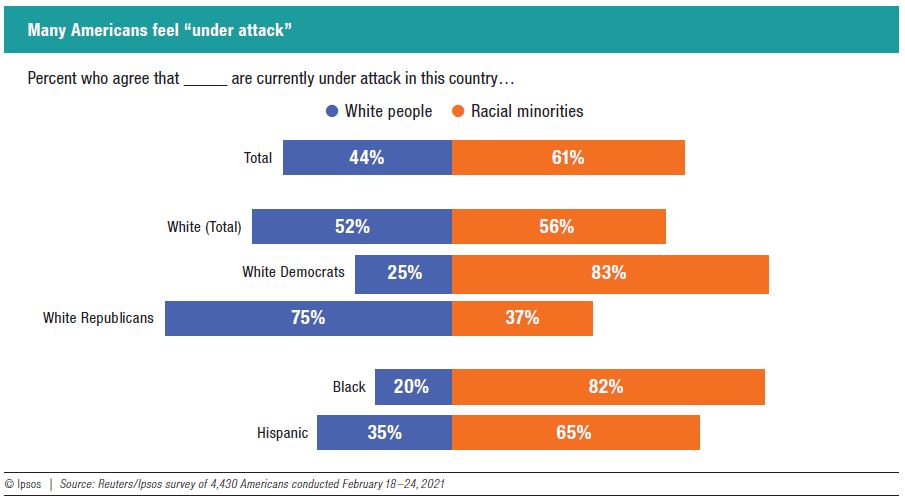
While these contrasting points of view stand in direct opposition to each other, what is clear is that few groups feel secure in America today.
Feeling like a stranger
In a changing America, not everyone feels at home. A plurality of Americans (39%) say that they feel like a “stranger” in their own country, hinting at the profound sense of alienation many are experiencing. That sense of alienation is deepest among white Republicans. A majority of white Republicans (57%) say they feel like a stranger in their own country, more than any other group. This puts them in stark contrast with the 23% of white Democrats, 27% of Black Americans and 29% of Hispanic Americans who feel estranged.

Outside events can influence Americans’ sense of alienation. During the pandemic and the contentious 2020 presidential election, just over half of both Republicans and Democrats agreed that they felt like a stranger in this country. But, with Biden in office, Democrats are now feeling more at ease in America today; Republicans less so. In this hyper-partisan era, what party holds power can play a role in how partisans feel. Democrats, who were pessimistic throughout the Trump era, are now much more secure about the economy and trust the federal government under Biden. While feelings have changed among Democrats, Republicans’ estrangement is proving to be remarkably stable. Republicans are still feeling about as alienated now as they were two years ago, a time when their party controlled every branch of government.

IMMIGRATION AND THE AMERICAN IDENTITY
America is a nation of immigrants, but how central are they to our national mythos? Just three years ago, a majority would have agreed that immigrants are an “important part” of the national identity. But since 2018, opinion has undergone a profound shift. While a majority of Democrats and Independents still believe that immigrants are central to the national identity, just 48% of Republicans agree, according to an NPR/Ipsos survey conducted in May 2021. This represents a decline of 23 points between 2018 and 2021. In the same survey, half of Republicans also agree that most immigrants struggle to assimilate into American culture, compared to 28% of Democrats and 36% of Independents. Removing immigrants from the national sense of self underlines the anxiety and tension within the GOP about who is “American.”

Structural fairness
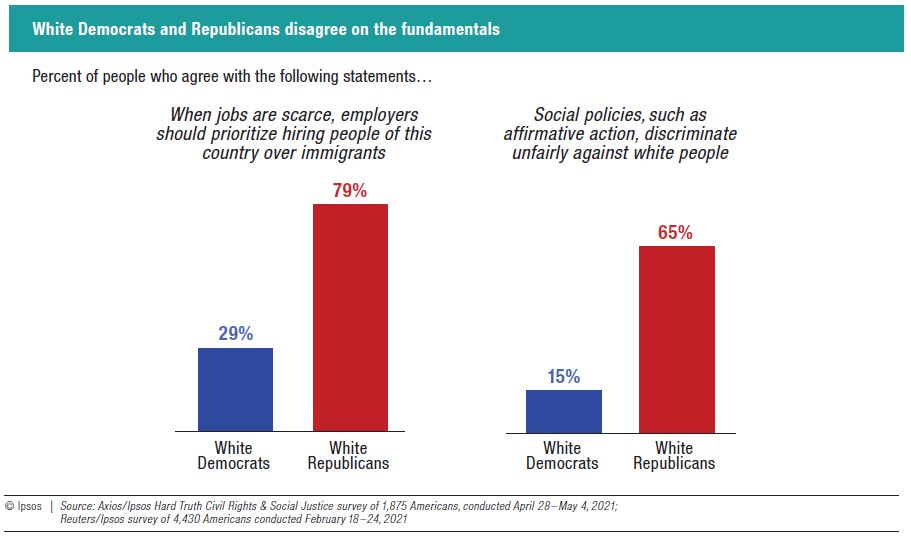
The growing insecurity among some white Americans influences whether they feel the country treats them fairly and what policymakers should do to address their worries. For example, many white Republicans feel that immigration and racial justice measures are unfair. Most white Republicans (79%) believe that when jobs are scarce, employers should prioritize hiring people of this country over immigrants, 50-points ahead of white Democrats. Additionally, many white Republicans feel domestic policies, like affirmative action, discriminates against white people.
Ensuring equal rights
How white Americans understand race today sets the stage for how they see the country moving forward. Even as a majority of Americans (59%) believe that the nation still needs to keep making changes to achieve equality between Black and white Americans, large differences between white Americans emerge based on partisanship, according to Axios/Ipsos polling. Particularly striking is the contrast between the 92% of Black Americans who say the nation still needs to keep evolving compared to 19% of white Republicans. White Democrats are closely aligned with Black Americans on this measure, with 87% agreeing that further change is needed.

Yet, underlying these numbers is a generational shift in both perspective and demographics. Younger Americans are more likely to agree that the nation still has a way to go before reaching racial equality. For context, younger Americans are already much more diverse than older generations. And, as noted, no single racial or ethnic group is projected to comprise the majority by the middle of this century.

In short, generational change will lead to a more diverse, pluralistic society. This reality may be driving some of the anxiety that some white Americans feel today, academic research indicates. Furthermore, America’s changing demographics have led some to argue that the nation will inevitably swing left as it becomes more diverse, leaving the GOP behind. Yet, that reality might not be so simple. A more pluralistic society is likely to contain a multitude of viewpoints as well.
Conclusion
This is a historic period for the United States. Under the existing view of society, the current dominant group (white Americans) will soon fall into minority status. There are only a few examples around the world or in history where that has happened that did not result in an illiberal regime. But one of the special characteristics of America has been our adaptability of how we view ourselves. In past eras, people who were seen as not-American in one generation (think about the waves of immigrants from Ireland, Italy, or Eastern Europe) were folded into the country by the next. As the country shifts, Americans’ adaptation (or not) of their view of who America is will frame where we go from here. Over the past 12 months, these points of tension surfaced in undeniable ways. The continued force of race in the United States and the subsequent reaction to a changing America were on full display. But taking a broad view, we can see that despite the real and ongoing pain of the last few years, in many ways America has continued to progress towards the goal of a more perfect union. Time will tell if this generation succeeds in continuing that arc of history.

![[WEBINAR] Winning B2B Buyers: AI Gets You Considered; Trust Gets You Selected](/sites/default/files/styles/list_item_image/public/ct/event/2026-10/Winning%20B2B%20Buyers%20AI%20Gets%20You%20Considered%20Trust%20Gets%20You%20Selected.png?itok=Q4kElwY2)
![[WEBINAR] Accelerating Innovation Development with Synthetic Data](/sites/default/files/styles/list_item_image/public/ct/event/2026-08/thumbnail-templates%20demo_1.png?itok=nao0XJ7q)