
Emptier Planet
 Population change isn’t necessarily a good thing or bad thing. But it is a big thing. And the implications for the future of the world are profound.
The great defining moment of the 21st century will occur in three decades or so when the global population starts to decline.
Many people are surprised to hear this. But the truth is that the earth’s population is not growing out of control. Instead, we are heading for a population bust. Humanity, made up of 7.8 billion souls today, will be hard-pressed to get to 8.5 billion before it tips into decline and will round out the century about where it is now.
This trend is not only taking place in a handful of countries – it is happening everywhere. The forces driving this decline are already in place and we are feeling their effects in many aspects of our lives today.
This paper explores the likely scenario of a shrinking and shifting global population structure, looking at the driving factors (including urbanization and the empowerment of women), related trends (such as the maturing mainstream), the possible impacts of Covid-19, and implications for societies and business.
Watch Darrell present these findings in our “Dynamic Planet” webinar for Earth Day 2021 or download the presentation.
You can read more on this topic in “Empty Planet”, a book co-authored by Darrell Bricker, CEO of Public Affairs at Ipsos.
You can also listen to Darrell discussing the key themes of the paper, and making further explorations into what the demographic trends mean for our society, our economy, our culture, and our politics in this 40 minute podcast hosted by the Ipsos Knowledge Centre.
THE POPULATION BUST
WHAT YOU’VE HEARD ABOUT GLOBAL OVERPOPULATION IS WRONG
Population change isn’t a good thing or bad thing. But it is a big thing. And the implications for the future of the world are profound. The great defining moment of the 21st century will occur in three decades or so when the global population starts to decline.
Many people are surprised to hear this. That’s because we have been told by everyone, from respected scientists to Hollywood screenwriters that overpopulation is destroying the planet’s environment and outstripping the food supply, which will inevitably lead to an apocalypse. This is just wrong. The earth’s population is not growing out of control. Humanity, made up of 7.8 billion souls today, will be hardpressed to get to 8.5 billion before it tips into decline and will round out the century about where it is now.
The forces driving this decline are already in place and we are feeling their effects in many aspects of our lives today. With the effects of the Covid-19 pandemic, the decline could start even sooner and the population could end up even smaller than this already dramatic prediction. Populations were declining in around 20 countries before the pandemic hit and were expected to extend to 30 or more countries by 2050 or earlier. While savvy population-watchers know this is happening in developed markets such as Western Europe and some Asian countries, they are often surprised to hear it is also happening in developing markets.
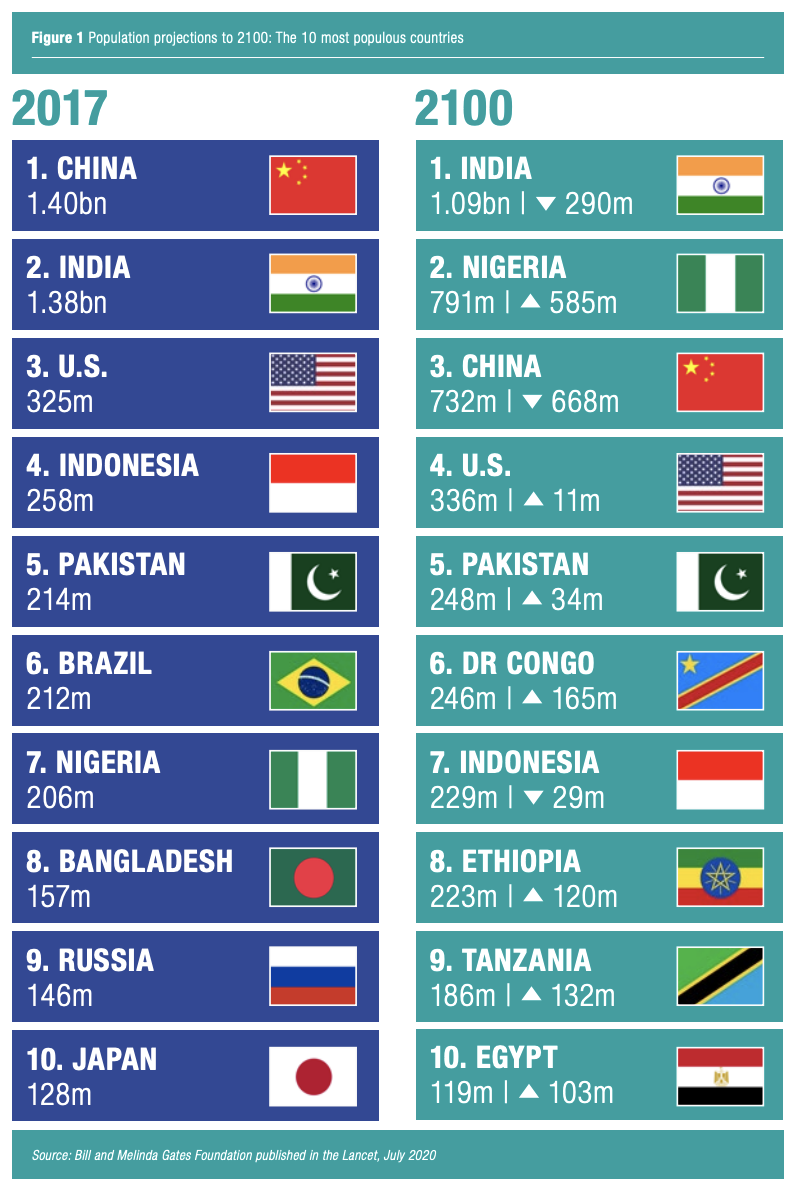
The latest population projections to the end of the century for the world’s ten most populous countries (created before the pandemic) are presented in Figure 1 on the following page. At the top of the list are China and India which together make up 36% of the world’s population today. The projections show China losing over 600 million people by 2100 while India’s population will also drop by nearly 300 million. Losing almost a billion people from the global population is like losing three countries the size of the United States – the third most populous country today – in less than a century. And this doesn’t include population declines in Europe, Latin America and the rest of Asia, which are already underway (or will begin by mid-century or earlier).
The projections also show that the massive population losses predicted for China and India will be partially offset by significant growth in mostly African nations. This assumes that the forces driving population decline in the rest of the world won’t take hold in Africa – a big assumption given what we are already seeing on the ground in Africa today. More on this in a bit.
DRIVERS OF POPULATION DECLINE
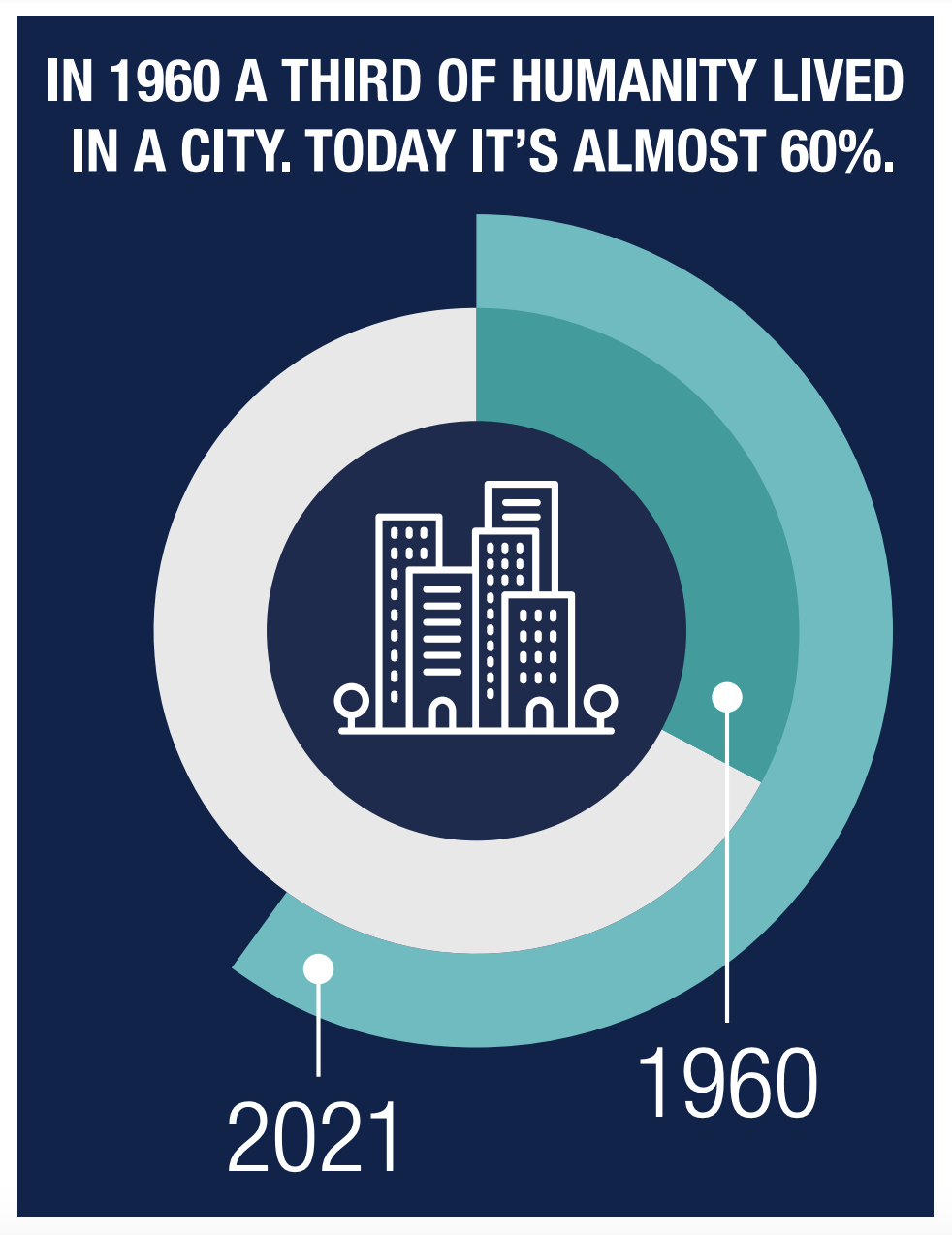
Why is the world’s population about to decline? In a word: urbanization. The largest migration in human history has happened over the last century and it continues today. It is people moving from the country to the city. In 1960, one-third of humanity lived in a city. Today it’s almost 60%. Moving from the country to the city changes the economic rewards and penalties for having large families. Many children on the farm means lots of free hands to do the work. Lots of children in the city means lots of expensive mouths to feed. That’s why we do the economically rational thing when we move to the city: we have fewer kids.
An even more important aspect of how urbanization leads to smaller families is that moving to the city changes the lives of women. It exposes them to a different version of life than their mothers and grandmothers lived in the country. Urban women are now much more likely to be socialized to have an education and a career. Combine this with easier access to contraception and the knowledge of how to use it and lower birth rates are the inevitable result. That’s why first-time mothers today are older than in the past, have fewer children, and teenage pregnancies have dramatically declined. In most developed countries today the fertility rate (or birth rate) of women over forty years of age has surpassed the fertility rate of women twenty years of age and younger.
What does a major decline in fertility look like? Look at Figure 2, which shows the UN’s birth rate figures for the world’s 10 most populous countries for 1960, today, and for 2050. For humanity to simply hold steady we need a birth rate of 2.1. This is called the natural population replacement rate and is the scenario when a population produces just enough offspring to replace those people who die each year.
Since 1960, the birth rate in the ten most populous countries has dropped by more than half. In eight of these 10 countries it is already at or below the natural replacement rate.
The fertility data misalignment includes Nigeria, a country that is supposed to be a significant driver of the world’s future population growth. Between 1960 and today, Nigeria went from producing 6.4 children per woman to 5.4 children per woman. If we go with the Lancet data (shown in the chart alongside the birth rate for ‘today’) Nigeria’s birth rate today is really 5.1. Put another way, Nigerian women are already having nearly 1.5 fewer babies on average than they were in 1960. That’s a slower decline than in many countries, but a significant decline nonetheless. A birth rate of 5.1 is still very high and certainly the highest among the world’s most populous countries. If the example shown in the rest of the world is enough to go by, we can expect fertility decline to accelerate in Nigeria and Africa just as it did in India, Brazil and China. The only question is how quickly.
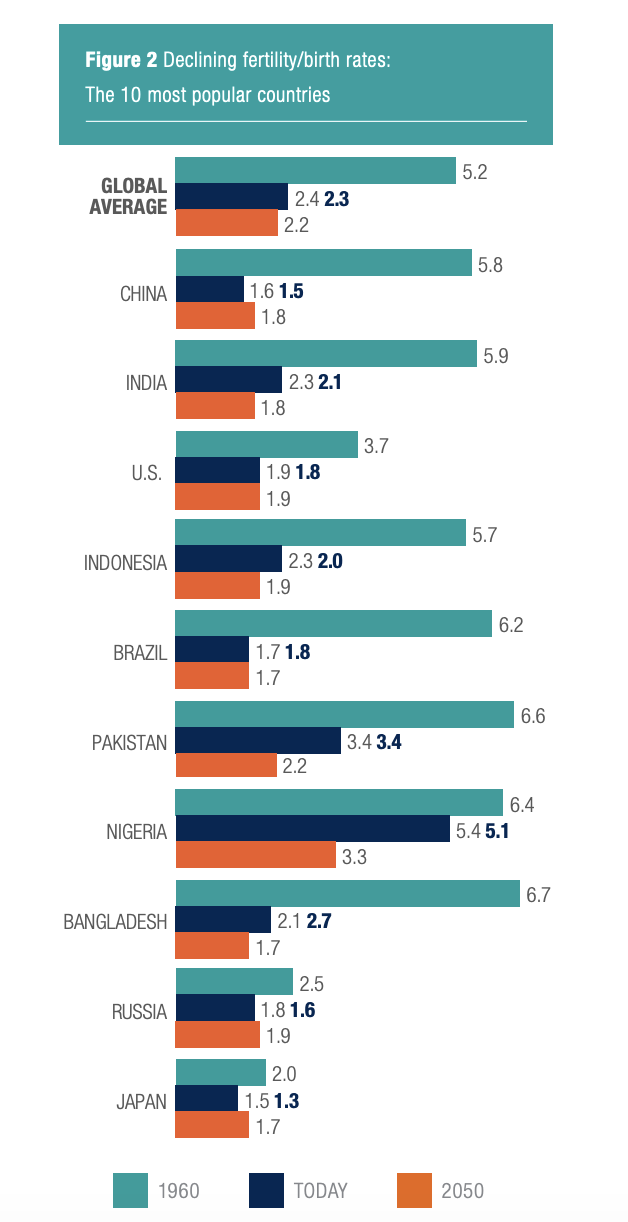
The decline in fertility presented in Figure 2 is understated. This is a function of the UN’s modeling assumptions which are biased to predict slower change than is occurring today. There is a growing consensus among demographers that fertility decline is moving faster than the UN’s models are predicting. The most recent challenge to these figures presented in the numbers are alongside, in brackets.
PANDEMIC POPULATION IMPACTS
Now comes Covid-19. If fertility was already collapsing, what has been the effect of the pandemic on the number of births over the last year? The data is starting to come in and it’s startling. Over the last year, Poland experienced a 25% decline in new births and preliminary data from many other European countries is also showing accelerating declines. The Brookings Institute estimates that 300,000 fewer babies will be born in the United States as a result of Covid, while Canada just reported its lowest birthrate in history. Particularly noteworthy is that early estimates for births in China over the last year show a decline of around 15 percent.
While there’s no doubt the pandemic has (so far) accelerated fertility decline in developed countries, some analysts suggest there could be a different effect elsewhere.
The argument is that family lockdowns due to the pandemic combined with disrupted access to birth control could lead to a post-Covid baby boom in regions like Africa. At this point though, this is only a hypothesis. There’s no data yet to say one way or the other whether this is happening or whether any potential baby boom will be a blip or a significant shift back to previous patterns.
Some also suggest there could be a mini post-Covid baby boom in developed countries. It’s true that surveys have shown for some time a desire among women to have more children than they are currently having. Maybe when families regain confidence in their economic future post-pandemic this could happen. Again though, this is just a hypothesis. Mini baby booms haven’t happened after other recent economic disruptions like the 2008/9 recession. Will the post-Covid recovery be any different?
COVID-19 HAS CAUSED:
- Depressed fertility rates (so far)
- Disrupted immigration
- Excessive death among elderly
- Outmigration from major cities (temporary?)
OUR AGEING WORLD
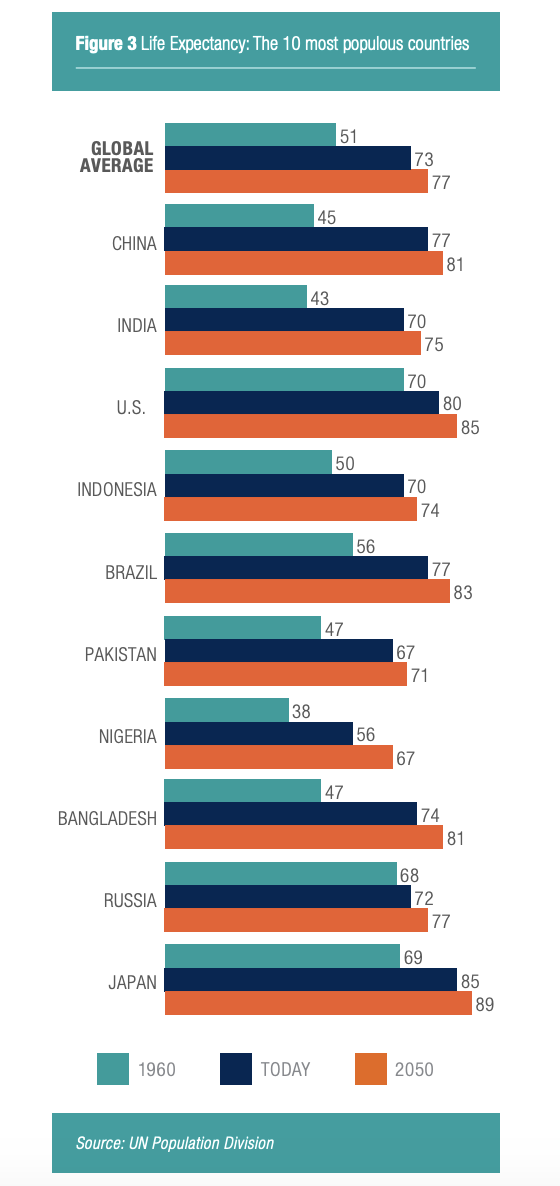
Given what’s happening to global fertility, it may soon be a poet who observes that, for the first time in history, humanity feels old. She would be right. Most of the world’s population growth today is happening not because we are having lots of babies, but because we are not dying as quickly as we did in the past. Figure 3 shows what’s happening on the ground with longevity estimates from the UN. They show life expectancy data for the top ten most populous countries in the world for 1960 and today, as well as estimates for 2050.
Look at China and India; the longevity story in both countries is astounding. In less than a century life expectancy will increase in China by 36 years. In India, it will increase by 32 years. But this is not just happening in these two countries. Like declining fertility, increasing population longevity is universal. Take Nigeria as an example; from 1960 to 2050 life expectancy is expected to increase by 26 years.
Something to keep in mind about estimates of the speed and extent of population ageing is that they are highly dependent on estimates of population fertility. If fewer children than expected are born, which looks to be the case, then the population will age faster than the current estimates suggest. As we already know to be wary of the UN’s fertility modeling, it is not too much of a stretch to suggest that the world’s population is already ageing faster than the UN’s projected estimates. This is not just an issue for the future, it is happening all around us today.
A MATURING MAINSTREAM
What does all of this mean for marketers, politicians and public servants? One crucial point is that it’s time to gear up for the “Perennials”, or older consumers and voters. Older generations will come to dominate the marketplace and public life in many countries for the forseeable future. The implications of this are huge for every aspect of consumer and citizen demand, from where and how people live to what products and services they will buy to what policies will be demanded from political candidates and governments. Any organization that wants to be successful must understand how to talk to, sell to, and service the Perennial market. This is, and will continue to be, the mainstream market in the developed world, not a specialty market. And increasingly it will grow in importance in the developing world.
The older segment of the population is already growing rapidly and these individuals won’t be going away as fast as they once did. They also have most of the money, property and power. But, ironically, they aren’t feeling the love from marketers and politicians who remain obsessed with the youth. The ageing market is not considered a very sexy market, so tends to get ignored. There’s a built-in bias that tomorrow will always be defined by a younger generation than the one that defines it today.
Younger people have always been the big spenders, so it’s legitimate for marketers to be obsessed with them. It’s to do with life stages: youngsters are the ones having kids and buying houses. If not today, then soon. Older people are past their buying days and don’t represent the same commercial opportunity as young people do. Or so we are told. What if these assumptions are wrong? What if the life experience for Perennials is in transition? What if the size of the older cohort is growing? What if people are living longer and livelier, and what if they continue to sit on the lion’s share of wealth? Because, in fact, this all happens to be true.
The mainstream is changing and the sweet spot in the market is older than too many marketers (and politicians) assume. Look at what is being offered through the eyes of the older consumer: is the font in that awesome app you are directing customers to use too small for older eyes? Is the music in your ad selected to please a Gen Z creative director or the customer with the cash? Little things can make a big difference in marketplace success.
The next generation of young people – the ones who are supposed to define our future marketplace and public life – are truly Generation Anxious. They are not buying homes at the same rate as previous generations, due in part to older people ageing in place and blocking them from the market. Along with this, the sale of new furnishings and other goods will decline. Younger consumers may eschew expensive new cars (even environmentally friendly ones) because they are paying off student loans, or because as urban renters they don’t need a car. If they continue to have fewer kids, in turn they will not buy clothes, furniture or toys in the same quantities. Sure, young people will still constitute a big number in the world’s population moving forward, especially in developing markets, but not as big as the growing number of older people walking the planet. And, underneath this all, intergenerational tensions could be brewing as young people grow increasingly resentful of the powerful Perennials blocking their progress.
Here’s something else to think about: as the population ages, it becomes more female. One of the emerging power segments in the marketplace will be female Perennials. They have the numbers and the financial resources to have a significant impact on both the commercial and political marketplace, but they are invisible in most ad campaigns. When was the last time you saw a political party focus its campaign strategy on what older women want? Is it common to see an ad featuring an older woman in a mainstream consumer context? Commercial and political actors need to figure out how to appeal to this emerging power segment.
THE WORLD WILL GROW FEWER
Contrary to what many of us might expect, planet Earth is not fated to overpopulation. Instead, we are heading towards a global population bust. This trend is already underway, and we expect to see the numbers tip into decline around mid-century.
There are three interacting factors driving population decline and causing dramatic shifts to our population structure: urbanization, fertility and ageing. On average, humanity is getting older, more female, and family sizes are shrinking.
Ageing and immigration will drive population growth more than the birth rate. Meanwhile, the geographic centre of the world’s population will move from Asia to Africa.
As a whole, population decline is not necessarily good or bad. But the dynamics at play are vital for us to understand.
19th century French sociologist Auguste Comte is often credited with saying that “demography is destiny.” A lot of intellectual capital since then has gone into attempting to prove that Comte was wrong. However, given the rapid change we are seeing in the size and structure of the world’s population, and the implications of these changes for our economic and political future, maybe Comte was just ahead of his time.

![[WEBINAR] AI in Higher Education: How AI Is Reshaping Teaching and Learning](/sites/default/files/styles/list_item_image/public/ct/event/2026-10/How%20AI%20Is%20Reshaping%20Teaching%20and%20Learning.png?itok=XYdLaI-4)

![[WEBINAR] Winning B2B Buyers: AI Gets You Considered; Trust Gets You Selected](/sites/default/files/styles/list_item_image/public/ct/event/2026-10/Winning%20B2B%20Buyers%20AI%20Gets%20You%20Considered%20Trust%20Gets%20You%20Selected.png?itok=Q4kElwY2)