World Refugee Day 2022: New Ipsos survey shows greater compassion for forcibly displaced as war in Ukraine wears on
June 17, 2022 — A new global study by Ipsos for World Refugee Day shows that:
- Three in four adults on average across the 28 countries surveyed agree with the principle that people should be able to take refuge in other countries to escape war or persecution, and attitudes toward refugees have become more positive on average since last year.
- Two in three support allowing more people into their country if they are seeking refuge to escape war, violent conflict, natural disaster, or the effects of climate change, but there is less support for more of those seeking refuge due to personal characteristics such as gender, sexuality or political opinions.
- Two in five say they have taken action to support refugees in the past 12 months, and nearly half of them were particularly motivated by the Ukraine war.
- The public is divided on whether their government is currently accepting the right number of refugees or spending the right amount to support them.
- Support for those seeking refuge from war and persecution and backing of refugee causes have risen since last year.
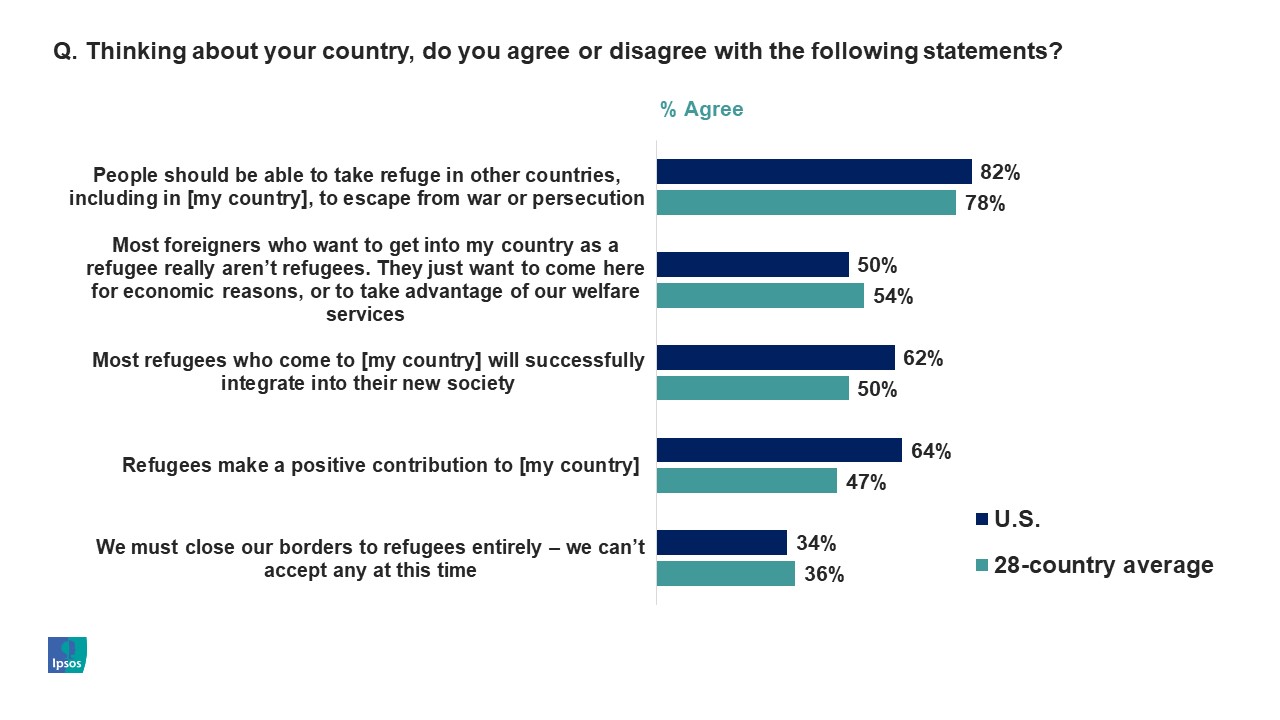
The survey released today by Ipsos ahead of World Refugee Day (June 20th) reveals that 82% in the United States and an average of 78% across 28 countries agree in principle that people should be able to take refuge in other countries, including their own, to escape war or persecution. Only 10% in the U.S. and 16% on average globally disagree. Agreement with this principle has become more prevalent since last year in most of the countries surveyed. It is the case in the U.S. where it’s up 10 percentage points. This trend suggests that the war in Ukraine has increased public openness to refugees and reversed some of the concerns generated by the pandemic.
The survey was conducted online between April 22 and May 6 among 20,505 adults under the age of 75. It finds a majority of those surveyed in each one of the 28 countries agreeing that people should be able to take refuge in other countries, including the survey respondents’ own country, to escape from war or persecution. Agreement is highest in Sweden (88%), Brazil (86%), and Poland (85%) and lowest in South Korea (61%), Malaysia (64%), and Turkey (66%).
The backdrop to the survey is that over 100 million people are now forcibly displaced around the world, according to UNHCR, the UN Refugee Agency, in light of the Ukraine crisis, which is the fastest displacement crisis in recent times.
Majorities both in the U.S. and globally support allowing more people into their country if they are seeking refuge to escape war, violent conflict, or natural disaster, or the effects of climate change; pluralities do so if due to personal characteristics
Nearly two-thirds on average across all 28 countries (64%) and three-quarters in the U.S. (72%) support allowing more refugees into their country who are seeking refuge to escape war or violent conflict, with about one in ten (11% on average globally, 8% in the U.S.) opposing it.
With climate change effects expected to drive additional displacement in the future, majorities both on average globally (55%) and in the U.S. (58%) support letting in more people into their country who are seeking refuge to escape natural disasters or the effects of climate change while one in seven (14% both globally and in the U.S.) oppose it.
However, when it comes to allowing in more of those seeking refuge due to personal characteristics, support is more muted although it surpasses opposition – on average globally and in the U.S.
- 41% on average globally and 45% in the U.S. support allowing more people into their country if they are seeking refuge due to their race, ethnicity, or nationality (vs. 19% globally and 16% in the U.S. who oppose it);
- 38% globally and 42% in the U.S. support it if due to their sexual orientation or gender identity (vs. 23% and 20%, respectively opposing it):
- Again, 38% globally and 42% in the U.S. support it if due to their gender (vs. 20% and 18%, respectively opposing it);
- 36% globally and 45% in the U.S. support it if due to their religion (vs. 23% and 16%, respectively, opposing it); and
- 35% globally and 38% in the U.S. support it if due to their political opinion (vs. 24% and 21%, respectively, opposing it).
![To what extent would you support or oppose allowing more refugees into [your country] who are seeking refuge for the following reasons?](/sites/default/files/inline-images/Slide1_48.JPG)
More favorable attitudes towards refugees have been accompanied by action – often motivated by the war in Ukraine
Two in five on average globally (40%) and in the U.S. (38%) report that they have taken action to support refugees in the past 12 months – many for the first time. Nearly half of them say they were motivated by the situation in Ukraine:
- Poland, the country hosting the largest number of Ukrainian refugees, is where those surveyed are most likely to say they have taken action to support refugees (72%).
- Among those who say they have done something for refugees in the past 12 months, nearly half (45% on average globally and 47% in the U.S.) would describe their actions as motivated by the situation in Ukraine; more say it was the first time they had ever done anything for refugees than say they regularly do so (39% vs. 24% globally, 34% vs. 31% in the U.S.)
Gillian Triggs, UNHCR's Assistant High Commissioner for Protection, said: “The Ukraine crisis has triggered an outpouring of compassion, support and funding. We hope this momentum can be maintained, so that all, and not some, refugees have access to protection and receive support. Because everyone has the right to seek safety no matter who they are or where they come from.”
Skepticism towards refugees persists, but Americans
Not all the findings are so encouraging for refugees. For example:
- More agree than disagree that most foreigners who want to enter their country as a refugee are there for economic reasons or to take advantage of welfare services (54% vs. 37% on average globally, 50% vs. 39% in the U.S.).
- While more than half (56% globally, 58% in the U.S.) disagree that borders should be closed to refugees entirely, about one-third (36% globally, 34% in the U.S.) agree and think their country cannot accept any more refugees at this time.
Compared to people from many other parts of the world, Americans tend to have a more positive assessment of refugees’ ability to integrate and to contribute to their country:
- 64% in the U.S. agree refugees make a positive contribution to their country (vs. a global average of 47%); only 25% in the U.S. disagree (vs. 41% globally).
- 62% in the U.S. agree most refugees will successfully integrate into their new society (vs. a 28-country average of 50%); only 28% in the U.S. disagree (vs. 40% globally).
Despite increased support for refugees, views are divided on whether governments should provide more support
Three in five globally (60%) and two-thirds in the U.S. (68%) agree that being allowed to work would help asylum seekers to learn their country’s language and integrate. However, views on granting asylum seekers the right to work are more nuanced. About half (48% globally, 53% in the U.S.) agree that giving asylum seekers the right to work while waiting for a decision on their asylum claim could attract people to their country without a genuine asylum claim.
Opinions on whether one’s government is currently accepting the right number of refugees or spending the right amount on support to refugees tend to diverge.
- About one-third (36% on average globally, 30% in the U.S.) think their government should accept fewer refugees than it does at present while comparable proportions both globally (33%) and in the U.S. (31%) believe their government is currently accepting the right number. Not as many think their government should accept more refugees (15% globally, 24% in the U.S.)
- About two-fifths on average across the 28 countries (41%) and in the U.S. (38%) think their government should maintain current spending levels on support for refugees around the world, while a quarter (28% globally, 25% in the U.S.) think the government should decrease current spending levels. Fewer both globally (16%) and in the U.S. (19%) think spending should be increased.
Trinh Tu, Managing Director of Public Affairs, Ipsos UK said: “The war in Ukraine has galvanized public support for refugees fleeing war or persecution across the 28 countries surveyed, with many people taking personal action to support refugees for the first time. And as we emerge from COVID-19, the public are also more relaxed about keeping their countries’ borders open to refugees. However, public concerns that most refugees are not genuine persist, as is the public’s lack of awareness and support for those seeking refuge for other reasons. The warming of public attitudes towards refugees presents an opportune moment to address these more persistent beliefs and change hearts and minds.”
About the Study
These are the results of a 28-country survey conducted by Ipsos on its Global Advisor online platform. Ipsos interviewed a total of 20,505 adults, aged 18-74 in the United States, Canada, Malaysia, South Africa, and Turkey, and aged 16-74 in 23 other countries between April 22 and May 6, 2022.
The sample consists of approximately 1,000 individuals in each of Australia, Brazil, Canada, mainland China, France, Germany, Great Britain, Italy, Japan, Spain, and the U.S., and 500 individuals in each of Argentina, Belgium, Chile, Colombia, Hungary, India, Malaysia, Mexico, the Netherlands, Peru, Poland, Saudi Arabia, South Africa, South Korea, Sweden, Switzerland, and Turkey. (Note that Switzerland was not included in 2021)
The samples in Argentina, Australia, Belgium, Canada, France, Germany, Great Britain, Hungary, Italy, Japan, the Netherlands, Poland, South Korea, Spain, Sweden, Switzerland, and the U.S. can be taken as representative of their general adult populations under the age of 75.
The samples in Brazil, mainland China, Chile, Colombia, India, Malaysia, Mexico, Peru, Saudi Arabia, South Africa, and Turkey are more urban, more educated, and/or more affluent than the general population. The survey results for these countries should be viewed as reflecting the views of the more “connected” segment of their population.
The data is weighted so that each country’s sample composition best reflects the demographic profile of the adult population according to the most recent census data.
The “Global Country Average” reflects the average result for all the countries where the survey was conducted. It has not been adjusted to the population size of each country and is not intended to suggest a total result.
Where results do not sum to 100 or the “difference” appears to be +/-1 more/less than the actual, this may be due to rounding, multiple responses, or the exclusion of “don’t know” or not stated responses.
The precision of Ipsos online polls is calculated using a credibility interval with a poll of 1,000 accurate to +/- 3.5 percentage points and of 500 accurate to +/- 5.0 percentage points. For more information on the Ipsos use of credibility intervals, please visit the Ipsos website.
The publication of these findings abides by local rules and regulations.
For more information on this news release, please contact:
Nicolas Boyon
Senior Vice President, U.S., Public Affairs
+1 646 309 4879
[email protected]
About Ipsos
Ipsos is the world’s third largest market research company, present in 90 markets and employing more than 18,000 people.
Our passionately curious research professionals, analysts and scientists have built unique multi-specialist capabilities that provide true understanding and powerful insights into the actions, opinions and motivations of citizens, consumers, patients, customers or employees. We serve more than 5000 clients across the world with 75 business solutions.
Founded in France in 1975, Ipsos is listed on the Euronext Paris since July 1st, 1999. The company is part of the SBF 120 and the Mid-60 index and is eligible for the Deferred Settlement Service (SRD).
ISIN code FR0000073298, Reuters ISOS.PA, Bloomberg IPS:FP