
It’s Time for Disruption: Unpacking Investor and Financial Advisor Loyalty

Who Do You Love? Investors often feel more connected to their advisors than to the firm
Let’s face it—the risk of financial advisors leaving your investment firm and taking their books of business with them is considerable. How much money does your firm stand to lose if even one advisor leaves, and their investors follow them? Research shows that in addition to employee replacement costs, the impact of advisor turnover on assets under management (AUM) can be substantial. Given the potentially devastating implications, simply accepting this risk may not be the best business strategy.
Trust Me: Connections between investors and advisors are forged over time
Developing successful financial advisors and supporting them in building strong relationships with their clients is essential to an investment firm’s business growth. Investors stay with advisors they trust. This trust is earned over time by advisors who listen to the needs of their investors and skillfully apply their trade to meet the clients’ long-term financial goals. Advisors who are successful at fostering relationships enjoy books of business that continue to grow over time—in AUM, revenue generated for the firm, and the number of investors they represent.
Embracing The Investment Triangle
While the strong personal connection formed between advisors and their investors is advantageous, it also poses a corollary risk to your firm. Since trust is by nature relational, it develops more easily through one-on-one interactions than through less personal firm-to-investor communication channels. As a result, the client loyalty that is hard-won by successful advisors does not automatically extend to your firm as a whole. Without putting forth concerted effort to build direct relationships with your investors, your firm may be unable to fully leverage the trust that has been built because all sentiment has been channeled through the advisor. And if advisors feel they lack the resources and support they need to be successful, your firm becomes vulnerable to advisor defection. Ipsos works with investment firms to mitigate the risk of advisor turnover by helping them understand and optimize three key dimensions of business performance:
- Investors’ connection to their advisors
- Your advisors’ connection to the firm
- Investors’ connection to the firm
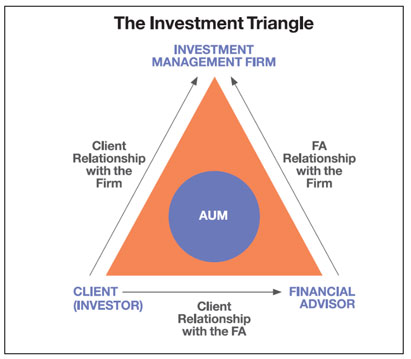
Successful financial services firms realize that sustained investor loyalty requires supplementing advisor-investor relationships with equally strong, direct linkages between the firm and both investors and advisors.
Historically, investment firms have been largely excluded from the close relationships forged between investors and advisors. With the emergence of digital disruption in almost all aspects of life, there has never been a better time to challenge the principles that were thought to be unassailable. Today’s firms have an unprecedented opportunity not only to leverage technology and omni channel strategies to enhance advisor-investor relationships, but also to directly strengthen their firm’s connection to individual investors. This can lead to communications and service offerings that directly empower the investor, independent of the advisor relationship.
You had me at Insights: Understanding the connections and taking appropriate action
Shoring up weak links in The Investment Triangle requires strategic business analytics to understand the needs and expectations of advisors and investors within these key relationships. Ipsos’ proprietary, multi-tiered framework helps clients strengthen all three dimensions, building stronger connections between investment firms and their investors as well as their advisors. Your firm may have a state-of-the-art customer experience program that measures the voice of the customer and the voice of the advisor across these linkages. Or it may rely largely on ad-hoc studies and internal metrics to assess the overall health of key relationships. In either case, your organization’s data ecosystem likely contains a mountain of potentially rich data on your firm’s investors, advisors, and investment transaction history. Regardless of your company’s approach to business measurement, Ipsos can maximize the value of your existing data through analytics that lead to a deeper understanding of key business relationships:
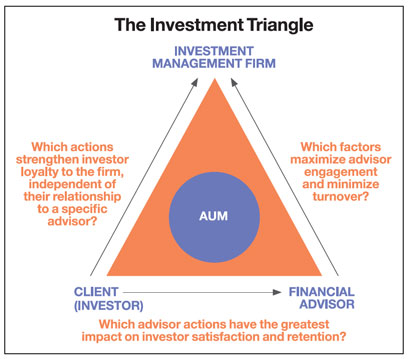
Ipsos’ approach to investment relationship analytics identifies key dimensions of firm-advisor-investor linkages, reveals underlying inter-relationships and dependencies, and quantifies their impact, resulting in insights that lead to action.
- Data integration and modeling that predicts the impact of firm and advisor actions on AUM
- Prescriptive analytics that benchmark the behaviors to emulate of the firm’s high-performing, long-tenured advisors and high-value, loyal investors
- Quantification of advisor likelihood to defect and the financial impact for more effective risk mitigation
The Path to Investment Triangle Enlightenment
The impact of a valued advisor leaving the firm can be substantial and lasting. Strategic data analytics can mitigate this risk and help firms navigate firm-advisor-investor relationships more intelligently. Whether Ipsos supports your firm by utilizing existing data streams, integrating disparate datasets across your organization, or by creating new and intentionally linked information systems, the Ipsos approach to investment firm analytics will provide deep insights and clear pathways to action. We would be pleased to collaborate with your team on how to apply Ipsos analytics to create more value in these key relationships, and look forward to accompanying you on your path to embracing The Investment Triangle.


![[WEBINAR] Global Voices of Experience 2026](/sites/default/files/styles/list_item_image/public/ct/event/2026-02/thumbnail-global-voices-experience.jpg?itok=NN6W-9Ft)