Social Listening: Why Does Social Matter?
At its most fundamental, Social Listening identifies what consumers are saying about you and your competitors via social media.

How does Social Listening Compliment your Current Research Program?
- Using advanced search software we scrape the web for conversations relevant to your business needs from Twitter, to blogs/forums and news sources
- We interpret the results in order to provide contextual insights to gain a holistic understanding of your
business concerns
How can you Benefit?
- Fill the gaps in current research
- Provide depth on known issues
- Hear the ‘Buzz’ in your market
- Highlight new areas of focus
How our Social Listening Tool Works
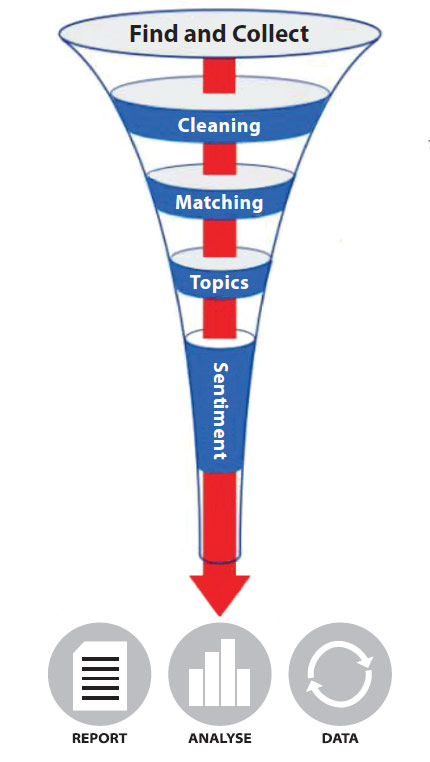
- The tool covers multiple channels—forums, blogs, news sites, Twitter, Peer2Peer and comparison sites, industry sites, image and video sharing sides, and any other site with dynamic content (with some exceptions)
- Uses its own Web Crawler which visits the web in near real-time
- Our Ipsos team creates a search query to investigate a brand or issue
- Queries are structured much like Google searches, using Boolean logic language with operators like ‘AND,’ ‘OR,’ and ‘NOT’ separating search terms
- Ensures the results are a relevant match, and cleans out spam
- Queries run across 40m+ sources
- Downloads over 100 million pages of new data each day
- Identifies common topics, locations, organizations
What is Delivered?
Deliverables from a Social Listening include:
- Volume of mentions tracking charts over time
- Key topic Word Clouds
- Key topic Buzz Graphs showing relationships between terms based on how they’re mentioned together in a query with indication of strength of connection
- Easy to understand graphical representation of topic insights and themes and volume of discussion
- Location of discussion (i.e. Twitter, blogs, forums, news, etc.)
- Analysis of positive vs negative discussions
- Top relevant hashtags on Twitter
Consumers and shoppers are continuously exposed to ‘touchpoints’ which may reinforce and disrupt mental networks and thereby influence purchase decisions.