
Are you feeling included in beauty inclusivity?
This issue of What the Future features messages of body positivity from Alex Keith, Anastasia Garcia and others. We are seeing more variations of humans in ads and the media. The definition of “beauty” is, arguably, expanding. While we might see these changes all around us, are we really feeling beautiful ourselves?
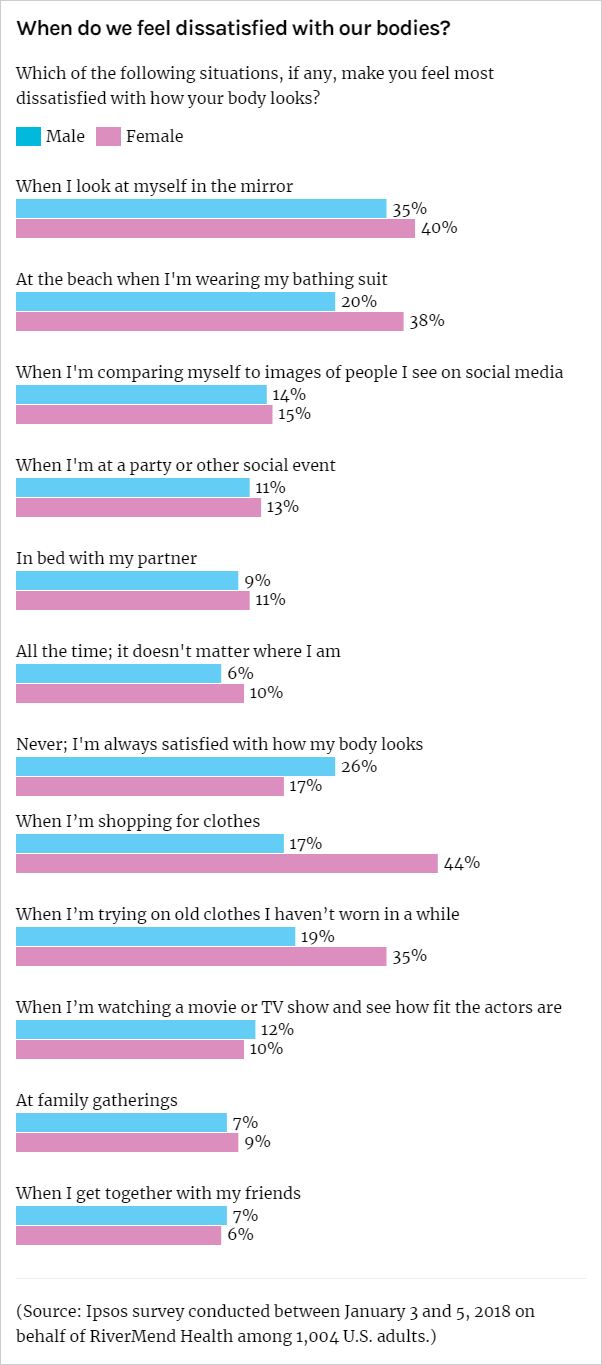
Ipsos conducted a survey for RiverMend Health that shows that many of us are not. When asked about situations in which we feel “dissatisfied” with our bodies, only one in five reports always feeling satisfied.
In contrast, nearly twice as many people —and more than twice as many women— report feeling dissatisfied when they look in the mirror.
Though women continue to be dissatisfied with their bodies in greater numbers than men, there are underlying signs that men feel just as much pressure to confirm to the ideal body type. Eight in 10 Americans agree that as many men as woman want to change their weight. There are also signs that things may be changing with the youngest generation. In a separate study conducted in late 2017 among tweens age 10 to 13, roughly one in three said they “love their body the way it is” and wouldn’t change any part of it even if they needed only to wave a magic wand to do so.
Part of the issue is that while the definition of beauty is expanding, it’s still evolving. In the RiverMend survey, people still consider an athletic frame to be the “perfect body.” Only 20% think the “dad bod” is the right fit for men. This is true throughout the globe, as you’ll see in our global beauty survey.
For brands broadly in the beauty space (fashion, fitness, healthcare and more), pushing that definition by including more different body shapes and sizes in media and marketing efforts could go a long way to helping people feel more comfortable in their own skin—whatever that may look like.
This article was originally published in What the Future, an award-winning deep dive into different aspects of consumer thought and behavior. Each quarterly edition features exclusive new data from world-leading research firm Ipsos. WTF explores how the opinions of today impact the trends of tomorrow.
![[WEBINAR] AI in Higher Education: How AI Is Reshaping Teaching and Learning](/sites/default/files/styles/list_item_image/public/ct/event/2026-10/How%20AI%20Is%20Reshaping%20Teaching%20and%20Learning.png?itok=XYdLaI-4)

![[WEBINAR] Winning B2B Buyers: AI Gets You Considered; Trust Gets You Selected](/sites/default/files/styles/list_item_image/public/ct/event/2026-10/Winning%20B2B%20Buyers%20AI%20Gets%20You%20Considered%20Trust%20Gets%20You%20Selected.png?itok=Q4kElwY2)