
First Impressions Matter
It has been shown there are many factors that influence our impressions of people we meet for the first time. The attributes used to describe a person, their clothing, their physical attractiveness all strongly influence the first impressions we form. These impressions, in turn, influence subsequent behavior towards those people.
In First Impressions Matter, we show that the first impressions consumers form of a new product can determine whether they move forward to buy it or disengage completely. A good understanding of first impressions, therefore, is necessary for the innovation’s success.
We share new research into this topic and show how first impressions can provide insights into where to adapt communications or innovations to increase their success in market.
Read more in First Impressions Matter
Key Takeaways:
 |
Fulfill an unmet need – Otherwise consumers will see no need for your product or that there is nothing special |
 |
Understand if there are any negative barriers – Capturing “positives” is only half the picture. We need the full picture to drive success. |
 |
Dress for success – Leverage your package and product design to differentiate yourself |
 |
Be innovative – It is not enough to be new, different or interesting. Meet an unmet need in a truly different way. |
 |
Be clear – Insufficient information or vagueness will lead consumers to stay with the status quo |
First impressions are important, and the trouble is you get only one chance to make a good one. This is true in trying a new product, as much as it is in dating. As this paper sets out, the first impressions consumers form of your new product can determine whether they move forward to learn more about your product and buyit or disengage completely. A good understanding of firstimpressions, therefore, is necessary for your innovation’s success. In our earlier paper Speed Dating with Innovations,1 we emphasized the need for marketers to have the skills of a speed dater – building an effective “pick-up line” to ensure your innovation cuts through advertising clutter and is noticed. In this issue, we look at what happens after consumers are exposed to your innovation’s communication. Specifically, we share the findings from our research into first impressions and show how data from this unexplored area can provide insights into how to adapt your communications or innovation itself to increase trial. We also show how first impressions can be used to refine the prediction of an innovation’s potential.
CAPTURING FIRST IMPRESSIONS
Most of us would agree that first impressions of innovations matter. In practice, however, many innovation testing suppliers do not capture first impressions. Closed-ended questions asked after concept exposure (e.g., purchase interest, liking) capture the general “outcome” of first impressions but do not capture first impressions per se. This may be because it is inherently difficult to capture first impressions. They are formed instantaneously and are fleeting in nature. A series of experiments by Princeton psychologists Janine Willis and Alexander Todorov reveal that it takes only a tenth of a second to form an impression of a stranger from their face.2 Given the transient nature of first impressions, we needed a way to capture it quickly: an agile approach that can be implemented immediately after exposure to an innovation and capture thoughts and feelings that last only briefly. We determined this could be done most effectively by asking consumers for their thoughts immediately following concept exposure. We used an open-ended question so consumers could express any sentiments. If consumers did not like the color of the package, for example, they can express that. If consumers like the new product but are emotionally attached to their current product, they can express that as well. Such individualized responses to innovations cannot be captured by closed-ended questions where both the subject and response options are pre-determined by the researcher. In short, an open-ended format has the advantage of capturing consumers’ heterogeneity of responses.3 Consumers vary greatly in how they respond to an innovation and closed-ended questions simply cannot capture all the possibilities.
CODE RED
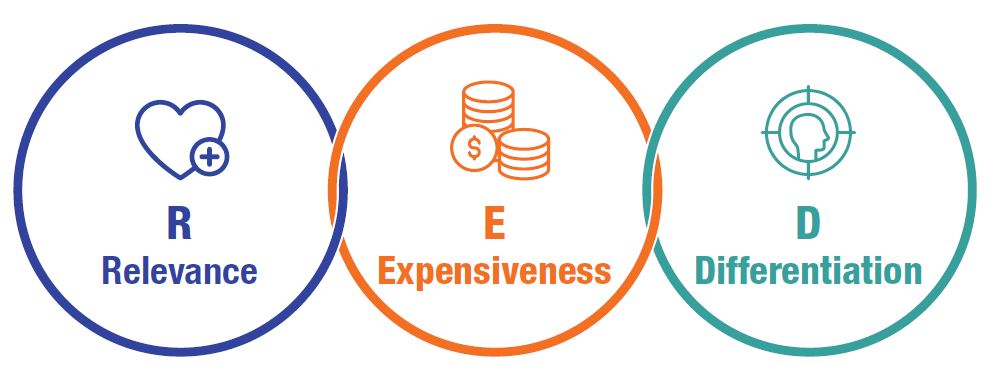
At Ipsos, we use three key metrics that have been proven to predict a new product trial in market: Relevance, Expensiveness and Differentiation. Relevance is the extent to which a product meets consumer needs, functional and/or emotional. Expensiveness is the extent to which a product is priced higher or lower than the competition. Finally, Differentiation is the extent to which a product has a unique benefit versus competitors. For brevity, we will refer to these three metrics by the acronym RED from this point on. The RED metrics are always asked in the context of consumers’ existing solutions. That is, how well does the new product compare to the consumers’ existing solutions on each of these metrics. For a consumer to adopt an innovation, it must have a relative advantage over the consumer’s existing solution. For fully developed concepts (aka late stage concepts), consumers are additionally asked to shop from a shelf after exposure to a new product. The selection or non-selection of an innovation serves as a behavioral measure of trial.
BEYOND RED: INCREMENTAL VALUE OF FIRST IMPRESSIONS IN PREDICTING TRIAL
While the RED metrics have been the foundation of Ipsos’ approach to predicting a new product potential for decades, we wanted to understand if first impressions would add incremental predictive value. To do so, we analyzed simulated test market data from 2,500 consumers in the United States across three product categories. A composite RED score was first computed for each concept. The concepts were then placed into three groups based on this score - low, medium and high – where higher scores indicate greater trial potential. Using a sentiment modeling tool, the verbatim responses to the first impression open-ended question were then coded into positive, neutral and negative impressions. The goal was to determine if the impression data provided incremental prediction beyond the RED metrics. Our findings found first impressions provided incremental prediction of a new product trial beyond the RED metrics. While a composite RED score was predictive of trial on the shelf, overlaying the first impressions data provided additional discrimination (see Figure 1). At all levels of RED score (low/medium/high), consumers who had positive first impressions were more likely to select the new product from the shelf than those who had a neutral or negative first impressions. In short, while the RED metrics are predictive of an innovation’s potential, first impressions help refine that prediction.

UNDERSTANDING THE COMMON DIMENSIONS IN FIRST IMPRESSIONS
Having determined that first impressions added incremental predictive value, we sought next to understand first impressions themselves. What is the content of first impressions? What dimensions are present in first impressions? To do this, we text analyzed the verbatim response of 4,500 respondents to 300 concepts tested across a variety of product categories (e.g., wine, health products, laxative, over-the-counter medication, food, oral care) from 13 countries (China, France, Germany, Indonesia, Italy, Japan, Netherlands, Philippines, Poland, Russia, Saudi Arabia, UK and the US). Due to the diversity of product categories tested, consumers’ first impressions included dimensions that are unique only to specific product categories (e.g., negative reactions to a new wine product because of a preference for beer). While such category-specific dimensions are important to understanding first impressions, to protect the confidentiality of our clients’ data and to share findings that would apply to a broad audience, we report only dimensions that generalize across most product categories (see Figure 2). Consumers’ first impressions were generally positive or negative, and sometimes both, illustrating the complexity of first impressions. Consumers’ positive thoughts included seeing the innovations as meeting their needs and/or as making their lives easier, simpler or faster. Consumers’ negative thoughts included perceptions of the innovation as unnecessary, expensive, or not offering anything new. First impressions also included perceptions of a new product uniqueness or lack thereof (e.g., “nothing special”). For someconsumers, the innovation made no impression at all(e.g., “none”).

While the responses are largely intuitive, we highlight two dimensions to illustrate the nature of first impressions. Given the speed at which first impressions are formed, this means that they must be based on readily accessible and available information. Two such readily available pieces of information are packaging and brand name. The following examples illustrate these two dimensions: While what we say about the new product matters, how it looks and who makes the product also matters. We turn now to understanding more on the impact of first impressions on the RED metrics.
USING FIRST IMPRESSIONS TO BETTER UNDERSTAND HOW TO IMPROVE RELEVANCE AND DIFFERENTIATION
While we have shown that first impressions provide incremental prediction beyond the RED metrics, it is logical to also expect that first impressions will impact how people evaluate the new product on the RED metrics themselves. As a reminder, we capture first impressions immediately after concept exposure and consumers then evaluate the new product on RED. As such, the dimensions of first impressions themselves can provide insights into how we can improve new product scores on the RED metrics. In this section, we sought to understand how first impressions determine how consumers rate a new product on Relevance and Differentiation. As many of the concepts tested did not include price, we omitted Expensiveness from our analysis.
BOTH POSITIVE AND NEGATIVE IMPRESSIONS MATTER
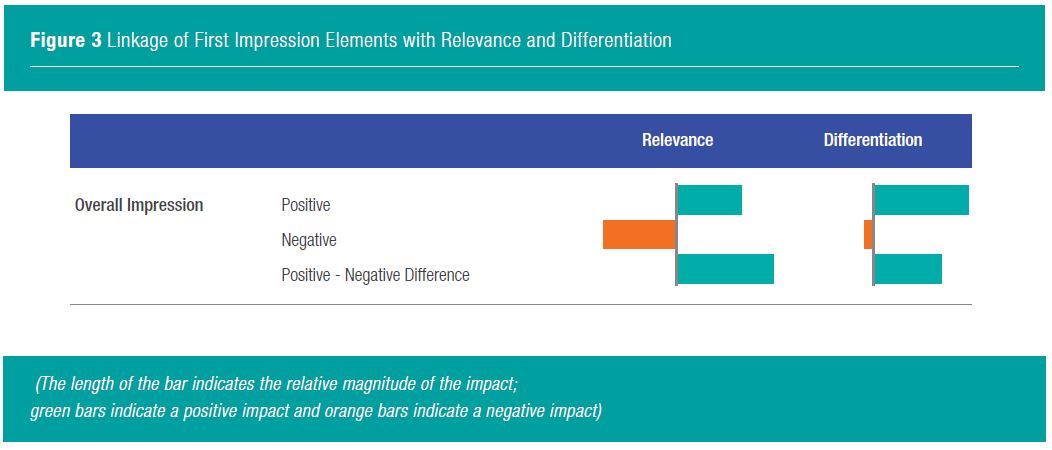
In general, innovations with positive first impressions were considered more relevant and differentiated. Negative first impressions, in contrast, were associated with decreased Relevance but had no impact on Differentiation (see Figure 3). More importantly, when positive and negative responses are considered simultaneously by computing a difference score between them, this difference score becomes even more strongly related to Relevance. Considering both positive and negative first impressions allow us to better predict relevance. Most innovation testing approaches in the market research industry do not consider negative responses. This is another reason why first impressions improve prediction. First impressions include negative information which is not typically captured by closed-ended questions. The quote below illustrates how consumers can simultaneously feel positive and negative.
LOOKING GOOD HELPS DIFFERENTIATE
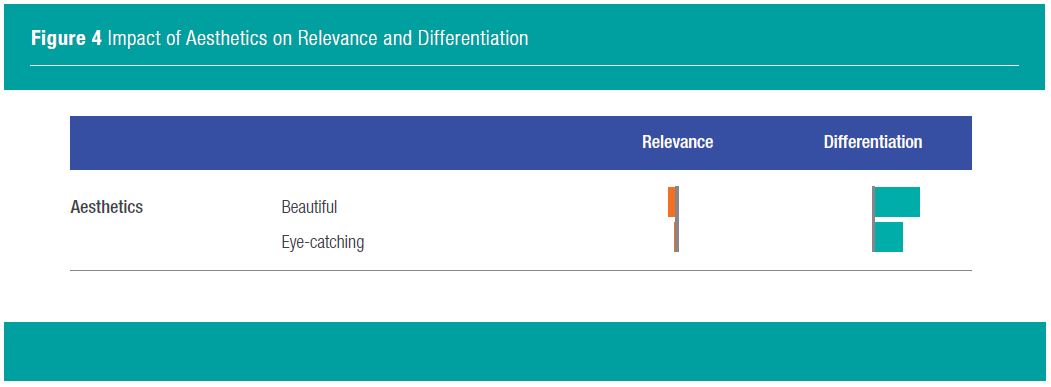
Innovations that were considered beautiful or eye-catching increased differentiation but not relevance (see Figure 4). In short, aesthetics can help differentiate a new product from existing solutions, but it does not influence how well it addresses consumers’ needs. As an example, one consumer’s first impression was: “packaging looks beautiful, but it seems a little expensive”.
BE INNOVATIVE, NOT JUST NEW OR INTERESTING
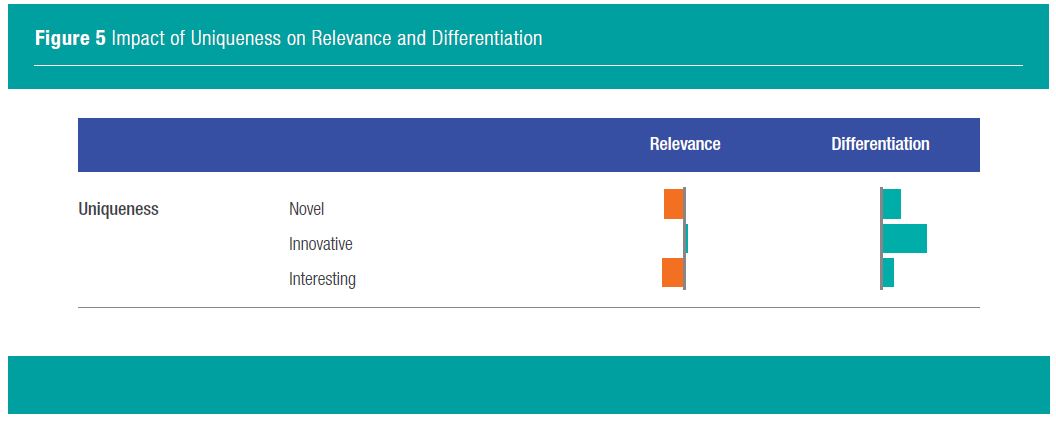
Our analyses provide a more nuanced view into what it means to be differentiated. It is not good enough for a new product to be novel/new, nor is it enough to be considered just interesting. For an innovation to be viewed as truly differentiating from existing solutions, it needs be viewed as innovative (see Figure 5). This means that innovations must meet consumer needs in a new way. A combination of benefits/ingredients that do not exist in current products would be an example of an innovative product (e.g., “This is a good innovation because there is a mixture of X and Y ingredients”).
LEVERAGE THE STRENGTH OF A GOOD BRAND
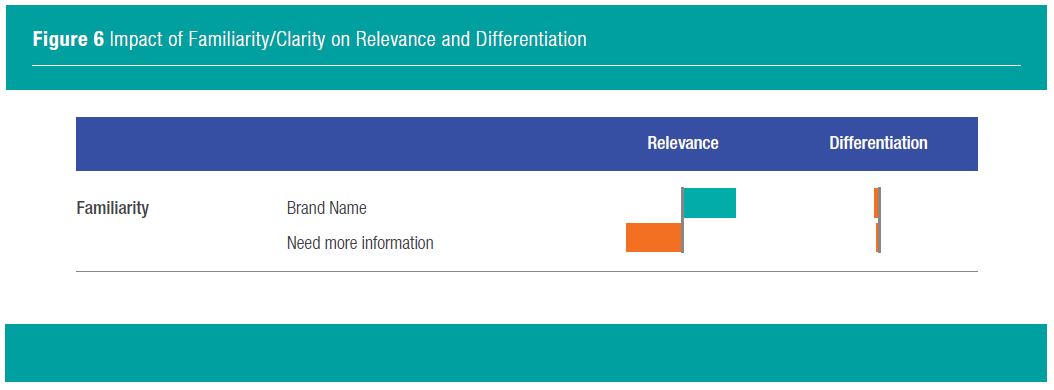
The instantaneous nature of first impressions require readily available and accessible information. One such piece of information in addition to aesthetics is brand name. To the extent that consumers are familiar with a brand and like it, they are more willing to try a new product. Concepts in which the first impressions included mentions of the brand name scored higher on relevance (see Figure 6). A brand name with a good reputation provides familiarity and confidence in the promise of the new product (e.g. “great idea from a trusted brand. I would probably buy this product”). The strength of a brand name can be reinforced with visual brand assets that most closely represent the brand and its values. Ipsos' research in advertising testing show that visual brand assets are closely linked to effective branded attention.
A LACK OF CLARITY WILL RESULT IN THE STATUS QUO
For consumers for which the innovation’s description was lacking in information (e.g., “Well, this might be good. I need more information”), they were more likely to consider the innovation as lower on Relevance (see Figure 6). Insufficient information means a consumer cannot make an informed choice. If so, they are likely to default to the status quo (i.e., their existing solution).
MAKE A GOOD FIRST IMPRESSION
Social psychology has shown that many factors influence our first impressions of people we meet for the first time. The attributes used to describe a person, their clothing, their physical attractiveness all strongly influence the first impressions we form.5 These impressions, in turn, influence subsequent behavior towards those people. We have shown that it is no different when consumers encounter an innovation. First impressions also matter for innovations and can be used to provide insights into innovation adoption as well as help refine the prediction of an innovation potential. Just as you would do everything possible to ensure you make a great impression on a first date, marketers should do the same for their new products. As the saying goes, you only get one chance to make a good first impression. While our focus has been on the communication of new products, our findings would also hold for brand communications in general. In a related vein, our colleagues have shown that high performing ads are more likely to deliver a positive emotional response towards the end of the ad – providing evidence that the last impression you leave consumers with is also important.6 We leave you with five ways to make amazing first and last impressions for your innovation and increase your opportunity of a second date.
TOP FIVE TAKEAWAYS
- Fulfill an unmet need - otherwise consumers will see no need for your product or that there is nothing special
- Understand if there are any negative barriers – capturing “positives’ is only half the picture. We need the full picture to drive success
- Dress for success – leverage your package and product design to differentiate yourself
- Be innovative – it is not enough to be new, different, or interesting. Meet an unmet need in a truly different way
- Be clear – insufficient information or vagueness will lead consumers to stay with the status quo


![[WEBINAR] TOAST 2026: Under Pressure - Fewer, Fragmented, Fought-For](/sites/default/files/styles/list_item_image/public/ct/event/2026-07/thumbnail-templates_1_0.png?itok=MxL-wPJW)