
What would free college change?
About half of bachelor’s degree recipients from four-year colleges and universities graduated with debt, according to the College Board. They hold an average of $28,800 in student loans. That begs the question: What would change if college, at least up to a bachelor’s degree, were free?
President Biden campaigned on a platform that included ambitious changes for higher education. He already has laid the groundwork for student debt cancellation. Most Americans, especially college grads, recently surveyed by Ipsos agree that college is a valuable investment in the future.
Yet the majority want to see big changes. Half of Americans support making a bachelor’s degree free at four-year colleges, according to a Country Financial/Ipsos poll. Two-thirds support making an associate’s degree free at community colleges. Millennials are most likely to strongly support free education.
For students and their parents, cost-free higher education could be life-changing. Nearly six in ten respondents in the Country Financial/Ipsos poll believe student debt policy reform will make college more accessible to more people. There are generational differences, of course. Many iGen and Millennials strongly agree with this, but nearly four in ten Baby Boomers think that student loan forgiveness will not stimulate the economy.
If a policy like this were to become law, it could spur massive changes and open up a valuable pipeline to employment to a greater portion of the workforce, easing some of the labor crunch we see today. One thing is for sure: the revenue structure for higher education would change as well as how students are recruited.
Changes are already under way with the Supreme Court’s ruling that the NCAA must let student athletes receive education-related compensation for their athletic participation. This could be just the beginning of the revolution.
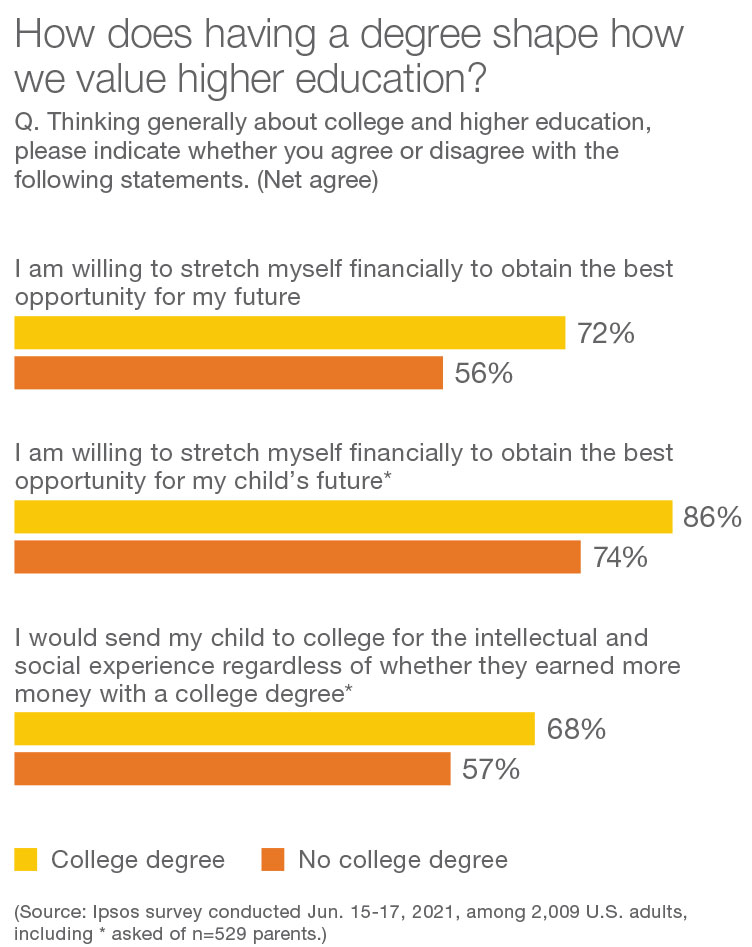
This article was originally published in What the Future Education, a research magazine by Ipsos exploring the current state of America's education system as it prepares the workforce of tomorrow. Are we ready? Download the magazine here.
![[WEBINAR] AI in Higher Education: How AI Is Reshaping Teaching and Learning](/sites/default/files/styles/list_item_image/public/ct/event/2026-10/How%20AI%20Is%20Reshaping%20Teaching%20and%20Learning.png?itok=XYdLaI-4)
![[WEBINAR] Winning B2B Buyers: AI Gets You Considered; Trust Gets You Selected](/sites/default/files/styles/list_item_image/public/ct/event/2026-10/Winning%20B2B%20Buyers%20AI%20Gets%20You%20Considered%20Trust%20Gets%20You%20Selected.png?itok=Q4kElwY2)