
How will digital collectibles factor into Affluent sports collections?
Look at any sports collector’s “fan cave,” and you’ll likely see trading card albums, autographed photos, uniforms and game equipment. How will that shift as sports collectibles become increasingly digital?
NFTs, or non-fungible tokens, have exploded on the collector markets, from art to music to sports. Simply put, NFTs are a kind of certificate of authenticity stored on the blockchain to verify ownership of myriad digital assets. Unlike fiat cash or cryptocurrencies like bitcoin, NFTs can’t be swapped or exchanged for similar items, which makes them ideal for collectors.
We’re in the early stages of what could become a huge market and new category in the evolution of sports collectibles. So far, NFTs appeal to a small segment of the population, especially the Affluent, which Ipsos defines as people with household incomes of $125,000 or higher.
Only 30% of Affluents consider themselves “somewhat, very, or extremely familiar” with NFTs, according to the Ipsos Q3 2021 Affluent Barometer. This is slightly more than the non-Affluent population (26%) and it is largely driven by men (37%) and Millennials (43%). However, 57% of Affluents who have some knowledge of NFTs are interested in learning more about them.
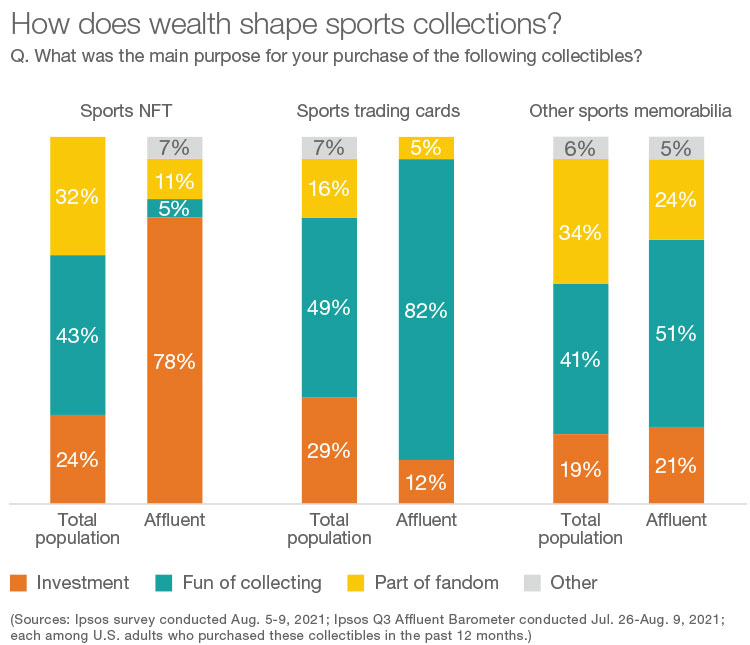
When Affluents buy sports NFTs, they’re mainly as investments (78%). Although sports NFT prices can start in the single dollar ranges for common collectibles, others already have reached heady prices, like an NFT of a single edition photo of LeBron James called The Statue of LeBron, offered at more than $30 million.
Among Affluent sports NFT buyers, we don’t see a lot of overlap with traditional card and memorabilia buyers. Those buying cards and memorabilia do so much more heavily for “the fun of collecting” (82%) and as “part of fandom” (51%), further validating sports NFTs as investments (78%). Affluents also are far more likely than the overall population (24%) to see NFTs as investment vehicles. Conversely, they’re more apt to collect trading cards and other sports memorabilia for fun and less for fandom than the overall population.
While we anticipate NFTs topping the 2025 luxury holiday shopping lists, this probably won’t change until we figure out how to display digital objects in our homes, at least the physical ones.
This article was originally published in What the Future Sports, a research magazine by Ipsos exploring the changing roles that the worlds of collecting, engaging with brands and betting will play in how we engage with the teams and players we love. Download the magazine here.
![[WEBINAR] How winning brands are making themselves essential in a tight economy](/sites/default/files/styles/list_item_image/public/ct/publication/2026-09/thumbnail-templates%20demo_3.png?itok=0YmowUKN)

