
Flourishing & Rebuilding: Holistic Wellness Post-Pandemic
The healthcare landscape is changing. It’s more important than ever to consider the “whole person” in an all-encompassing way including wellness and mental health.
Our pursuit of holistic wellness has taken center stage now as we move into year 3 of the pandemic. Mental and emotional health are seen as essential components on the road to recovery and people are taking note of the products, services, and experiences having a positive impact.
Revisit our on demand webinar featuring National Alliance on Mental Illness Chief Advocacy Officer, Hannah Wesolowski. Together, we discuss the key elements and drivers shaping the idea of well-being in 2022, as well as actionable guidelines for lending support. To kick-off the session, we set the stage referencing recent Ipsos data quantifying the range of emotions Americans have experienced during the pandemic and techniques for improving or coping with mental states. To enhance our insights, we also share verbatims from our online communities. Listen in.
AI-generated audio transcript is offered below. Apologies in advance for inconsistencies that have been included.
0:04
Thank you for joining us for today's webinar, Exploring Insights to Address the Holistic Wellness Deans of Consumers and the Role That Brands Can Play. Today's discussion will feature a guest panelist from the National Alliance on Mental Illness. You can read more about our speakers on the slide in front of you.
0:24
Throughout today's session, you'll remain in listen only mode. However, throughout the webinar, you may submit questions online using the Q and A feature.
0:33
Time permitting, we will answer questions at the end of today's session.
0:37
However, if time runs short, question will be answered by e-mail.
0:41
Today's webinar is also being recorded, and will be directly e-mailed to you.
0:46
Now, without further ado, it is my pleasure to introduce today's first speaker, Mallory Newall, Vice President of ..., Public Opinion Research Tool, Malory. You have the floor.
0:58
Great. Thanks, Megan.
1:00
Hi, everyone. We're so happy that you could join us today, And it's my pleasure to be part of this webinar with my two co panelists. As Megan mentioned, I'm part of ... Public Opinion Research Practice, and so my team specializes in all of the public facing research that is conducted here in the US, some of which will be showcasing throughout our discussion today.
1:23
And I'll let Hannah introduce herself followed by chat as well.
1:29
Thanks Mallory. Hi, everyone. I'm Hannah, what's allows ski. I am Chief Advocacy Officer at NAMI, the National Alliance on Mental Illness.
1:37
And we are the nation's largest grassroots mental health organization, and over 650 communities across the country. And we provide support, education, awareness, and advocacy. So really looking forward to this conversation today. Thanks.
1:53
Hi everyone. Chen Nielsen, I'm with ... Community Practice and have focus my career the last 16 years with Ipsos on consumer packaged goods, healthcare services.
2:10
And I'm really excited to share some new data that we have on what's happening and how people are feeling about their lives today.
2:21
All right. Thanks, Chad.
2:23
So, for the purposes of our discussion today, we kinda want to break it up into three parts a little bit on what we're seeing, the collective experience that we've all had throughout the pandemic and to get to this point, and then to dive into a little bit on what we're going to be talking about today. This concept of of languishing, and flourishing.
2:43
And then, finally, you know, where do we go from here?
2:46
And what can folks do about how to better understand and deal with our current mental, state and changes in the mental health care landscape as we look to kind of move forward out of the Copa 19 Pandemic?
3:03
And then as Megan said, time permitting we will take some questions.
3:10
So this data comes from some recent Ipsos research, basically.
3:14
Just kind of wanted to start off our discussion today by acknowledging sort of where we've come from and where we've been, And, and I think many of us on this call today can really align with some of these attributes here.
3:30
And so, for the purposes of our discussion today, we really wanted to look into this idea of how, if at all the pandemic has impacted your mental health and well-being, whether you've felt stuck feelings of up and down and that sort of feeds into that concept of languishing. that we'll get to a little bit more later on. But then also what you can do about it.
3:55
And there's some encouraging data points here on this slide. You know 8 and 10 people agree that they've found habits and routines to keep their balance.
4:06
A vast majority say that they've developed effective coping mechanisms to get them through the pandemic but as you can see toward the bottom, the majority of Americans also acknowledge that they felt stuck during the pandemic and about half say that they've been up and down.
4:21
So, we are really living in I think a very mentally precarious time period right now.
4:28
I think we can all understand how the pandemic has taken a toll on our collective well-being.
4:36
And so, today, we'll explore that a little bit more.
4:38
but I think focus more on where we go from here and what we can do about it as we look to this idea of you know, kind of looking at the whole person through the health care landscape and better focus on mental health and well-being.
4:57
And I wanted to include this slide here just to show the constant waves that have been going on through the pandemic. So, basically, for the better part of two years, I have been conducting a survey called the ... coronavirus Consumer Tracker. And we take a look at how consumer behaviors are perhaps impacted by the pandemic and sort of what we've been seeing over the past two years. This is all publicly available on our website, too.
5:27
And we've taken a series of questions and basically created this index, The ... Pandemic Adaptation Continuum.
5:34
And basically, people fall into two groups, whether they are coping, you know, sort of adapting to the restrictions, bunkering, feeling a sense of threat about the pandemic. There are more restrictions in their area versus people who are, we call them improving.
5:52
And, and that's people who are kind of moving past these restrictions, getting feeling like they're getting back to, using air quotes here, normal life.
6:01
And as you can see, these notions of coping and improving are in a constant state of flux.
6:09
And they are really, I think, impacted by the environment around us. Right.
6:15
So, as you can see, you know, last year, this time when the vaccine became widely available, people were feeling this sense of security, ability to do more, to see people again, That sense of improvement improved dramatically.
6:30
And then one last summer hit come, you know, the delta variant, We saw sort of an inverse, right? And people were back to that feeling of having to make adaptations, bunkering, feeling that kogod was a big threat to them. And we saw that again more recently with .... So I think over time, the states that we are in have really been in a constant shift over the past few years.
6:59
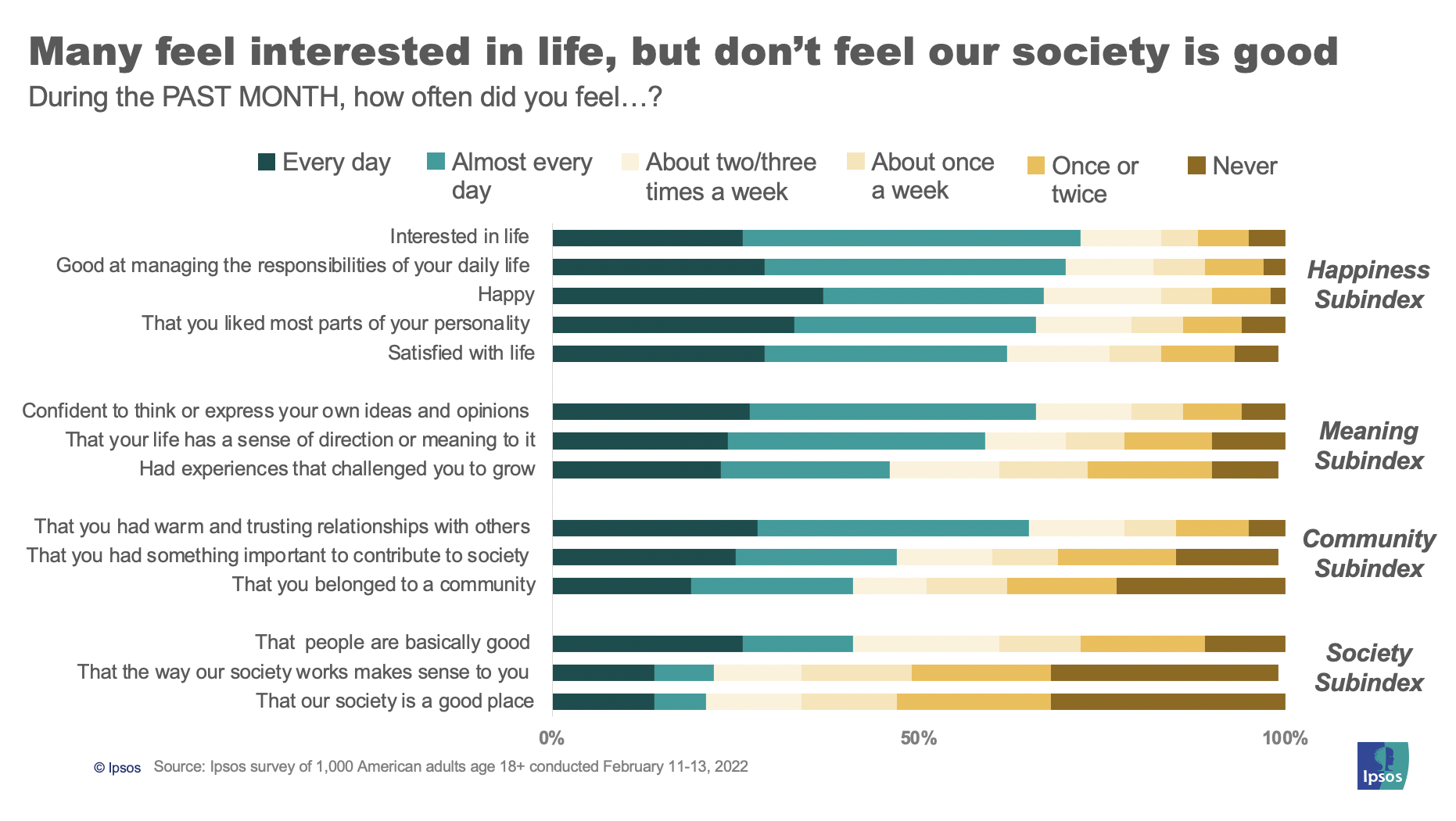
And there's a lot of data on this slide here, but basically what we wanted to do was take a look at how people are feeling currently, both on a personal level in terms of their personal happiness, their meaning, but also how they feel broadly about the community around them and society.
7:22
And these are questions that actually feed into this idea of whether you are flourishing or languishing. And this is not a concept that was developed by Ipsos. This is a concept that was developed by a sociologist Corey Keys.
7:38
Many of you may have heard about this idea of languishing, from Adam Grant New York Times Article last year but what we at Ipsos wanted to do, because we're researchers as kind of dive in a little bit deeper and quantify some of this right now.
7:52
So what you're seeing on this slide is that no, let's take those top two groups and the happiness and meeting.
8:01
And generally speaking, most Americans feel that they are, know, interested in life credit managing their responsibilities, Feeling happy are satisfied, and that their life has meaning to it. But, where we start to kind of break down are these broader, societal implications.
8:22
You know, Most people may not be feeling every day, that And our society is a good place that the way our society works makes sense, or even that people are basically good.
8:35
And what we'll explore today is that this idea of not only languishing, but also holistic well-being. And the mental health care space really goes far beyond just the individual.
8:54
Then finally, for the context setting, and I'd love to bring hanna's experience and expertise on this slide. And this is some data from a recent poll that ... conducted together, and I just wanted to illustrate that.
9:08
No, we talk a little bit about how people individually are feeling now, but this is also what we're up against right now, from a sort of infrastructure standpoint. You know, many Americans say that they are unsatisfied with the state of mental health care in the country right now, and three quarters that middle chart say that they're not content with the status of mental health treatment in this country.
9:32
And I think a big takeaway is, if you look to the right side on this slide, a majority of Americans say that improvements are needed to how we deal with mental health or suicide crises in this country or a drug and alcohol crisis. and there's a lot of strong intensity behind that. Most people say that significant improvement is needed. So what does what does that tell us about how we move forward from here and what we need to do?
10:01
Yeah, and hearing all the data up till now it's just it's what we're witnessing here at me. And now I think it's what we've experienced for a long time, but I think for the first time throughout the pandemic, so many people have realized how their mental health, the people around them is fragile. It really does impact all of us. And so I double Edge sword that we're at a point of acceptance. But there's really a lot of need out there for mental health care, someone to talk to, at the very least, to deal with these ebbs and flows as as we deal with different searches in the pandemic.
10:37
And and differences of, of how we approach pandemic safety, Know, when we see 75% are not content with the status of mental health treatment in this country, it's really not surprising and, and that's really because there is a very fragmented mental health system. We know it really varies community by community. And it's streaming and already precarious system. A great deal because so many people are trying to get help, and there isn't a lot of help available. About 130 million Americans live in Mental health Provider Shortage Areas. It's a huge proportion of the population. We just don't have enough workforce to really meet the need, and, unfortunately, a lot of people are forced to pay out of pocket, if they can find a mental health provider.
11:27
So when we look at this, in terms of equity, it's also a big concern, because not everyone can afford to pay out of pocket for mental health services.
11:35
Yet, we're seeing huge to meet demand for having someplace to go, and getting that help, as we deal with not just coven, but social unrest and social justice movement. And so much has happened in the last few years.
11:49
It's really been a jam packed two years in terms of what's been happening in our society, And so, you know, that this is, we're at, uh, important tipping point in terms of how we invest in mental health care and really realizing it is something that we need to look at a little bit more holistically.
12:09
And if we think about our youth as well, I think there's really big focus. And I know we worked with ... as well on a poll of parents. And almost half of parents are concerned about their children's mental health coming out of the pandemic.
12:23
And when you're trying to find a provider for children and youth mental health, it's even harder to find somebody who has a focus and expertise in that area.
12:33
So, you know, it's, it's an important inflection point because, I think, know, just in terms of maintaining overall wellness, people are realizing that mental health is part of their overall health that they need to address and make sure that they're getting those those those checkups, just as they're going to their physicals every year. They need to be talking with mental health professionals to really address their, their well-being.
12:57
You know, in our community research, we see the same thing. And I think the last two years has really been critical in that it's normalized now. The need for mental health.
13:08
And people recommended, you know, when we ask people how would you recommend to others to deal with the pandemic and cope?
13:16
You know, a couple of things that people absolutely talk about is, of course, friends and family, but they also mention like us, their spiritual home. So that could be like a minister pastor, their physicians or personal physicians. But lots and lots of people say, Hey! There are people out there who need mental health, and they need to seek professional help.
13:43
And I think that's a little bit different, perhaps than what we maybe would have seen like three years ago, four years ago, you know that culture's really changed. When it comes around the awareness of mental health.
13:57
Yeah, it's a lot more normalized now to seek that help, which is great. But it also means we need to invest in that infrastructure to make sure that when people try to seek that help, it's it's actually available in their community, and that it's strong in every community and isn't just available for some who have the resources to obtain it.
14:18
That's a great point, and, and I think, too, I have to wonder if one of the reasons why, um, people are starting to have these conversations about seeking mental health care is Certainly, we are at this inflection point, as Hannah pointed out and the past few years have really taken their toll. But this idea of languishing, as you see on this slide is almost like this, this feeling of of just being stuck in the middle, right? I remember when that New York Times article came out last year.
14:55
It was being described as sort of like not not feeling depressed, right, but you're not necessarily happy or content with everyday life as well. You're kind of just muddling a little bit and, And as we sort of experience, all that's happening around us.
15:13
I think it's, it's forced people, to kind of reckon with what it is that we were dealing with and, and to be a little bit more introspective of, no.
15:23
No, I don't have depression, but maybe there is something going on.
15:27
Maybe there is something here and kind of going back to that slide that we showed previously with all of these these four indices about happiness society meeting, and all of those colors, basically what it boils down to is is this right here.
15:46
And, and again, this is something that the sociologist and came up with and have, you know, I know folks in this field have been exploring for many, many years at this point. But basically, if somebody is flourishing, if, you know, if they're feeling happy and good, they have more personal happiness, get a broader sense of of meaning from the world around them, a sense of belonging. Again, which I think is very important and speaks to what Chad was just saying, that people are looking to not only friends and family, but to others in their community around them. And also a greater sense of hope. And so if somebody you know on the flip side of that is languishing there are less likely to feel these things.
16:29
And so I think as as we look to move forward here, this right here is sort of what we are tasked with addressing.
16:42
And part of the reason why we at Ipsos wanted to actually explore this phenomenon of flourishing, and languishing a bit more is because we were curious, you know, what does this look like? Who, who is impacted by this? And we ran the survey in 20 21, right after that article came out, and again, this year, and there hasn't really been much change overall, but one thing that really stood out to me is, it's, it's really those younger generations ... and Gen Z, particularly Gen Z Those who are 18 to 25.
17:19
If you look at that, about one in three, no answer these questions and are characterized based on, you know, having a sense of languishing. And same thing with, with your income level as well.
17:33
Those who are lower income who may have also been more likely to be working out, you know, outside of their homes during the bulk of the pandemic are also more likely to experience this.
17:49
We were really interested in understanding at a personal level level how lingual languishing manifests in people's lives. So again, we went out to our research community and talk to folks and kinda help them identify whether they are languishing or not languishing, and then we ask them, how does that? How does that play out in your life? And we kind of came up with these these big themes that people are really feeling right now.
18:18
one of them is really around inertia and just kind of having that lack of energy that to get up to get going, a lack of motivation, we and others really talk about stagnation and they just felt like it's like groundhog Day. They're going through the motions every day, kind of stuck in a loop.
18:37
We also heard some of these folks talk about hopelessness, and just this idea of sync their weary. When Will coven ever end? And it's really weighing on them.
18:48
We have people that despite, you know, the vaccine, and despite some of the progress we've made, they still feel trapped. You know, they don't want to leave the house. And for many people, because, they're not out looking for new work, they're finding that their work is filling a little less meaningful.
19:08
And then, of course, we have people, unfortunately, who are feeling isolated, they're missing times with friends and family, and, you know, we had some stats around that.
19:18
And among those people who were languishing, you know, nearly 75% talk about the fact that they can gather with friends. And they can't go out and, you know, do fun things is really, really impacting their lives in a negative way. And, you know, it's getting to be summer.
19:39
And people love getting out, they love getting to concerts, they love going out with friends. And a lot of people are choosing not to, and so they really feel like they're missing out, and just the joy of life is kind of passing them by.
20:00
And if I could just to emphasize a point that you made, Chad.
20:04
You know, I think that loneliness and isolation, you know, for a long time, you know, as those of us who've been in the mental health space, as we turn to friends and family in times of struggle. And, you know, that's really what we depend on.
20:17
And those positive social connections have been shown repeatedly to contribute to overall mental well-being. So for those who are languishing, it's really this vicious cycle of feeling isolated. Then you're not connecting with family and friends and doing anything. And then you feel even more trapped, more lonely, more helpless, and it really just feeds on itself.
20:36
You know a a lot of people have also lost the people that they turn to as a result of the pandemic. You know, we've lost many lives and it's, it's really disrupted. That for, for a lot of folks, so, you know, colleagues, family, friends, that they may have turned to that were part of their, their social network, Really, that has been disrupted completely, whether they've lost a job or, or somebody has passed away. It's had a huge impact on day to day lives. So, you know, I think there's a lot of impact here on overall well-being when we think about those different factors of not being able to socialize or doing the things that we can look forward to, it has a huge impact.
21:20
Absolutely.
21:21
So, I think we've We've talked a lot about where, where we've been. And this idea of languishing this chat, I think he summed it up really well. The sense of a lack of inertia, right? Feeling stuck.
21:36
So now I think we need to kind of look forward, right? Where do we go from here?
21:42
Not even as we're, you know per your point, Hannah, not even as we're coming out of the pandemic but as we were just moving forward collectively in a society where a lot is happening right now global unrest on top of you know the the pandemic ends And I think that's really the question at hand right for?
22:01
For companies, for brands.
22:03
For those in the healthcare space and Just for us as individuals and how we relate to each other and communities right and how do we look at our own health care and our own well-being from? Here.
22:16
And one thing, Chad that you did that, I really like is, is this on this slide, which I'll let you talk about, but, you know, what advice would you give to somebody that's, that's feeling these things and going through it right now.
22:30
Thank you. Yeah, we talked to over one thousand people.
22:34
And we ask them, how would you advise those who are coping with the pandemic, Helping them to move beyond just living and staying in that inert state. but moving on and actually progressing, and maybe even moving to that flourishing space.
22:51
And like we talked about earlier, mental health now is just, know, really just part of the site geist. It's like everybody's talking about it. And so there is this balance, people talked about mental health, and they talked about physical health.
23:07
With mental health, you know, lot of people said it's really important to keep your brain, you know, exercised. So, I don't know how many of you are doing Word all?
23:17
I got Wardle today and four rounds of a little tricky, but, you know, really suggested that people use some of the games, the apps, and things like that.
23:29
But then there was a lot of talk and advice on just staying focused, and I have a quote down here on the on the left-hand side of the page, and you know this, this person said, curb any negative thinking. Remember, So much is in your own hands.
23:45
And so there's a lot of people that said, you know, you really just have to kind of apply their work into staying positive.
23:53
I'm really focused on gratitude, putting yourself and surrounding yourself with people that are, that are really positive.
24:01
And then they balance that out with physical health. And so, of course, exercise was mentioned, and some people, you know, we're gung ho and take on something new. But a lot of people just recognize that just getting out and walking is, you know, perfectly fine, and it's super helpful.
24:20
People also recognize that environments are different for everybody.
24:25
And so, you know, if you're at home, take advantage of it.
24:30
Think about hobbies, thinking about different things that you can do, but a lot of people talked about the power of nature, And getting outside, and just breathing, and being around trees is something that can really be healing.
24:47
Then, lastly, well, yeah, there was leisure, which I kinda talked about, with hobbies, and so you'll find some new things to do, but, you know, the other big part of it, Hannah really kinda talked about it is, just that connection with people, and, you know, friends and family, your work colleagues, and just how important it is.
25:09
And we're gonna see in a couple of slides, really how important your customers, or your constituents, how they feel about connection, and the role that it plays in their lives.
25:33
Yeah, That's a great point, because this is certainly all, and what, what the individual can do, right, which I think plays a big role in it, but, But it's not the full picture, right.
25:43
And we also need to address kind of infrastructure around people.
25:49
But, as you can see here, am No, there's a very clear difference, and this is back from our survey, that we feel that recently, too.
25:58
Kind of revisit this idea of languishing ants.
26:02
There's, there's a very clear difference between those who feel that they are flourishing.
26:08
That they're doing well versus those who feel like they're kind of stuck in the middle In terms of whether or not there. They're actually coping, you know, maybe whether or not they're doing some of the things that Chad just walked us through.
26:23
And, um, I think one thing that was particularly striking to me in this data set is is the third point here the pandemic has not impacted my mental health or well-being.
26:36
There's a more than 30% point difference between these two groups of people at most who are flourishing, say that they agree that the pandemic has not impacted them and compared to just 39% of those who feel that they are languishing.
26:52
So there is a no significant portion of our population who again, may be out there thinking, Paul, I, I don't feel depressed. I don't, I haven't been diagnosed with a mental illness, but something is still going on and, and all that's around us has impacted me.
27:10
So so what now, how? How do we help those people?
27:15
Mallory I'm just pointing out I was looking at some data this morning and another data set yesterday.
27:21
And, you know, I think it's important to recognize also, while here we're talking about the pandemic. But Ukraine and everything that's happening in Ukraine is creating a lot of emotional turmoil. And people I was watching videos yesterday, people talking about what's most important to them right now. And people are really, really struggling and feel so helpless with what's happening in Ukraine.
27:51
And that is just layered now on top of all of this other, all of these other things that are going on as a result of, you know, being in this pandemic which is moving into an endemic.
28:07
Yep, I think that's a great point.
28:09
Again, know, all of these feelings, and what we're talking about here today, does not exist in a vacuum, and a lot of it is driven by Cov Ed, but I think it's, it's part of the bigger picture of how, how we deal moving forward.
28:25
Here's just some data points to backup. Chad, what you are talking about is no thing, steps that people are taking to make a difference to their own personal happiness, and, again, sort of on the individual level. Whether it's making a point to eat healthy, and spending time outside in nature, and donating money to charity, or your time. And across the board. Whether it's doing something for yourself or doing something for others.
28:53
You can see that those who are experiencing these feelings of languishing are certainly lagging behind those who, who generally feel better and in doing some of these behaviors to kind of perhaps shift their perspective or change their mood.
29:11
Malory, I'd just note that these are elements that you just talked about, that we have known, have really contributed for people with mental health conditions, and I'm getting on staying, while there's a lot of research on the positive impact of exercise and physical activity, schedules, and consistency of eating, healthy lifestyle. So, I think that's just really reinforces, when we see those are flourishing, are really focused on these activities, how much of an impact they have on overall wellness and mental well-being.
29:43
So, you know, I think it really speaks to a lot we've been seeing in the medical side for a long time, but that really applies to a lot of people, whether you have a diagnosed mental health condition. Or you really are languishing right now with where we are in the pandemic and and society at large.
30:00
And it's interesting, too, I think, many employers and companies are starting to look at some of these behaviors and think about how they can implement them for their employees, right?
30:12
Whether it's wellness reimbursement package, you know, giving employees money to for gym memberships, or things like that, and flexible work schedules So people can take time during the day to exercise or go for a walk.
30:28
Um, And it's interesting, because I do think we are at this tipping point where it is starting to be kind of a focus more broadly than just the individual.
30:38
And a lot of companies, brands, employers, are really looking to how they can implement some of these policies on a broader scale, which Chadd you referenced, and, And I think we can talk a little bit about now, you know, who might be doing that well, and what that looks like.
30:56
Thank you.
30:57
Right?
30:57
So we, again, we talked to large base of people and ask them about what are the brands, What are the services?
31:06
What are some of the products that they recognize and kinda celebrate that helped people and helped them during a pandemic these last couple of years?
31:19
And really people give credit where credit's due, and companies that help connect people to their inner circles. We talked about that, family, close, close friends, their outer circle, maybe it's their church family.
31:34
Those brands have become essential tools in people's lives. And so, there's a there's a lot of different tech companies that were mentioned, But just bring up Apple, through FaceTime, Zoom, and even Microsoft Teams.
31:49
These are brands and companies that are really making a tremendous difference in people's lives. So, if you're, you know, listening to this, and you're a brand, I think the question to ask is, you know, how is my brand?
32:07
Or how's my organization meaningfully helping our customers connect with others in new, better, or different ways? So, a lot of the technology has solved for, right, and people have gotten pretty good, over the last couple of years. Even. Those who had challenges in the beginning, the technology has gotten pretty good.
32:31
As far as helping your customers connect with people close to them, or even broader to a larger community, what could be your role in doing that? And how could you do it a new, better or different way?
32:51
You know, one of the clients I work with likes to talk about, no, consumers left behind.
32:56
You know, can you think about, Do we have people that, we know our customers that might be left behind, and, if so, what role can we play in filling that gap?
33:09
Another, another group of companies and brands that people really talked a lot about, was all around mental health, and wellness, of course, topic that we're, we're talking about today. And, you know, apps like com was, they were talked about quite a bit.
33:29
And people really appreciate them. I have this quote, I just stumbled on it as, I was kinda getting ready for this. And when one of our respondents said, When we ask, you know, what's, what's a brand that's been helpful?
33:45
And she said the Com app, choose.
33:48
I haven't downloaded it yet, but their ads inspired me to take NaN to just sometimes stop and breathe.
33:58
I'm like, Wow, that's that's powerful.
34:00
No, yes, we actually want her to download the app. That's important.
34:05
But, even to know that you can have an important and pronounced profound effect on the community, on customers and potential customers.
34:18
Um, Through your communication, and through the way that, you know, how you outreach in, and all of the different places you go to, to talk to your customers. So the question is, is how can I be part of the solution? How can my product support people in reaching their goals and living a healthy life.
34:40
So that's really something that you can take back to the organization.
34:43
I've got two more.
34:44
But before we move on to those, Hannah Mowery, did you guys have any thoughts or any take on this on these?
34:57
Yeah. I would say, you know, Especially when we like it.
35:00
Apps like Calm and Headspace.
35:02
We've seen a lot of these really come into being or if not, come into being, you know, a lot more popular over the pandemic, because they do kind of help us get past these shortages that we might see and really the hurdles of going to see somebody in person. But really, having a place to either meditate or to talk to somebody. Do those mindfulness exercises. You know, I think one thing we can also think about if you're, if you're a technology company there are a lot of people who don't have good access to broadband so how do we make sure that these are tools that all people can access. So you know I think as a brand when you ask yourself what role do I play even if you don't provide these services? Do you provide a way for people to access them? You know Telehealth has been a really important part of of people getting care during the pandemic. You know, I love when I have a health issue that I know that I don't need to go ahead and see my doctor if it's something that can be done over telehealth.
35:59
I save at the time, go into the office, parking, Waiting, you know, just jump on and it's no different for, or kind of mental health and talking to a counselor or a psychologist or whomever you're, you're connecting with. So, you know, I think there's a lot of ways that brands can think about how they're supporting those connections, as well. There's a lot of opportunity there to really help people get what they need to be.
36:26
Wow, Cribbed point.
36:34
All right.
36:35
Our, know, we talked a little bit about, kind of, how we, we connect to people and, and, and, I think that's a great point about telemedicine and apps that are helping us, you know, be more holistically well, right.
36:52
But now, there's also the side of things like have been watching the escape. So, Chad, I'm curious to hear what you heard.
37:01
And in your community, research about companies that, sort of fill that need as well.
37:07
Yeah. You know, it's interesting.
37:09
I don't think it would be exaggeration to use the word gratitude when people think about a company like Amazon, Wal-Mart or Instacart. There were a lot of other examples. These are just three that I polled.
37:23
People really appreciate the um, almost instant access that they have. Now, you know, I call the right there, right time, there, right place, 24 7. And you know in the beginning of the pandemic, we all talked about what behaviors are going to stick?
37:43
What is going to stay around?
37:45
And I think we all know that delivery and pick up at the kerb, all of that is here to stay.
37:54
And so, and people appreciate that They, they're really, I think they understand. They don't take them for granted. But it has become part of their life.
38:06
And so as a brand, I think the question that you can ask yourself is how is my brand not just showing up to where, you know, this particular product can get to someone's house quickly? But how are we elevating our offer?
38:26
So it is specific to delivery. It's specific to e-commerce.
38:31
And how does our e-commerce offer up no offering differ from what they can find, the traditional channels?
38:41
So, I think there's a lot of opportunity to think about innovation by channel.
38:46
And, the different kinds of products, they may be easier to deliver. They may be easier to pull, you know, when they're pulling it from the store shelves, to ship it out. Like, I think about, you know, when you see people at Whole Foods and their bullying and putting in the baskets. And, and so, you know, you do have opportunities to think about how your product can be made better.
39:08
It can be packaged differently to really support this, you know, the new world that we're living in, as far as e-commerce goes.
39:17
The other thing that people talked a lot about, and this one really surprise me put them, really, really said that, you know, new streaming services, you know, like, HBO, Max, Disney, and then Netflix which is course, of course, in this we kind of old school.
39:39
But they were critical to helping people get through the pandemic and getting through the pandemic. Really important part of people's lives, actually.
39:49
And two other things that came out quite a bit was gaming. I'm not a gamer, so it wasn't something that was a top of mind for me. But for, for a lot of people it's entertainment. It's a respite, so weight, escape.
40:06
But there's also ways to connect with people globally by playing games with them and making connections with them. So gaming was really important.
40:15
And of course, there is a group of the population who is ready to get back on airplanes, ready to get back in the car, ready to get going, and travel, and so that was something else that came through.
40:32
That was really important, And so, really, what people are looking for are experiences.
40:39
And, so, as a brand, I think you can go back and, you know, talk to your colleagues and the power bi product, or how's my service or even the way we communicate with our constituents.
40:52
How does it enhance people's experience and, you know, what levity are we bringing to people's lives and how are we helping people to get those scape that they really need? That's helping them. You know, again, this is all about driving like, how do we get into that that place that we're growing or wellness? And for a lot of people, entertainment is a really important part of it.
41:15
And so you have an opportunity to again, like how can we bring some levity and some fun to people's lives?
41:23
Well, it's not, it's not just that too but the common thread that I see through all of these companies that you've talked about here is, you know, bringing this back to what we're looking for As we think about well-being is a sense of ease, right? As the ability to access health care at your fingertips when you need it, the ability to get food and groceries delivered to your home, you know, whether you're in a central worker. Or you've got kids at home. Or you're sick, you know, and ease of of entertainment and connection with people as well.
42:00
And so, I think that that sense of how can we facilitate ease and per Hanas point, how can we make that is equitable, right, is, is a big key to the future of wellness and the future of how we look at our collective well-being.
42:24
Then, finally, I'd just say this right there, there is also broad support from the American public.
42:32
And way back at the beginning of these slides, we talked about this profound need that something needs to change, particularly when it comes to mental health care.
42:42
But, there's also broad support for making those changes and developing a more critical infrastructure. Again, this data comes from the work that that Hannah and I did together.
42:53
And as I told you, Hannah, when we actually feel that this and we're going over the results, it's, it's not often that I see numbers like this. You know, when I'm conducting public opinion research on support for policy initiatives.
43:08
So, this is really striking. And, you know, around 9 and 10, want to require all health insurers to cover mental health crisis services.
43:18
Um, you know, or support the creation of 24, 7 call centers to deal with mental health crises.
43:23
And so, not only are we talking about this ease of access for consumers, but we're also talking about this desire, this bigger push, to make a change, And I think we're at this point where there is some momentum here, right?
43:41
There's, there is acknowledgement that, because of everything that has happened over the past two years, change needs to be made.
43:49
There's a desire to make that change, we're kind of seeing a little bit of what that could look like on the consumer side, but also from the policy perspective to there.
43:58
There really is a broad push, that now is the time to act, and to work to collectively improve our mental health crisis response in this country, and to help people who are suffering and who are trying to work through some things right now.
44:18
Yeah, and, you know, I think if you have a physical health crisis, you have a heart attack. You call 9 1 1, and you have an expectation of what is going to be available. You know, EMS is going to be dispatch, you'd probably be taken to a hospital.
44:30
And I think that there has been, as people are more exposed to mental health, over the last few years of really thinking about it and being concerned about their loved one's mental health or their own, that they're feeling a lot more vulnerable. And realizing that that infrastructure is not really can place If their, um, their mental state deteriorates. Is there going to be help available for them for their child, for their spouse or their brother or their sister?
44:57
There's a lot of concern out there. You know, health insurers don't cover a lot of mental health services still. So, you, know, again, it makes it really hard to access it. And a lot of the mental health providers out there are, don't take insurance, because they're, it.
45:13
Reimbursement rates aren't high. So there's a lot of things that we need to do to make this accessible.
45:18
And I think people are really realizing that languishing. It just can take one thing to to kind of push you into a mental health crisis state. It may be temporary, but when you, if you are there ever, you want services available that treat you with dignity and respect and get you the help that you need, just as would happen if you break your arm. Or, you know, if you get cold it, that there's healthcare available. I think, again, it's just addressing our overall health and wellness that this is something that's really important.
45:52
All right, well, we've spent a lot of time walking you through, kind of some, some existing trends.
46:00
Look into sort of what, what public opinion says around our current well-being. And so we've got a couple of time for questions.
46:09
There's There's a chat function here. So feel free to type in your questions. We'll do our best to answer as many as we can during the time that's remaining.
46:23
Chad, I think you're the keeper of the questions. Do we have any that have come in so far?
46:27
Yes. We have a, Yeah. This is very interesting.
46:32
The question is, is there seems to be two groups at odds right now.
46:36
Those who are more comfortable resuming normal life. And those who feel coben remains a high threat to them.
46:43
How does this dichotomy affect our current approach to mental health care?
46:48
How do we deal with these varied approaches coming out of the pandemic?
46:55
I think that's such an interesting question because, you know, as I mentioned before, our social networks are so important.
47:01
But, there is this real dichotomy of, I know people who are still really, you know, being extra cautious. Have extra concerns in their life. Are worried about the the pandemic and those who you are feeling like they are ready to be more out in the world, or have to be and so, you know.
47:21
It is creating strains on those social networks that we depend on, because people feel differently than the people that they're closest to and so it's just it's contributing to this cyclical nature of of languishing, and really impacting the relationships we depend on most. So, I think that's one thing that's a real big concern.
47:43
And certainly, you know, brands that are thinking about this, too, is how do you message to those different types of customers. and where they are. And, and really not try to pit against each other that that kind of anger and frustration doesn't help with our overall wellness. But it also makes us feel like the people we typically depend on, we can't depend on right now because we feel so differently from them, so it does have a huge impact of when we look at mental health and and how we help people coming out of this pandemic. So it's an interesting question, and I think something is how we really.
48:19
How do we bring people together and not feel like they are pitted against each other, which frankly, you know, I'm a political person That's hard, and it's, it's it's hard in all aspects. It's a highly partisan environment, too, and that contributes to it. You know it, If you're not with me or against me, and you know, that doesn't help in any aspect of this, makes people feel connected and feel like they have the support they need.
48:45
Think your last point is exactly right Hannah.
48:47
and you know for the past two years we have been working with ...
48:52
to track behaviors and attitudes around the pandemic through the axial Ipsos Coronavirus Index and the biggest shift that we've seen when it comes to your current behavior. You know whether you're leaving the house, whether you're seeing people, your perception of relative risk around the pandemic, your willingness to get vaccinated, or to get boosted.
49:16
It has all become highly, highly politicized and very partisan.
49:21
And I think what we don't want is four, you know, whether it's mental health treatment or the idea of wellness or self care to become politicized.
49:34
Right.
49:35
You know, this, this can be kind of one of those things that, um, and those rare things at this point may be in touch and have a red or blue attachment to it.
49:46
It is, yeah, it is really one of those, those rare topics right now that is non partisan, non even bipartisan. It's really non partisan because.
49:56
So we always say here at an ami no mental health mental illness doesn't discriminate and it can impact any of us at any time.
50:03
And um, you know we're really seeing strong support on both sides of the aisle and I think that's, uh, we don't want it to become politicized and we don't want people against each other, That's kind of what we experience for decades. In terms of seeking mental health care, there was a lot of stigma attached for men and we're finally moving beyond that, which I think is a positive outcome of the last few years, is that we're really smashing that stigma.
50:31
We have a question from Steve, He's asking, how concerned are you that high inflation and falling real incomes will impact mental health consumers.
50:43
Ability to afford mental health treatment does Ipsos have additional research about what that does It does.
50:52
It does have future research about what that a future looks like.
50:59
Yeah. I can start off with this.
51:03
Because we have done a lot of public opinion research around inflation right now, and I can tell you that people are certainly feeling and more constraints when it comes to no economic uncertainty, but also their day to day I say.
51:20
I think the place where people notice at the most is, you know, the price of food and the price of gas, right, and we know that the price of gas. fluctuates wildly, of course, but obviously, prices are higher right now.
51:34
Um, And And it does impact things like consumer confidence, and it impacts things like your willingness to make larger household purchases and, and your own feelings of financial insecurity.
51:52
Now, we've not asked any questions directly about the impact of this on seeking mental health treatment, but what I can tell you is that for many Americans, you know, inflation and price increases. Certainly are a stressor, particularly for those who were seen at the very beginning of this deck to show more signs of languishing. You know, younger folks, lower income folks.
52:19
And so, you know, again, I think it becomes a question of sort of two parts, right?
52:26
Is seeking mental health treatment, an additional source of anxiety, or a stressor from a financial perspective, And I think it's certainly possible right now, given what our data is, showing people are feeling more broadly.
52:41
It also speaks to Hannis point on, on equity, and I'd be curious if you have anything to add.
52:46
But, but, really quick, first, I'll just also say that, that, yes, we have done research around inflation, and we've also done research around the future of, of wellness and health care.
52:58
On our what the future series we did something about wellness and that took a big look at how technology might factor into the future of wellness and health care.
53:11
Things like telemedicine, right, and how that could even impacts elder care for those who perhaps are in the sandwich generation right now or caring for elder family members.
53:25
And, no, again, we have to juxtapose that, again, questions around access and affordability, and equity.
53:36
Hannah, anything else you want to add there?
53:39
Yeah, I think there's been real challenges, enough boarding, mental health care for a long time, because there are such high out of pocket costs, because not all insurance covers mental health care, insurance is required to. But also because people are often forced to go out of network, which means we're paying a lot more out of pocket, and just with the high prices that we're seeing, it reduces the amount that people have to spend and they have to make cuts somewhere. But we also know that in tough economic times people's anxiety worsens their mental health may deteriorate because money concerns are such a big concern.
54:17
So you know you have those two forces and Mallory I just want to, you talked about the sandwich generation and caregivers. That's that's an area that we're always concerned about.
54:28
The people who are helping others with health conditions or mental health conditions who are worried about their parents, their kids.
54:38
What is this all doing to them? And you know, so I think there's real concern about the strain and the mental impact on caregivers of all types because it is a strenuous situation of trying to hold it all together for others and has a huge impact on people.
55:00
We have a question. They're asking, how can my brand help our customers live their best lives? How can we support them in getting the help they need?
55:12
I can tell you some of the research that we did, a lot of people talked about.
55:18
Yes.
55:19
And the help that they, that companies can provide through the insurance providers and just making sure people understand and know how to get there quickly, whether they're gonna call or where they are going to do it online. So, I think that's a very easy, practical solution.
55:40
And you're referring to employee assistance programs, right?
55:43
Yes, yes, Sorry. Yeah.
55:46
Yeah, I completely agree with that, Chad. I think there are two things there and your employee assistance program, and how much mental health support is that offering. And do people know about it because often companies provide EAP.
55:58
Is that, know, people forget about, they hear about it once a year in their benefits overview, and they forget that it's a resource available to them.
56:06
But also, when you are negotiating your renewal for the insurance coverage you provide for your employees, does it have substantive mental health benefits? Are you reducing those out of pocket costs so your employees can go get the help they need, And I think talking about mental health, just making it part of the conversation, not asking people if they're sick, what their, why are they say, you know, normalizing mental health days. Those are things that employers can do and I think it really does play out to consumers when they see companies doing the right thing like that. And I'd also be remiss if I didn't note that companies should be sharing 1 800, 273 Talk. That's the National Suicide Prevention Lifeline. And a lot of the research we've done with Ipsos is about the transition of that Lifeline to a broader mental health crisis line this Summer, which will be available to everyone at an easy number 9 8 8 No matter where you live.
57:04
If you dial 9, 8 8, you'll be connected to local call centers with trained crisis counselors. And it's, it's not just about suicide prevention, it's anyone who needs help and need someone to talk to, That's a resource that's available.
57:18
So it's 1 800, 273 Talk 8, 255 right now. But later this year, after July 9, 8 8. Anyone can dial it. And I think companies can play a big role in making sure that consumers employee their employees. Everyone knows that that resource is available no matter where you are.
57:37
That's a great opportunity for brands to get involved and make a meaningful impact in a big way. Consider, they've got loud voices And people are listening to them. Their customers are listening to them, so that's exciting.
57:52
Yes, we're very excited about it.
57:58
OK, do we have time, or looks like we're just at time, Unfortunately, follow up and answer some of these over e-mail, we can do that. We can e-mail people, answers to their questions.
58:16
Guys, thank you all so very much Mallory, Hanna, Tad, What an incredibly important and relevant presentation you guys just gave one way? Um, and thank you, everyone, for joining us today on this on this webinar.
58:32
If we didn't get to your question, as they mentioned, we will do so by e-mail, and you will also receive an e-mail with a direct link to today's recorded presentation. as well as the slides from today.
58:44
And, of course we are, we welcome the opportunity to speak with you, so, please feel free to reach out to us.
58:51
That now concludes today's webinar, so have a wonderful day, everyone.
![[WEBINAR] Ipsos Global Trends 2026: The U.S. Edition](/sites/default/files/styles/list_item_image/public/ct/event/2026-09/thumbnail-gt-26.png?itok=AbsiS6xk)
![[WEBINAR] Know America at 250: Public Opinion Update](/sites/default/files/styles/list_item_image/public/ct/event/2026-09/250_0.png?itok=zfBpfzIn)
