Workers expect both carrots and sticks in their AI futures
The Ipsos Consumer Tracker, fielded on Ipsos' Omnibus platform, asks Americans questions about culture, the economy and the forces that shape our lives. Here's one thing we learned this week.
Why we asked about AI carrots and sticks for workers: A futurist friend was giving a talk recently and discussing the metrics of productivity, and efficiency that executives seem to be chasing. If AI makes workers more productive, she wondered, would they want to be rewarded by a shorter workweek or higher wages? If only she knew someone with a survey vehicle in field fortnightly who could get some actual data on that… Oh. Wait. She does!
What we found: As we started to draft the question, we realized there was a really big assumption built into it: That any workers would actually be given that option. There’s been a flurry of headlines about CEOs laying off or hiring fewer workers due to heightened productivity (whether real, or hoped-for gains, because the productivity boost itself is deeply disputed.)
But when I asked an LLM for examples of workers being rewarded, it found only a few examples of shorter work weeks, but some evidence of higher wage growth in jobs most impacted by AI.
We then reframed the question as “What do workers expect if they get more productive?” Turns out, it’s complicated.
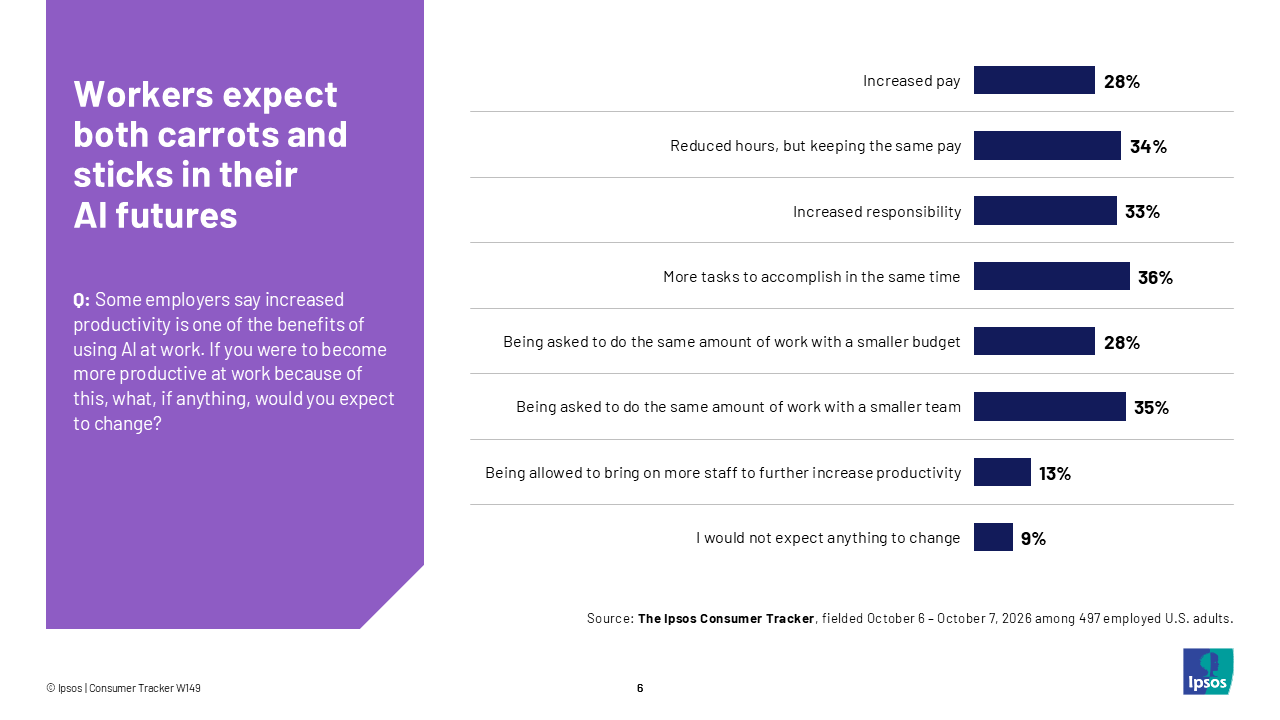
Workers are just as likely to expect sticks as carrots. How so? Sticks included increased responsibility (36%) and being asked to do the same amount of work with a smaller budget (28%) or worse, more work to get done in the same time (36%).
The carrots were expected by about the same numbers of people. Increased pay (28%) was expected by slightly fewer people than shorter hours but the same pay (34%). Notably, only 13% said they thought it would lead to more humans on board to keep boosting productivity. And only one in ten (9%) said they expect no change.
All of this lack of clarity in risks vs. rewards likely contributes to the broad uncertainty that leads to general nervousness about AI and very specific nervousness about job changes and job losses we see consistently in our data.