
Mapping the journey to sustainable pack: What consumers want
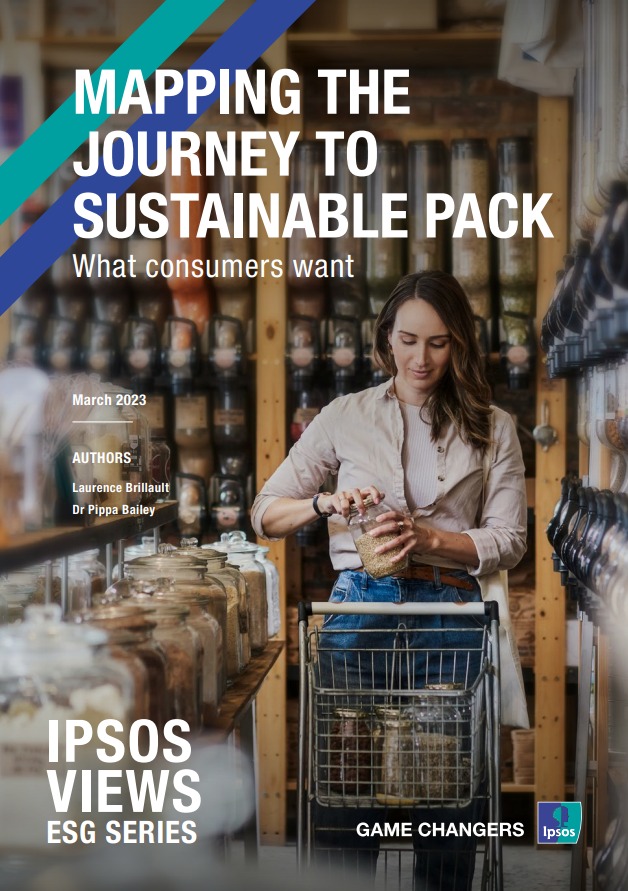 A key part of a holistic sustainability strategy for most CPG companies is their packaging blueprint. And the move towards more sustainable packaging is not only an opportunity to help the planet but also a commercial opportunity, with consumers looking for more environmentally friendly solutions. Considering various environmental concerns, the accumulation of waste, packaging and plastic is the third-biggest concern across the globe (41%), after the threat posed by climate change (46%) and extreme climate events (43%).
However, consumer perceptions of what’s sustainable don’t always align with the actual carbon impact of packaging. To understand the effect of different packaging materials and designs as a driver of choice, we surveyed people across five markets using Ipsos DUEL, a choice-based survey where appeal is defined through preference and response time.
In this paper, we share research on consumer perception of packaging materials, the role of sustainability claims and willingness of consumers to pay for sustainability. Our analysis unveiled five key findings:
- For consumers, there is no universal sustainable material: from one market to another – and even between categories in the same market – what consumers perceive as being the most sustainable packaging material varies between plastic, glass, carton and metal.
- Context, execution and claims matter: even when consumers present a clear opinion about one material being more sustainable than another, they may still choose a product packaged in a different material.
- There is no universally appealing pack-claim combination: between markets and even between categories in the same market, consumers may not intuitively associate a sustainability claim to the same material.
- Most consumers are not ready to pay for the sole benefit of sustainability but sustainability can contribute to the premium perception of the product.
- There is no such thing as an average consumer: depending on their level of concern and their engagement towards the environment, consumers’ attitudes towards material and willingness to pay can be significantly different.
We also share a five-step framework to help CPG companies best design the packaging part of their sustainability strategy:
ORIENTATE – FOCUS – ACT – TALK – EVALUATE.
To learn more about how much consumers are ready to trade-off for sustainability, and what to consider to best design a holistic sustainability strategy, from packaging material sourcing to communication, on or off-pack, read Mapping the Journey to Sustainable Pack.


![[WEBINAR] KEYS: Dialling Up the S In Sustainability](/sites/default/files/styles/list_item_image/public/ct/event/2026-06/keys-webinar-sustainability.webp?itok=xPunvoGu)
![[Webinar] Real-World Evidence: Empowering the Patient](/sites/default/files/styles/list_item_image/public/ct/event/2026-05/healthcare-real-world-evidence-webinar.jpg?itok=kT0PwLPQ)