AI Grows Up: Media Audiences' Needs
AI has entered the mainstream.
Ipsos has been tracking GenAI usage since its inception, and it is clear that there has been a tipping point, with this technology moving from experimental to everyday use.
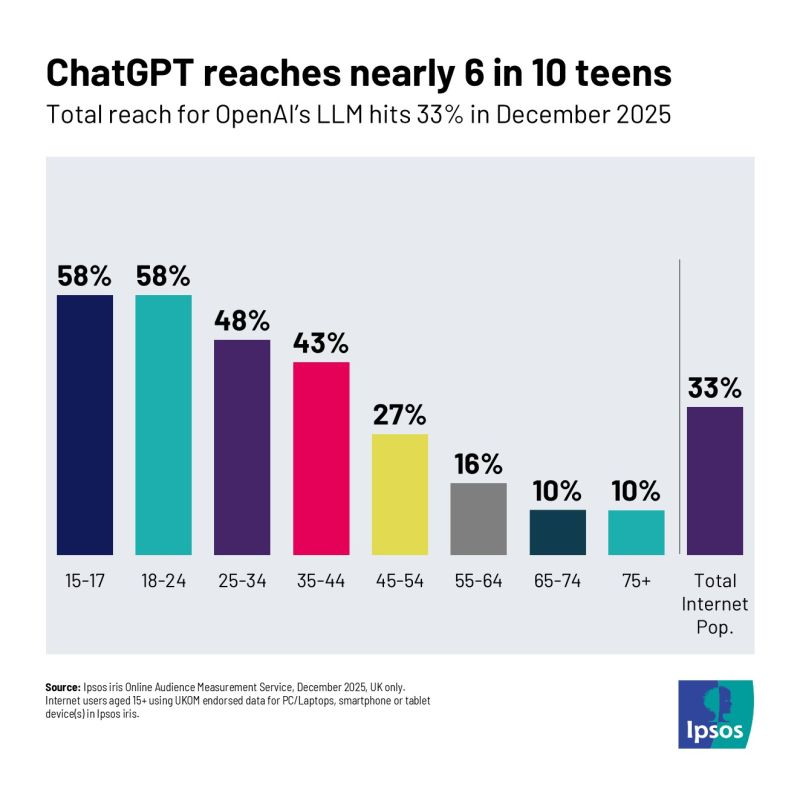
Adoption continues to grow, while habits are beginning to form among existing users. In the UK, over 1 in 3 use it weekly, a rise from 1 in 10 since 2023. Data from Ipsos iris, our passively measured panel for online behaviour, reveals a clear age slope as Gen AI moves from a "novelty" to a daIly tool for younger generations. Although younger audiences show the highest engagement with AI, usage is rising fastest among older groups (+250% among 55+ year-olds*)
We see even higher numbers for Global Influentials, with over 6 in 10 using it daily. AI is attracting and engaging this audience, with 68% saying that when a new product/service describes itself as being “powered by AI,” their interest in the product increases.
Adoption succeeds where it reduces effort.
Practical value is driving uptake. ‘The Our Life with AI’ report from Google, shows that globally, usage has moved on from entertainment and exploration to practical uses. These use cases range from learning and deep understanding (74%), and saving time (65%), to finding the right words to navigate a tough situation (64%). Students, in particular, are ‘super users’ – using AI to understand complex topics, manage day-to-day tasks, and make decisions.
AI is also changing the way audiences discover services, products, and content. Recent omnibus data from Ipsos shows one in four under-35s uses AI to search for gifts, for example. This year, media brands will be grappling with how AI is changing audiences' journeys and the speed at which this is shifting. Trusted insights are needed to keep up, from passive monitoring of complex journeys to tools to dig into Generative Engine Optimisation (like Synthesio GEO).
Media audiences still have questions – and red lines.
Experience is believing. People who use AI more are the most optimistic about its potential – and broadly, there is a sense of trust that the technology is accurate and truthful. We have also seen that as knowledge and usage increase, more questions arise about how this technology works, its impact, and its value.
Audiences are still working out their comfort levels with this transformational technology. Our recent ‘Future Risks report’ identifies AI as part of a ‘polycrisis’ that people believe we are facing. It doesn’t help that extreme cases and media coverage are stoking concerns, such as non-consensual image making.
Our ‘Making AI work for Europe’ report with Google suggests human-centric barriers matter as much as, if not more than, technological ones. Businesses and workers are grappling with questions of relevance, risk and trust in the AI era - which industry leaders in the US delved into at our recent 'After Hours' event.. Similarly, Global Influentials have high optimism about AI overall, but cite the need for regulation,security and transparency.
It is also worth noting, that compared to other industries, media feels different. It unique role in shaping culture, identity and public understanding means authenticity and trust matter even more. In this context, everyday audiences are cautious - and even Global Influentials have concerns about the use of AI to create media content.
This year, the media industry is well into its own journey to embed AI into every part of processes - from content creation, personalisation, to developing new services. In doing so, it is necessary to understand the emotional paradox audiences are facing. It is imperative to understand where audiences are excited, where they need reassurance, and, in some cases, the ‘red lines’ they do not wish to cross.
Keep the human in the loop.
In Generative AI and Audiences: Revisiting UK public attitudes to AI in media, the BBC puts forward an audience-first approach to the media industry for transformation with this technology. Audiences want AI to offer them value. It should be genuinely useful and enhance discovery, access or personalisation without diluting accuracy or authenticity.
Context matters. Media audiences are open to embedding AI into audio and video, particularly for behind-the-scenes tasks such as AI-generated playlists, background music, and AI-enhanced video production. In contrast, they are less tolerant of tasks such as AI voiceovers and fully written scripts, where emotion, lived experience, and storytelling matter.
For brands in this space, visible experimentation and early-moving come with risks. Audiences want reassurance that the media industry will protect the human elements of creativity, emotional nuance, and judgment. Ideally, audiences want human oversight to be visible through bylines, editorial sign-off, and clear responsibility.
Be mindful of high-stakes cases, like News.
For news, tolerance remains narrow and functional. Audiences overwhelmingly reject AI writing original news or generating editorial imagery, citing risks of misinformation and erosion of trust.
This is especially important to consider in light of AI becoming a navigation layer for news. News providers need to be mindful of how broad-reaching usage of AI tools will affect their visibility, transparency, and trust – especially where they have very little control over content.
Our report for the BBC found that the presence of errors in AI news summaries has a significant impact on people’s trust. Most interestingly, people don’t just blame the AI assistant for the error – this is shared with government, regulators, and even the news sources themselves. Because association carries weight, an error in an AI news summary can dent confidence in the outlet named alongside it, not just in the technology that delivers it.
Deliver value, don’t risk trust in your brands.
The industry needs to be mindful that acceptance and recognition of value isn’t enough – there is still work to be done in making sure audiences are comfortable with this transformational technology. Permission to embed GenAI is conditional on offering a balance of benefits and reassurance.
Transparency is critical. Showing audiences how AI is involved and the role of human oversight will help build trust. If done right, there is potential for this to be a competitive advantage.
Each decision to embed AI needs to be a conscious choice, with the audience in mind.
*Ipsos iris Online Audience Measurement Service, Apr 2025, 55+ using PC/laptop, smartphone or tablet device(s).