
Brexit postponed? The view from Milton Keynes
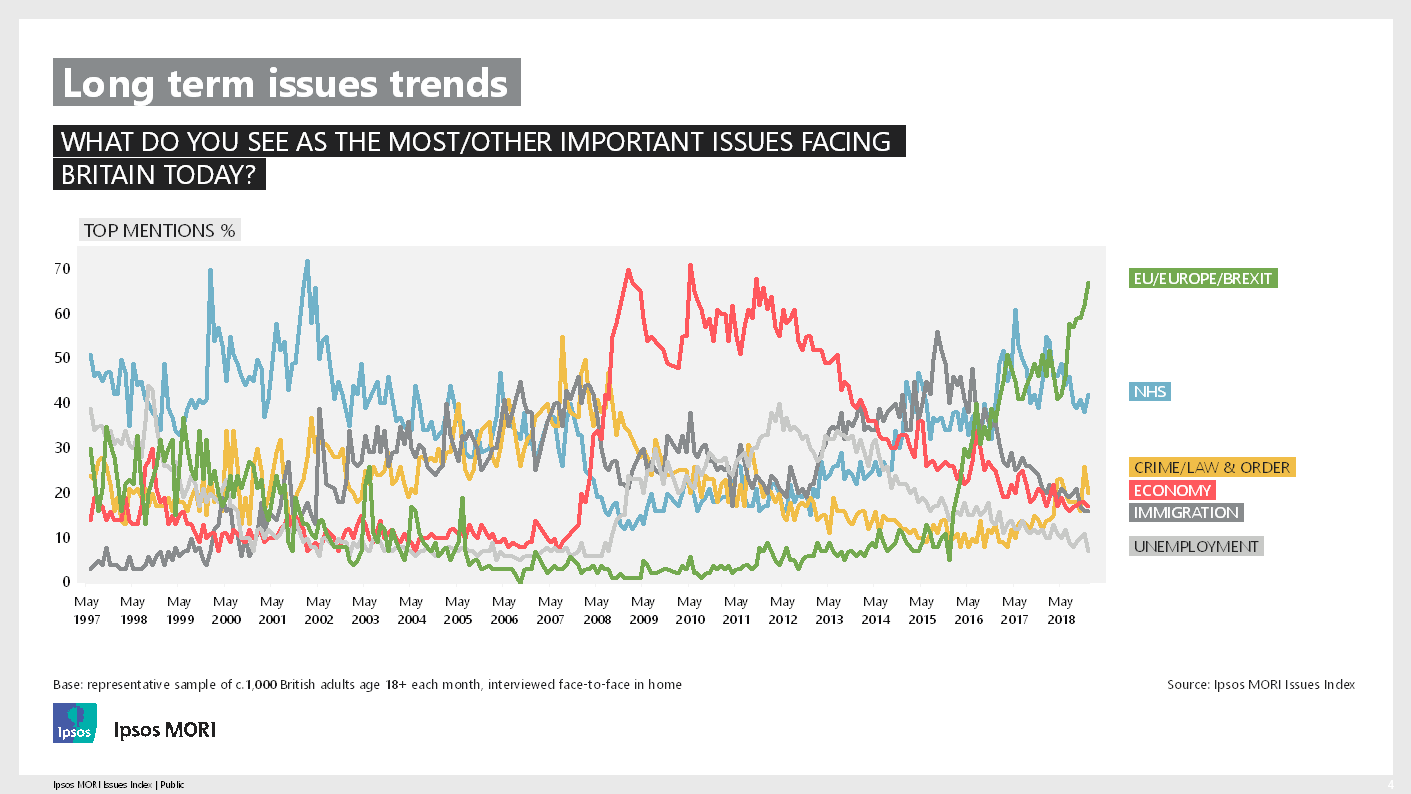
The scheduled date for the UK’s departure from the European Union – 29th March – looms ever closer. For some, however, it feels further away than ever; Brexit remains, by far, the biggest concern to the British people, with 54% of the public saying it is the most important issue facing the country in the latest Ipsos Issues Index . By way of comparison, the next most important issue – the NHS – has just 7% of the population rating this as the most important issue.
Early January has seen plenty of Brexit-related activity in Westminster. The Prime Minister lost her delayed “meaningful vote” by a historically large margin. Following this, she subsequently proceeded to comfortably defeat a motion of no confidence. With progress towards a Brexit deal apparently gridlocked, we visited Milton Keynes with BBC Radio 4’s Today programme. The referendum result in the town closely reflecting the national picture – Leave received 51.4% of the vote – and we wanted to find out what people there make of the current state of play and what they expect to happen next. Here are five things we learnt at a discussion group on Friday night, where we joined the BBC’s Nick Robinson to speak to a mix of Leavers and Remainers.
1. The “facts” remain confused and contested
In keeping with what we’ve heard since the very start of the referendum campaign, participants still felt ill-informed. As they put it, “what’s the deal?” – no one had any real sense of what the impact of leaving the EU might be, with the Leave campaign saying we would be better off but the Remain campaign insisting otherwise. They found the issues around Brexit to be complex and confusing – like “a drawn-out divorce”, in the words one Leave voter – where a huge range of issues, from trade to travel, must be resolved. They were particularly bewildered by recent events in Parliament – no one was sure exactly what the meaningful vote or the no confidence vote would mean for leaving the EU, whether it would happen, or if a second referendum might be imminent.
“You wonder what’s going on and half of these headlines I haven’t heard of…how could there be a second referendum?”
Farhad, Remain
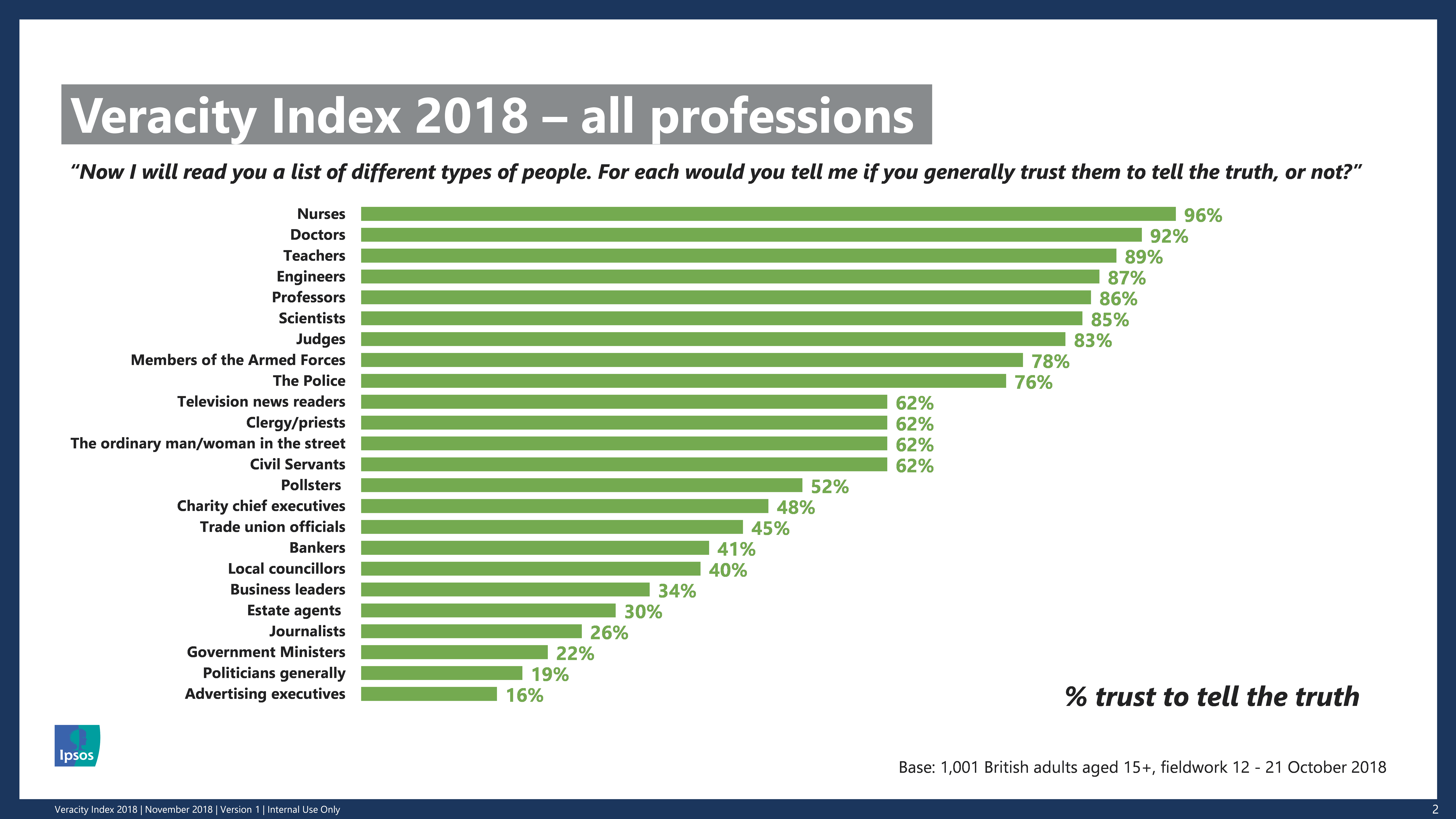
Further, the widespread distrust that we know people have in politicians and business leaders (though it’s a good job estate agents aren’t involved, as our latest Veracity Index shows ), fed the feeling that worst-case scenarios about what could happen when the UK leaves may be being exaggerated – “scaremongering”, as one Leaver put it.
Participants found it hard to accept that big businesses such as Mars or BMW would not find a way to work around any potential problems presented by Brexit or a lack of trade deals. For these participants, “it’s all about the money” and business would find a way to maintain their profits.
“They sell a massive amount of cars in this country. BMW aren’t going to turn around and say no we won’t sell there anymore.”
Glenn, Leave
In particular, there was limited understanding of what the phrase “no deal” might mean. At various points, Leave-supporting participants suggested that neither Switzerland nor Norway have a deal with the UK. Indeed, it seemed that, at least for some, the term “no deal” may just be synonymous with no longer being part of the EU.
2. Leavers are happy to take a hit
Leave supporters also reiterated a point we have heard them make before. They acknowledge that there will be some economic damage as a result of Brexit, but they are happy to accept this in exchange for leaving the EU. In fact, for these participants, there should also be some economic advantages – UK businesses can charge more for exports, while UK citizens will spend more time and money on holidaying at home.
“Butlin’s just renovated Maidenhead and maybe they are thinking people will holiday here. And why not because we are a beautiful country.”
Kim, Leave
This belief gave our Leave supporters the confidence to suggest that the UK would have no serious long-term trouble in the event of “no deal” becoming a reality. For them, there was little need to worry about the future and Brexit should, ideally, happen as soon as possible.
“It’s what he said – pull the plaster off, just go with no deal and walk away. What’s the worst that can happen? We’d suffer and then we start growing again.”
Darren, Leave
3. Mixed views on a second referendum
Inevitably with a mix of Leave and Remain participants, there were different reactions to the possibility of a second referendum. To some, this now feels inevitable. Nearly three years on from the original vote, those in favour of a second referendum felt that opinions across the country will have changed. They also argued that more young people – felt to be disproportionately affected by, and overwhelmingly against, Britain exiting the EU – would now be eligible to vote and it would be democratically right for them to be given that chance.
“The first referendum the margin was so slight and people’s minds have changed. What was it three years ago? You’ve got a whole group of people who weren’t entitled to vote who can now, and they have a right to have a voice.”
Hendrika, Remain
Those opposed to the idea of a second referendum were, as we have seen elsewhere since the referendum, of the view that the decision about whether or not to leave was settled. All that remained for them was to agree how to leave. To them, the idea of re-running a referendum so soon after the last one, and without yet enacting the result, would be “lying to the people” who voted for Leave in the first place. Further, there was a sense that another referendum so soon would be faintly absurd. Where, they asked, would this all end? Would Remain supporters keep calling for an endless series of referendums, until they achieved their desired result? And what then, after that?
“A second referendum? What if Remain wins by a narrow margin? So we say we need yet another again after that?”
Darren, Leave
4. People are running out of patience
With no one in Westminster seemingly able to agree on a clear way forward and ever more confusing messages circulating about what was happening and when, the patience of our participants was beginning to wear out. Leave supporters simply wanted the political class to get on with Brexit and had little patience for the apparent procrastination. They believed that the process was being overcomplicated and should be more straightforward.
“We’re just going round and round on a hamster wheel.”
Kim, Leave
Even for Remain supporters, frustration at the current impasse was evident. The lack of certainty about what happens next, about what the impact of Brexit might be, or if it would happen on schedule meant that they could not get on with life as normal. They felt unable to plan holidays to see family in other parts of Europe. In one case, a Remain voter described being unwilling to move forward with buying a new house in case prices changed in the aftermath of leaving the EU.
“I’m looking to buy a house too and I’m waiting until after Brexit in case prices go down. I need to move on with my life.”
Farhad, Remain
5 Brexit will be delayed
Most strikingly, there was a clear consensus among both Leave and Remain supporters that no one expected Britain to leave the EU as scheduled on 29th March and that there would be an extension to Article 50. Despite a clear sense that they wanted the debate over and done with – for better or worse – they also felt that a delay was inevitable at this stage. But any delay must be closely tied to a clear plan for how to use that time wisely.
“We’ve spent so many months and the public are still uncertain. But you’ve got to think of the greater good. If it’s only a year then fine, but if there’s no plan what’s the point?”
Nigel, Leave
*********
So, ultimately, our discussion in Milton Keynes told us one key thing: there is no optimism about Britain’s departure from the EU being sorted out any time soon. There was a strong belief that it is currently impossible to find a deal that satisfies everyone. Consequently, the debate is expected to go on for, at the very least, many months to come. Which – in Milton Keynes, at least - which, at least – is seen as a necessary evil.


