Majority of Britons support the UK applying to join the EU
- 56% say they would vote to apply to join if there was a referendum. 30% would vote to stay out.
- Majority think joining the EU would have a positive impact on the British economy long term and national security.
- But 4 in 10 think it would harm Britain’s ability to act in its own best interests and just 1 in 4 say it would make it better.
Should the UK join the EU?
When asked how they would vote if there was a new referendum, 56% of Britons say they would vote to apply to join the European Union. 30% say they would vote to stay out. The rest say they don’t know, wouldn’t vote or prefer not to say.
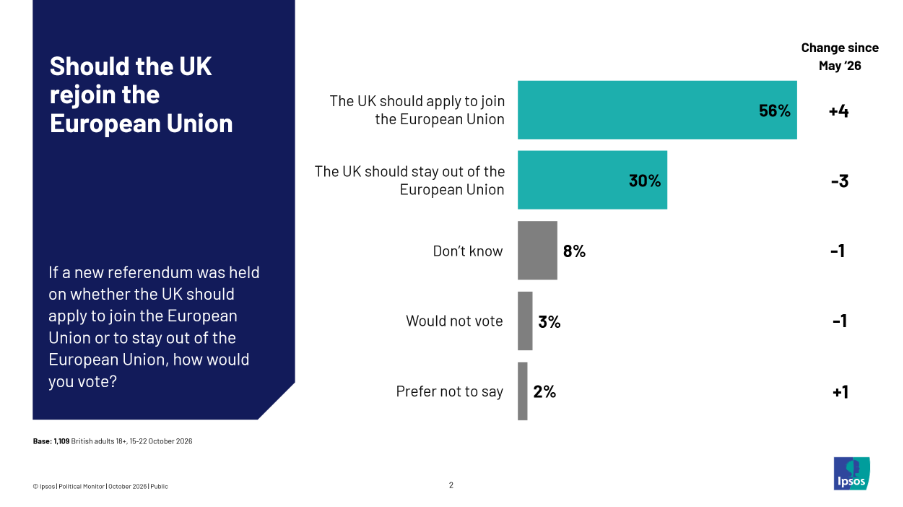
- Support for joining has increased 4 points since May whilst opposition has fallen 3 points.
- 77% of 2024 Labour voters and 73% of those aged under 35 support joining the EU.
- However, 47% of those aged 55+ would vote to stay out (39% to join), as do 76% of 2024 Reform UK voters and 54% of 2024 Conservatives.
- When overall numbers are filtered by likely voters in a future referendum 63% support joining and 34% oppose. 3% don’t know.
Should there be a referendum?
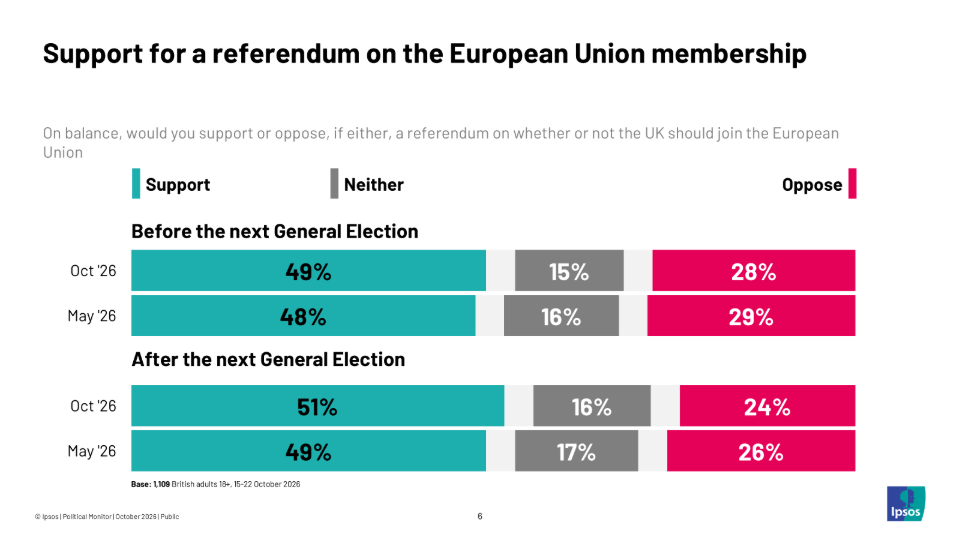
- When asked whether they support or oppose a referendum before or after the next General Election 49% support one before the next election and 28% oppose, 51% support one after the election and 24% oppose.
- Our survey also asked whether the public support joining the EU without a referendum if Labour win a General Election with a manifesto commitment to do so. Here 39% support joining this way and 35% oppose.
Impact of joining the EU
- Our survey asked the public what they thought the potential impact would be if Britain voted to join the EU.
- A majority of the public thought it would be better for Britain’s economy in the long term (54%) and Britain’s national security (53%). Half (50%) said it would be better for Britain’s economy in the short term, with 24% saying it would be worse.
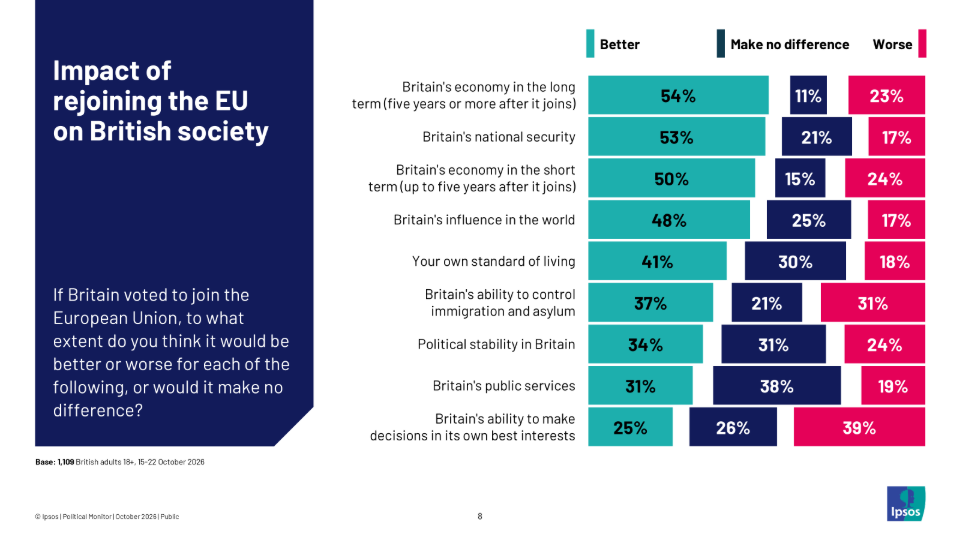
- However, the public are less sure in other areas. 41% think it would be better for their own standard of living. Although fewer than 1 in 5 think it would be worse (18%), this is still less than half and a smaller proportion than think it be better for the economy generally.
- The public are more likely to think joining the EU would make Britain’s ability to make decisions in its own best interests worse rather than better (39% vs 25%).
- Fewer than 4 in 10 think it would be better for Britain’s ability to control immigration (37%), political stability in Britain (34%) and Britain’s public services (31%).
Commenting on the findings, Keiran Pedley, Director of Politics at Ipsos in the UK said:
These numbers are encouraging for those who support the UK joining the European Union with a clear majority saying they are in favour and just three in ten explicitly opposed. A majority of the public also think joining would have a positive impact on Britain’s economy in the long term and national security too. Yet in other areas the public are less sure, which suggests there are still arguments which could be contested in any future campaign. Britons are less convinced joining will positively impact their own standard of living and the issue of immigration remains an important one. More generally, the public are more likely to think joining will have a negative, rather than positive, impact on Britain’s ability to make decisions in its best interests; a sentiment any future campaign in favour of joining would have to contend with.
Technical note
- For media queries, please contact the Ipsos in the UK Press Office at [email protected]
Ipsos interviewed a representative sample of 1,109 British adults aged 18+ via the Ipsos UK Knowledge Panel. Polling was conducted online between 15-22 October 2026. Panel members are recruited via random probability sampling, by sending letters to randomly selected addresses, which invites them to join an online panel. This approach means every household in the UK had a known and non-zero chance of being selected to join the KnowledgePanel. Those who are digitally excluded are provided with a tablet and free, restricted data connection. A sample of 2,316 adults aged 18+ were invited to take part in the survey. The sample was stratified by nation, age, qualifications and vote at the 2024 general election (as collected immediately after the election). The achieved sample was weighted in two stages:
- Design weights were applied to correct for the unequal probabilities of a person being selected for a survey, notably residents in smaller households have a higher chance of being selected.
- Calibration weights were applied through rim weighting to correct for differential non-response. Data was weighted to the adult population profile on age and gender, Government Office region, ethnicity, qualifications, work status and work sector (public sector/other), social grade (office coded), number of cars in household, constituency type, and newspaper readership (print and digital). Population targets were obtained from the 2021/22 Census, ONS population estimates and other large-scale probability surveys.
A two-part voting intention question is used with prompting on main parties (Conservative, Labour, Reform UK, Liberal Democrats, SNP in Scotland and Plaid Cymru in Wales). If a respondent indicates they will vote for ‘another party’ they see a second screen where they are prompted with the Greens, Restore Britain or another party that they write in. A follow-up ‘squeeze’ question is asked of those who are undecided or refuse the first question. Here all parties mentioned above are prompted on the same screen. A turnout filter is used based on two questions: current stated likelihood to vote (at least 9 out of 10 certain to vote) and previous voting behaviour (if they say they “always” or “usually” vote in general elections or that “it depends”).
All polls are subject to a wide range of potential sources of error. On the basis of the historical record of the polls at recent general elections, there is a 9 in 10 chance that the true value of a party’s support lies within 4 points of the estimates provided by this poll, and a 2 in 3 chance that they lie within 2 points. This is especially important to keep in mind when calculating party lead figures.
Note that this is a new methodology implemented since June 2025. It involves a new form of data collection (online random probability panel instead of quota telephone survey), an updated voting intention (which involves prompting for Reform UK), and an updated weighting scheme. This is based on our learnings during and since the 2024 General Election. This means that comparisons with previous waves need to be made with caution.