Public concern about defence and foreign affairs doubles in wake of Iran conflict, with economic pessimism also increasing to near-record high
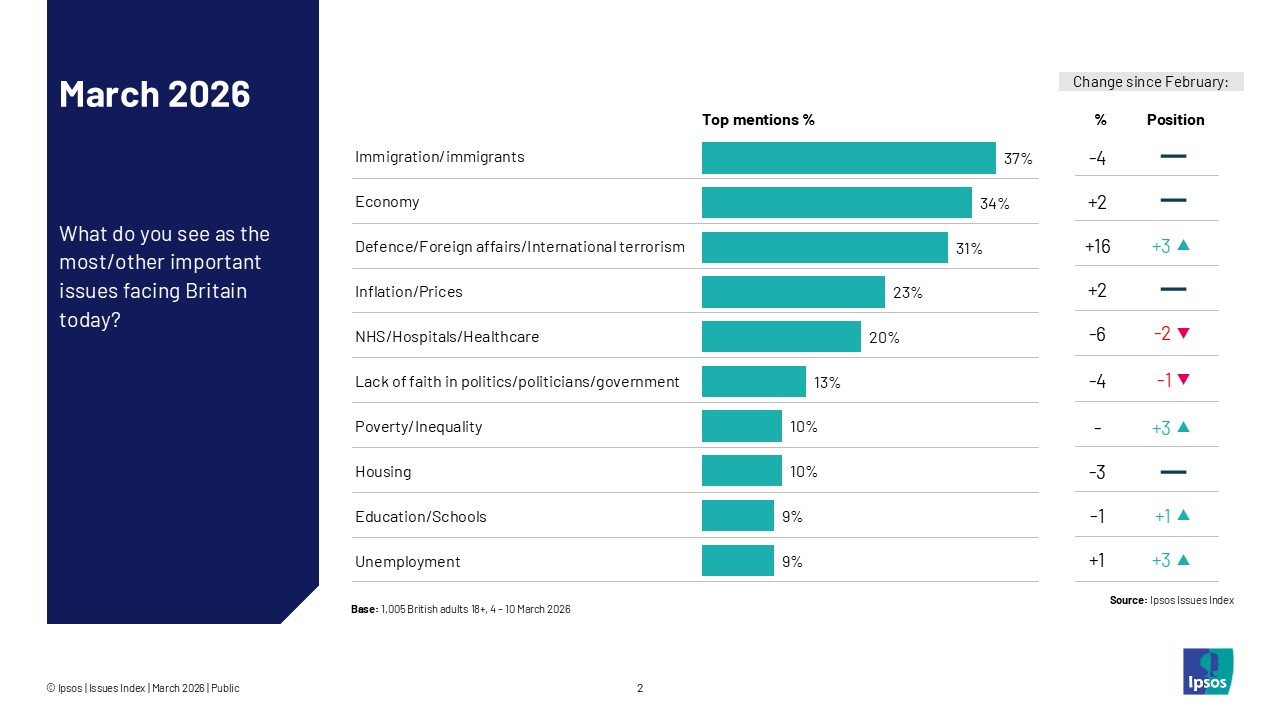
- Thirty-seven per cent name immigration as an important issue for Britain.
- Concern about defence and foreign affairs has doubled since last month to 31%, making it the third-biggest issue for the country and the highest since the start of the Russian invasion of Ukraine in 2022.
- Economic optimism has fallen to near-record lows with three quarters expecting a worsening of Britain’s economic condition over the next year.
The March 2026 Ipsos Issues Index reveals a sharp increase in public concern about defence and foreign affairs. Thirty-one per cent mention it as a big issue for Britain, double the score of 15% it reached in February. This is the highest level of concern on the issue since March 2022 in the immediate aftermath of Russia’s invasion of Ukraine (35%). Fieldwork was conducted between 4 and 10 March, following the outbreak of war between Iran, the US and Israel.
Concern about defence is higher among older people (40% of over 55s) as well as Labour party supporters and those in social grades AB (both 41%), while it is a lower priority for Reform UK supporters (22%) and those aged 18-34 (18%).
However, immigration remains the biggest issue facing the country this month. Thirty-seven per cent of the public see it as a concern, a fall of four points since February (and a decrease of 14 points from the recent high of 51% in September 2025). It also remains the single most important issue facing the country, mentioned by 22%. Concern remains highest among Reform UK (75%) and Conservative (45%) supporters, those aged 65+ (45%), men (44%) and people in social grades C2DE (41%).
Concern about the NHS has fallen six points since February, with 20% mentioning it as an issue, making it the fifth-biggest issue for the country this month. This is the lowest level of concern on the issue seen since September 2022.
Economic Optimism Index
Ipsos’ Economic Optimism Index asks Britons whether they think the general economic condition of the country will improve, stay the same, or get worse over the next twelve months, and has been tracking the economic mood of Britons since 1978.
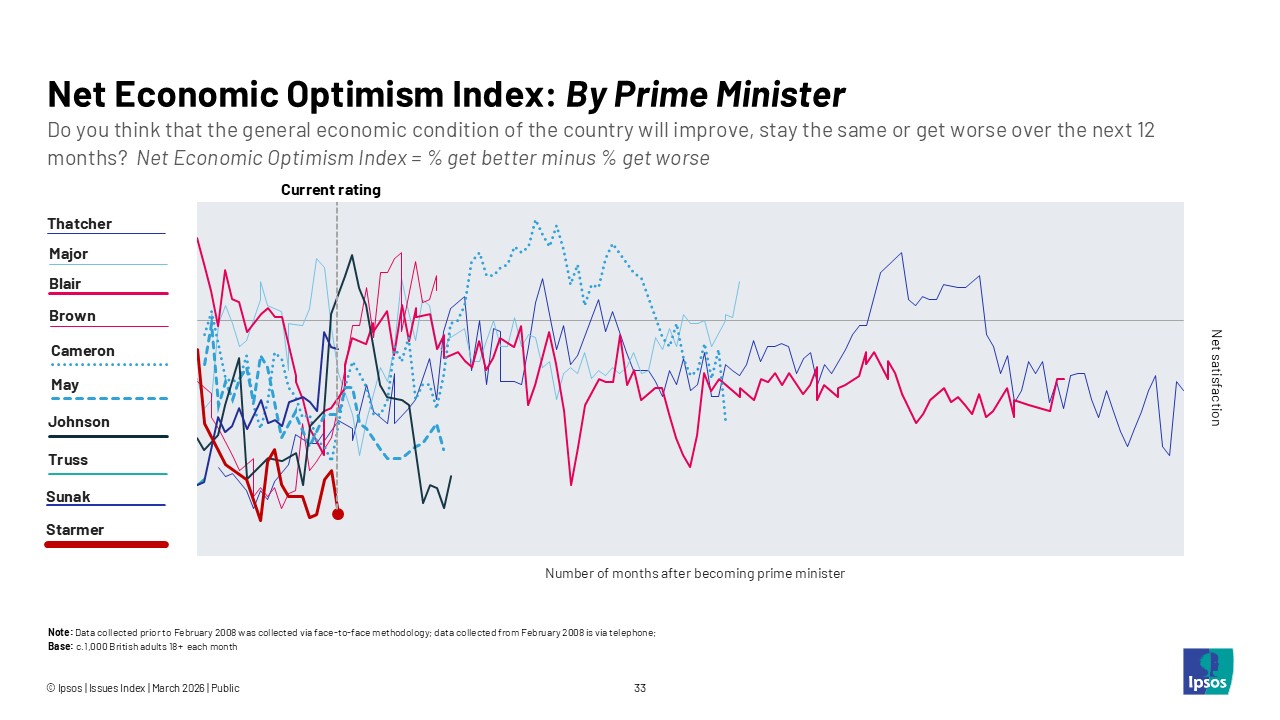
The March results show that 75% of Britons expect the economy to get worse, up 11 ppts since last month. 13% (-7) think it will stay the same, and just 9% (-4) think it will improve. This gives a net Ipsos Economic Optimism Index figure of -66, just two points above the historic low of -68 recorded in April 2025.
The net figure of -66 is as bad as levels seen during some of the most challenging economic periods in recent history, including the January 1980 recession under Margaret Thatcher (-64), the global financial crisis of July 2008 under Gordon Brown (-64), and the cost-of-living crisis following the invasion of Ukraine in the final days of Boris Johnson’s premiership in June 2022 (-64).
The level of net economic optimism this month (twenty months into Keir Starmer’s premiership) remains the lowest on record for a Prime Minister at this stage.
Mike Clemence, Research Director at Ipsos said:
The US and Israel war with Iran has pushed matters of defence and foreign relations back up the British public agenda, to levels last seen at the start of the Russian invasion of Ukraine. At the same time it has pushed economic sentiment back down, close to its historical nadir.
Yet immigration remains seen as the biggest issue facing the country overall, despite the intensity of that concern falling steadily since its recent high point of 51% in September last year.
Notes to editors
- For media enquiries, please contact [email protected]
- Ipsos' Issues Index is the longest-running gauge of British public concerns. It is conducted monthly and has provided an overview of the key issues concerning the country for over 50 years. The answers are spontaneous responses, and participants are not prompted.
- Ipsos interviewed a representative sample of 1,005 adults aged 18+ across Great Britain. Ipsos’ telephone omnibus was used for this survey. Interviews were conducted between 4 – 10th March 2026. Data are weighted to match the profile of the population. All polls are subject to a wide range of potential sources of error.