
Public Finds Much To Support in Conservatives' New Green Agenda
Main Findings:
- Eco-taxation and the "Polluter Pays" backed in principle.
- Major ideas from the Quality of Life Policy Review find public support -- backing for green homes, taxing "gas guzzlers" and moratorium on airport expansion.
- Public evenly split on VAT on short haul flights, but parking charges at out of town shopping centres considered a step too far.
- Proposals appeal to Conservative voters and find support more widely.
- Plans yet, though, to translate into political advantage.
The Conservative conference gets under way this week in Blackpool with the environmental agenda promising to be a key test for David Cameron and his party. Following the recent release of the Quality of Life Working Group, spearheaded by John Gummer and Zac Goldsmith, there has been considerable debate as to the extent to which David Cameron should embrace the policy recommendations.
New research by Ipsos, released in full today, reveals the public's reaction and shows they find much to support in principle. For example:
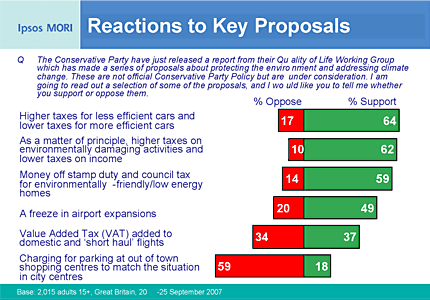
- Across five of the key proposals tested there is significant support for three: a large majority backs higher taxes for fuel inefficient vehicles (64%) and incentives for low carbon homes (62%), while supporters of a freeze on airport expansion outnumber opponents by more than two to one (49% vs 20%).
- The proposition to add VAT to short haul flights is more divisive and splits the public (37% in favour, 34% against and 23% undecided) but even here, in such a contentious area, reaction is not universally negative.
- In contrast, the proposal to charge for parking at out of town shopping centres is very unpopular with only 18% in support and 59% opposed.
Furthermore, the central theme of eco-taxation and "Polluter Pays" finds majority support in principle (even if other research we have done in this area indicates that the public remain to be convinced in practice that environmental taxes will really be earmarked for environmental protection).
Q The Conservative Party have just released a report from their Quality of Life Working Group which has made a series of proposals about protecting the environment and addressing climate change. These are not official Conservative Party Policy but are under consideration. I am going to read out a selection of some of the proposals, and I would like you to tell me whether you support or oppose them.
| 160 | Strongly support | Support on balance | Undecided | Oppose on balance | Strongly oppose | Don't know |
|---|---|---|---|---|---|---|
| 160 | % | % | % | % | % | % |
| A freeze in airport expansions | 19 | 30 | 25 | 15 | 5 | 6 |
| Value Added Tax (VAT) added to domestic and 'short haul' flights | 12 | 25 | 23 | 22 | 12 | 6 |
| Higher taxes for less efficient cars and lower taxes for more efficient cars | 29 | 35 | 16 | 10 | 7 | 4 |
| Charging for parking at out of town shopping centres to match the situation in city centres | 5 | 13 | 19 | 28 | 31 | 4 |
| Money off stamp duty and council tax for environmentally friendly/low carbon homes | 24 | 35 | 22 | 9 | 5 | 5 |
| As a matter of principle, higher taxes on environmentally damaging activities and lower taxes on income | 23 | 39 | 22 | 7 | 3 | 5 |
The relative balance of opinion in favour or opposed to the proposals is outlined in the graph below:
Phil Downing, Head of Environmental Research, says:
"The results should give David Cameron renewed confidence in the recent proposals of his Quality of Life Working Group. Not everything is palatable to the public, and out of town parking charges in particular face widespread opposition. However, they back, in principle, Polluter Pays and the idea that the environmental agenda is more than just pain free, easy wins. But of course the detail behind the initiatives, and the way Polluter Pays is implemented, will be key".
Looking at the impact on voters, the proposals are backed, significantly, by intending Tory voters. They also find wider support among Labour, and particularly Liberal Democrat, voters.
| % Support proposition | All | Conservative | Labour | Liberal Democrat |
|---|---|---|---|---|
| 160 | % | % | % | % |
| A freeze in airport expansions | 49 | 55 | 47 | 58 |
| Value Added Tax (VAT) added to domestic and 'short haul' flights | 37 | 44 | 36 | 49 |
| Higher taxes for less efficient cars and lower taxes for more efficient cars | 64 | 70 | 67 | 69 |
| Charging for parking at out of town shopping centres to match the situation in city centres | 18 | 23 | 19 | 19 |
| Money off stamp duty and council tax for environmentally friendly / low carbon homes | 59 | 58 | 61 | 68 |
| As a matter of principle, higher taxes on environmentally damaging activities and lower taxes on income | 62 | 66 | 62 | 64 |
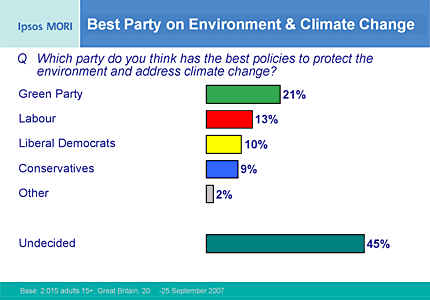
However, the backing has yet to translate into political advantage, even if the subject still remains there for the taking. When asked who they feel has the best policies to protect the environment and address climate change, 45% say they have yet to make up their minds. Among the three main political parties the situation is finely balanced -- 13% identify Labour, 10% the Liberal Democrats and 9% the Conservatives. The Green Party comes top with 21%.
Phil Downing thinks the Conservatives have yet to benefit because they the public is still waiting to see how firm the commitment to the agenda is, how the proposals will be implemented in practice and, crucially, how united the party is on the issue. "Thinking out loud and developing propositions in a policy review, however impressive, is not the same as adopting these measures as formal Conservative Policy, and other parts of the party have of course outlined ideas that appear to contradict the Quality of Life Group's propositions. So, while Cameron's stance on the environment has resonated with voters, much work still remains to be done and all eyes will be on Blackpool this week".
Technical details
Ipsos interviewed 2,015 British adults 15+. Fieldwork was conducted face to face between 20-25 September 2007. Data are weighted to the known national population profile. An '*' indicates a finding of less than 0.5%, but greater than zero. Where percentages do not add up to exactly 100% this may be due to computer rounding, the exclusion of "don't knows" or to multiple answers.
Phil Downing will present these results at The Climate Clinic in Blackpool on Tuesday 2nd October at 8am.
The Climate Clinic is, for the second year running, at the three main political party conferences. Its aim is to push for real political action to tackle climate change by mobilising the UK's most influential scientists, politicians, industry leaders and environmental campaigners. The Climate Clinic is a coalition of 30+ of the UK's leading environmental groups, trade bodies and professional societies representing over six million members. For more details visit www.climateclinic.org.uk. For media inquiries contact Jane Vaus 07748 010 447.


