Pulse Check - November 2025
November 2025
How the Autumn Budget landed with the public
The run up to the Budget was tough
Calling this the most turbulent Budget in recent memory almost undersells it. The months leading up to the Autumn Budget were marked by speculation, economic pessimism, and a sense that the country was bracing for more bad news. Pre-Budget, half of Britons said they felt worse off under Labour and two in three said they lacked confidence in their ability to put the economy right.
The lead up to the budget was marked by confusion, with briefing and counter briefing on what was is in it and much speculation about income tax rises. Then, the Office for Budget Responsibility accidentally published its analysis of Rachel Reeves’ plans before the Chancellor had even delivered her speech. To help make sense of the picture, including expert analysis on the economics and politics of the Budget, see our Autumn Budget Briefing with contributions from Ben Zaranko of the Institute for Fiscal Studies and Lucy Dunn of the Spectator.
How the announcement landed with the public: a 'smorgasbord' of tax measures and help for cost of living
Reeves opted against a single major income tax hike – although she continued the recent pattern of freezing thresholds. Instead, she unveiled a wide collection of smaller, targeted tax changes designed to raise revenue while keeping Labour’s fiscal rules intact, and introducing measures that would appeal to Labour MPs, such as increasing the minimum wage and removing the two-child benefit cap.
We asked Britons whether they supported or opposed 17 of the major measures in the Budget. The 5 policies with the strongest public backing tended to focus on easing cost of living pressures.
- Freezing the NHS prescription charge in England (for those who pay it) at £9.90 for the next year (71% support)
- Cutting £150 from the average household energy bill over the next year by ending the energy company obligation and other changes (70% support)
- Increasing the level of the national minimum wage for over-21s to £12.71 per hour and for 18-20 year olds to £10.85 per hour (66% support)
- Basic and new state pension payments going up by 4.8% from April 2026, above the current rate of inflation (63% support)
- Freezing regulated rail fares for journeys in England for the next year (63% support)
The 5 policies with the least support are mainly regarding taxes:
- Capping the amount under-65s can put into cash ISAs at £12,000 a year, down from £20,000* (15% support)
- People paying into their pension pot under salary sacrifice schemes starting to pay National Insurance tax on contributions above £2,000 a year from 2029. (17% support)
- Basic and higher tax rates on property, saving and dividend income increasing by 2 percentage points. (27% support)
- National Insurance and income tax thresholds being frozen for an extra three years from 2028 (29% support)
- Giving English regional mayors the power to charge tourists a tax for staying overnight in their towns and cities) (30% support)
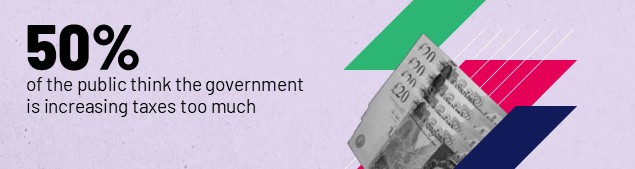
- It's unsurpring, therefore, that the half (50%) of the public now believe the government is increasing taxes too much, rather than not spending enough on public services and benefits (22%).
Even if some policies are popular, the overall reaction is decidedly bleak
A majority of Britons are more concerned about the UK economy following the budget (56%), up 11 points since the June Spending Review and last year’s Autumn Budget, and on par with concern levels following the March Spring Statement. Alongside this, 53% are worried about their own financial situation and 46% are concerned about the state of public services. The Budget may have delivered some crowd-pleasing measures, but it hasn’t shifted the underlying mood yet.
Political Implications
This Budget was Labour’s attempt to project competence in a volatile economic climate, and to show voters what it stands for. But early signs suggest the effort hasn’t landed as intended.
When we asked the public which party is most trusted to manage the economy, Reform UK are slightly ahead on 17%, compared to Labour on 13% and the Conservatives on 14% - although no party has a clear lead amidst a broader “none of the above” mood.
On improving public services, Labour has lost a significant advantage - down 12 points since June 2025 - and a full third of the public now say they simply don’t know who to trust to improve public services.
As Keiran Pedley, Director of UK Politics at Ipsos, noted in our October edition of Pulse Check: budgets are moments when governments can “set the political agenda.” But the question now is - which agenda has been set? The immediate media reaction broadly fell into three themes: highlighting the tax increases, and then two different responses to the rise in spending, either criticising it as a “Benefits Street” budget or hailing it as a return to Labour’s core values. Which of these drive the longer-term public response will be crucial.
The Road Ahead
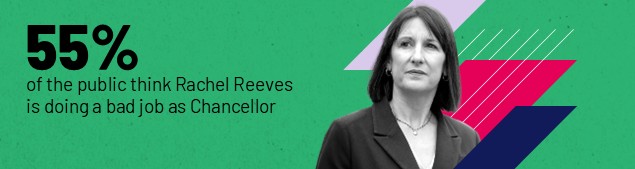
There are bright spots in this Budget: policies targeting the cost of living have resonated strongly. But public unease about the economy remains high, trust in Labour’s economic management is weak, and Rachel Reeves’ own ratings are historically low.
Still, Reeves has bought herself some breathing room. By expanding fiscal headroom to £22 billion, she has tried to insulate the government against future turbulence. She has also pushed some of the more painful tax rises to the end of the parliament, which could be a calculated bet that stronger growth and improved finances will give Labour something positive to take to voters before the next general election, but also raises questions over whether her attempts to balance public finances really are credible.
More broadly, speculation about a leadership challenge to Keir Starmer appears on ice for now. But time will tell if last week’s budget was the starting point in the public mood starting to shift back in Labour’s favour, or just another stop on the road to an extremely challenging set of elections next May.