
Rishi Sunak registers lowest favourability scores as Prime Minister
- 46% unfavourable towards PM (+7pts from January), 27% favourable (-3pts)
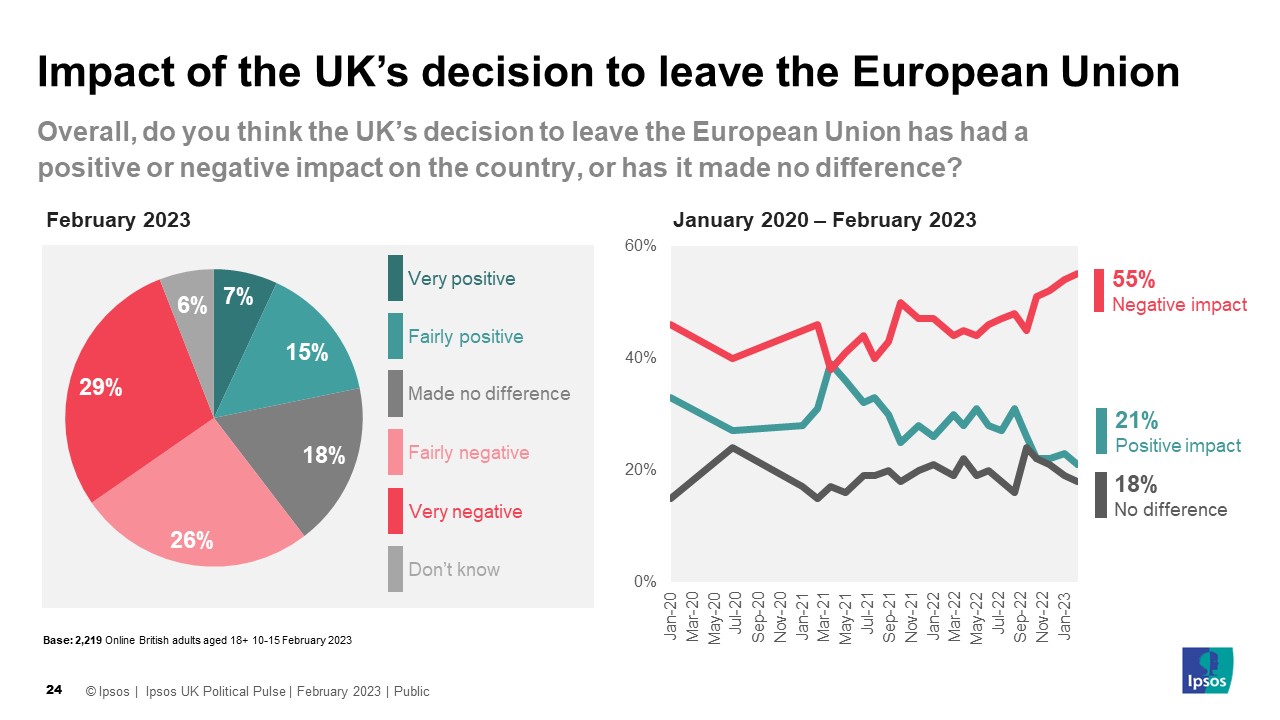
- 55% say Brexit has had a negative impact. Just 21% say Brexit has had a positive impact.
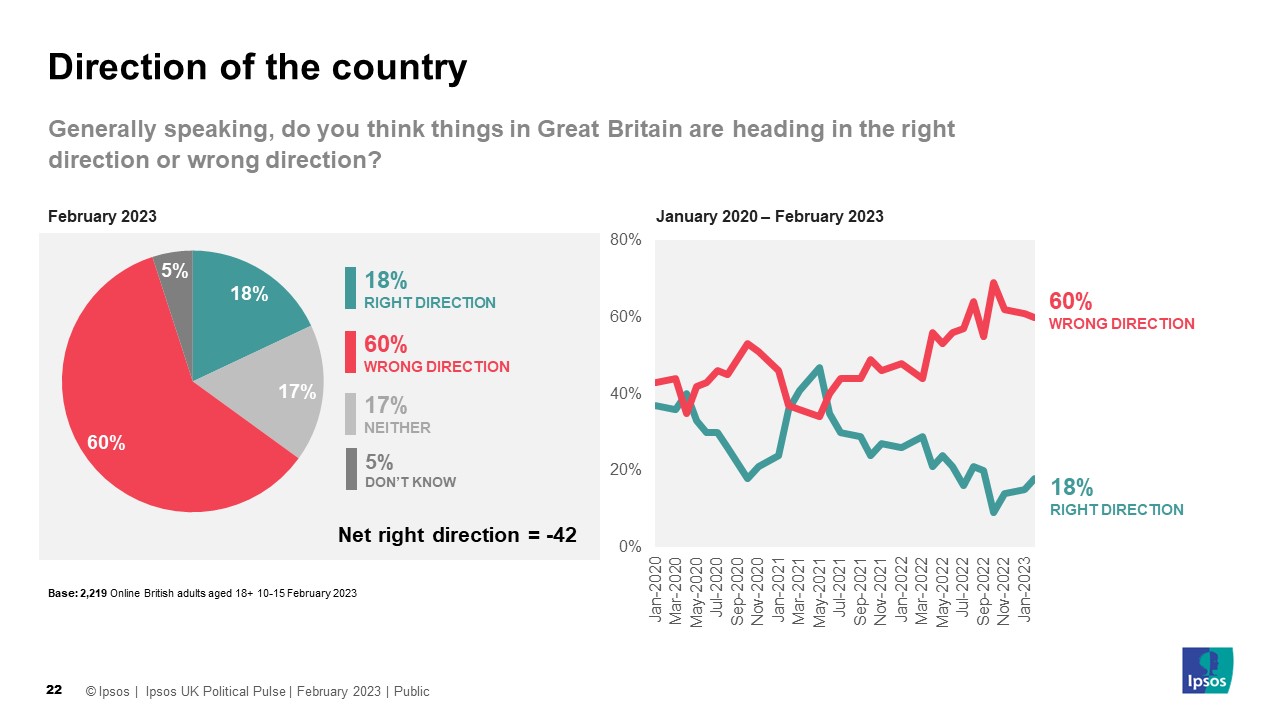
- 6 in 10 say the country is heading in the wrong direction.
The latest update to the Ipsos Political Pulse shows Rishi Sunak registering his weakest favourability ratings since becoming Prime Minister amidst significant public pessimism about the impact of Brexit and the direction of the country.
Favourability of politicians
Looking at opinions of leading politicians, Keir Starmer is seen most favourably, with 32% favourable and 39% unfavourable he achieves a Net score of -7. In comparison, the current Prime Minister, Rishi Sunak, is seen favourably by 27% of Britons while 46% disagree, giving a score of -19. Starmer’s numbers are unchanged from January but Rishi Sunak has seen falling scores (January: 30% favourable and 39% unfavourable).
A similar number of the public are favourable towards Boris Johnson as Rishi Sunak (28% vs 27%). However, with 52% unfavourable to the former PM, his overall net favourability rating is lower at -24.
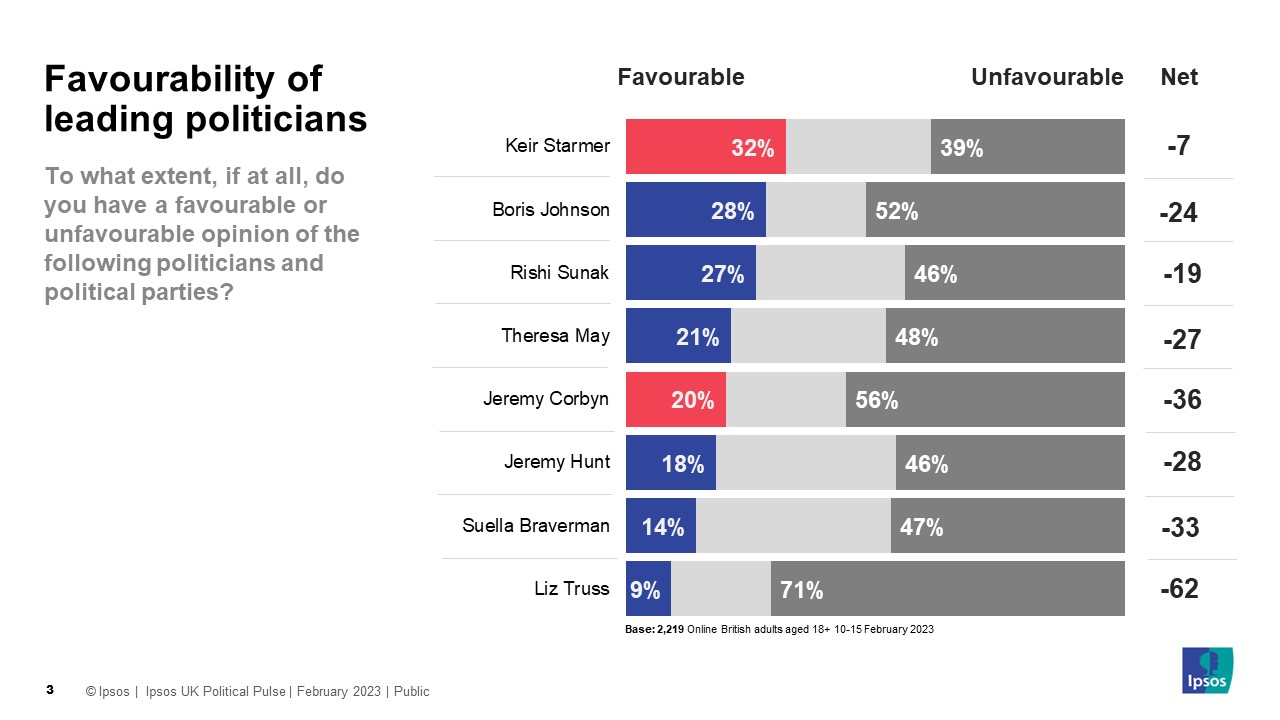
Looking at specifically at their own voters, Boris Johnson is seen slightly more favourably than Rishi Sunak. More than half of 2019 Conservative voters are favourable to Johnson (55%) while 49% say the same for Sunak. Overall, among 2019 Conservative voters, Johnson scores +29 while Sunak scores +23. However, Johnson’s lead owes more to falling ratings for Mr Sunak rather than improving ratings for the former PM.
Liz Truss sees the worst favourability rating of the politicians on our list with the public overall. Only 1 in 10 (9%) are favourable and 71% unfavourable meaning she has a net score of -62, significantly lower than other politicians such as Jeremy Corbyn (-36), Suella Braverman (-33), Jeremy Hunt (-28) and Theresa May (-27%).
Favourability towards parties
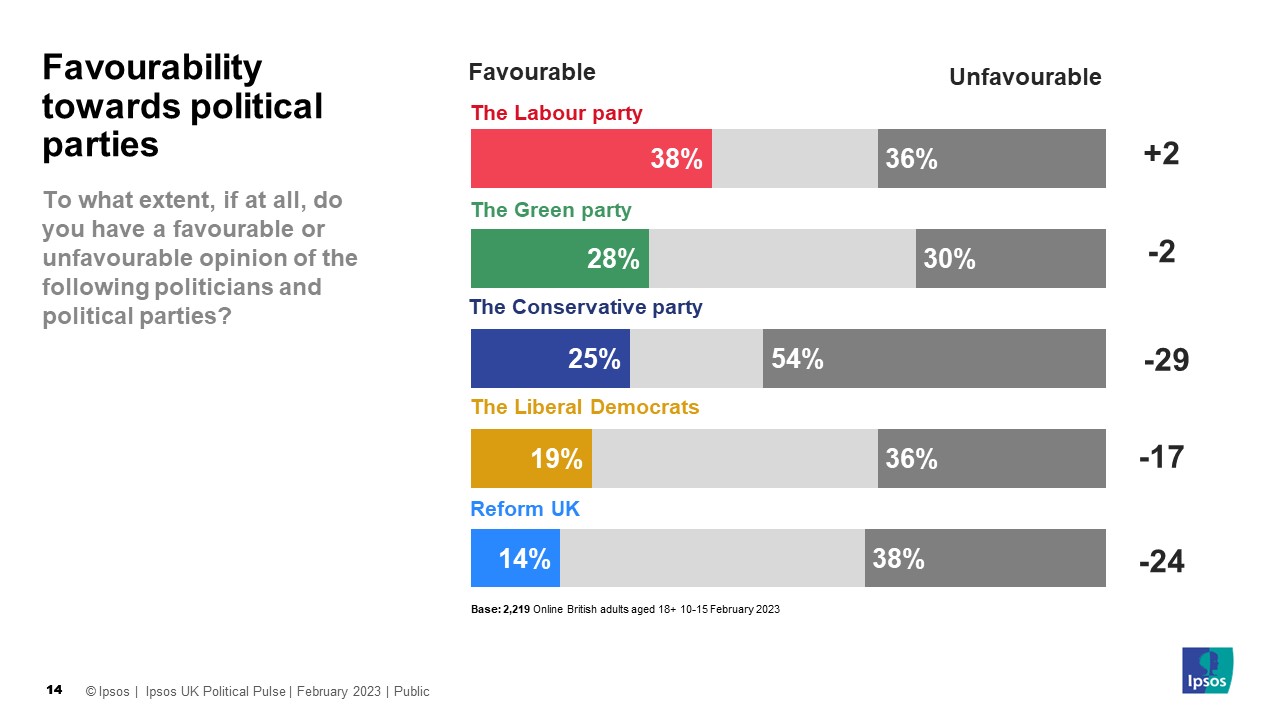
With a net score of+2, the Labour Party appears the most popular political party currently, 38% have a favourable opinion of the Opposition party (+3 pts from Jan) while 36% are unfavourable (no change). With 28% positive towards the Green Party (+5 pts) and 30% negative (-2), they see a net score of -2. The Conservatives see the lowest score with -29, 25% are favourable towards them (unchanged) while 54% are unfavourable (+3). The Liberal Democrats see a score of -17 while Reform UK (new to our list) score -24. However, many are neutral or do not have an opinion of each.
Brexit and direction of country
The public are increasingly negative about the impact of Brexit over time. Now, 55% of Britons say the UK’s decision to leave the European has had a negative impact on the country, the fourth straight month we have recorded numbers over half. Only 1 in 5 (21%) believe Brexit has had a positive impact while a similar proportion say it has made no difference (18%).
If we subtract the proportion saying Brexit has had a negative impact from the proportion saying positive the result is a net positivity score of -34. This continues to be the lowest we have recorded on Brexit, since we started asking this question in January 2020.
In line with this, we see 6 in 10 now believe the country is heading in the wrong direction (60%), remaining stable since January (61%).
Keiran Pedley, at Ipsos, said:
When Rishi Sunak became Prime Minister it was notable that his personal poll ratings were significantly better than those of his party. This increasingly no longer appears to be the case amidst public pessimism about the direction of the country. Our polling shows strong public concern about the cost of living and public services, whilst Brexit is being viewed more negatively over time as well. The Prime Minister will hope he is able to seize the political agenda in the coming weeks and months if he is to have any chance of turning his fortunes around.
Technical note:
- Ipsos UK interviewed a representative sample of 2,219 Britons aged 18+. Interviews were conducted online from 10-15 February 2023. Data are weighted to match the profile of the population. All polls are subject to a wide range of potential sources of error.


