Seven in ten (70%) Britons expect Labour to increase personal taxes amid deep economic pessimism
- Nearly two-thirds (64%) of British adults expect the general economic condition of the country to get worse over the next 12 months, with only 14% expecting it to improve and 18% to stay the same, yielding a Net Optimism Index score of -50.
- 70% of Britons believe it is likely that the Labour Party will increase the taxes they personally pay over the next year.
- Over half (53%) view keeping inflation low as the single most critical priority for growing the UK economy, ahead of helping UK businesses grow (46%) and reducing taxes (44%).
- Similarly, 53% think the NHS and healthcare should be prioritised to receive more public spending, whilst nearly half (47%) believe foreign aid should receive less public spending.
Widespread pessimism across demographics and party lines
The public outlook for the UK economy over the coming year remains starkly negative across nearly all sections of society.
- This month’s Economic Optimism Index finds that nearly two-thirds of Britons (64%) think that the general economic condition of the country will get worse over the next 12 months, compared with just 14% who expect it to improve and 18% who think it will stay the same, giving a Net Optimism Index of -50.
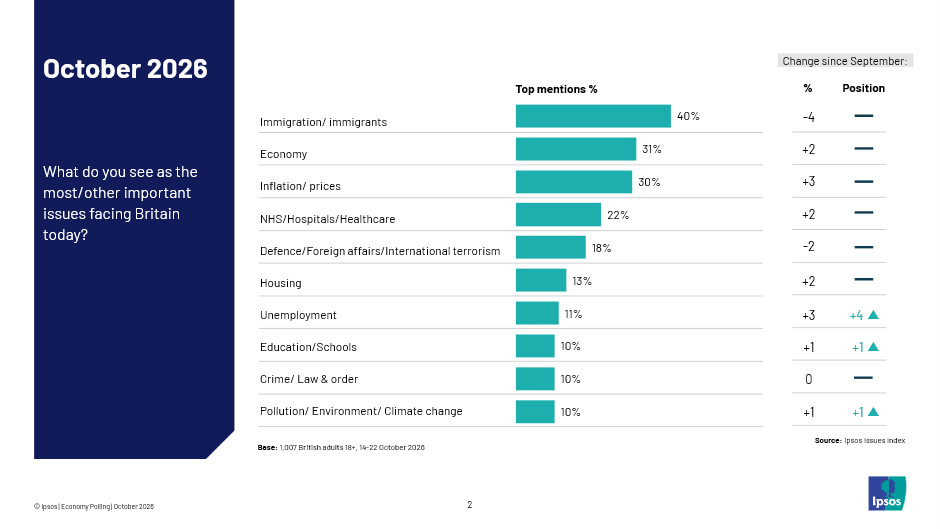
- The economy (31%) and inflation (30%) sit at 2nd and 3rd, respectively, in this month’s Issues Index, with Immigration (40%) maintaining the top spot.
High expectations of personal tax rises and national borrowing
Amid this backdrop of economic pessimism, a separate survey, carried out via the Ipsos Online Omnibus, highlights that British adults firmly expect the Labour government to pursue a mix of tax increases and borrowing over the coming year.
- 7 in 10 Britons (70%) think it is likely that the Labour Party will increase the taxes they personally pay over the next year, compared with 17% who consider this unlikely. This represents a modest softening from 77% saying it was likely in October 2025 and 78% in June 2025.
- Two-thirds (67%) believe it is likely Labour will increase government borrowing and the national debt, whilst 51% expect an increase in spending on public services (up 11 percentage points from 40% in October 2025).
- By comparison, when asked what alternative parties would do if they were in power, 60% think it is likely a Conservative government would decrease spending on welfare benefits (excluding pensions) and 56% think they would decrease spending on public services. Similarly, 61% think Reform UK would cut welfare spending and 53% believe they would decrease public service funding.
- Around half of the public further think each the Conservatives (54%) and Reform UK (48%) would increase personal taxes if they were in government.
Public spending trade-offs and growth priorities
When asked about managing the national budget and driving growth, Britons balance protective instincts toward frontline healthcare against strong resistance to broad-based direct taxes. - Just over half of British adults (53%) say keeping inflation low is most important for growing the UK economy, followed by helping UK businesses to grow (46%), reducing taxes (44%), and improving worker skills (40%). Large-scale infrastructure and technology projects fall to the bottom of the list, including businesses using new technologies such as AI (8%), building a third runway at Heathrow (7%) and completing High Speed Rail 2 (HS2) from London to Birmingham (5%).
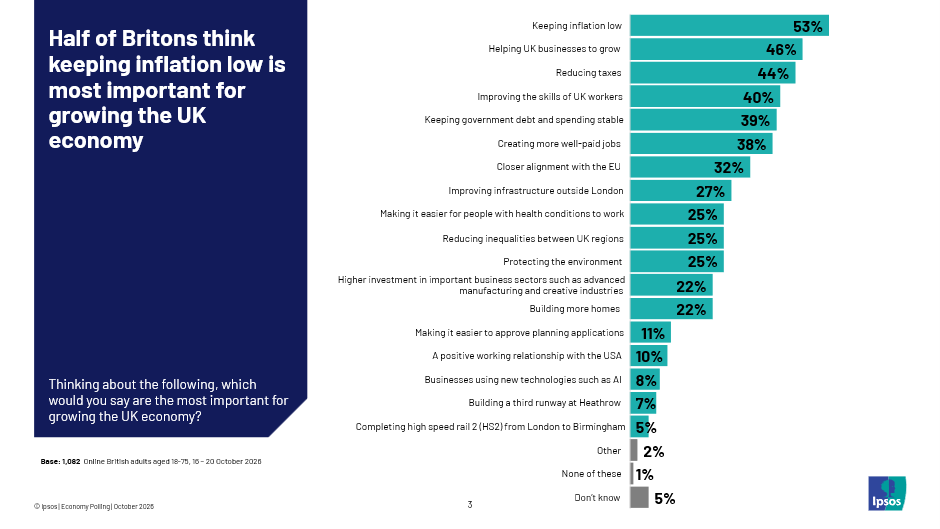
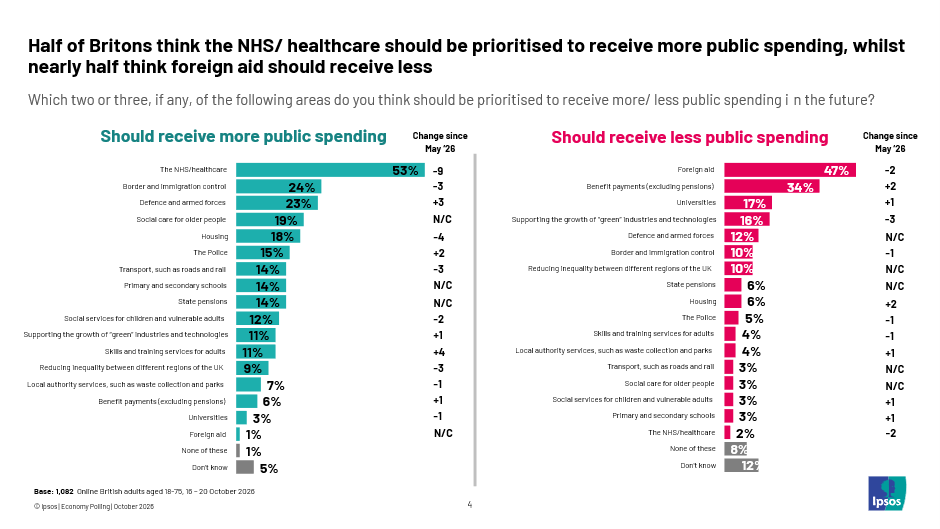
- On public spending priorities, 53% say the NHS and healthcare should be prioritised to receive more funding (down 9 percentage points from May 2026), followed by border and immigration control (24%) and defence (23%).
- Healthcare remains the top priority for 2024 Labour voters (63%) and Conservative voters (53%), whereas it falls to second amongst Reform UK voters (37%).
- By contrast, half of Reform UK voters (55%) prioritise spending on border and immigration control.
- When identifying areas for reductions, nearly half (47%) choose foreign aid to receive less public spending, followed by benefit payments excluding pensions (34%).
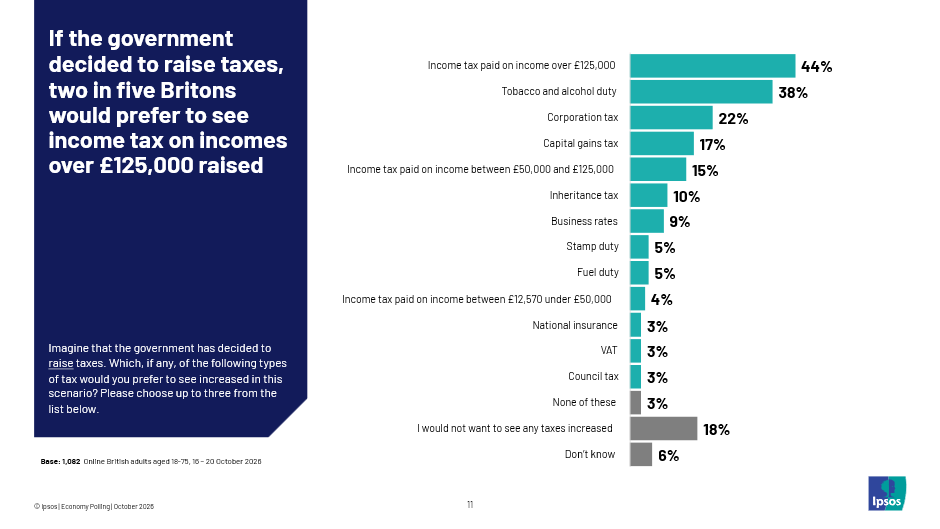
- If the Government decided to raise taxes, 44% would prefer raising income tax on earnings over £125,000, followed by tobacco and alcohol duty (38%) and corporation tax (22%). Only 4% would support increasing basic-rate income tax, and just 3% favour increasing VAT.
- Conversely, if taxes were cut, 46% would prefer reducing basic-rate income tax (£12,570 to under £50,000), followed by council tax (39%) and fuel duty (29%).
Commenting on the findings, Alex Bogdan, Research Director at Ipsos in the UK, said:
Ahead of John Healey’s first Budget, Britons remain troubled by widespread economic anxiety, with nearly two-thirds expecting the national economy to worsen over the next twelve months and keeping inflation low viewed as the primary prerequisite for growth. With seven in ten anticipating that the
Government will increase their personal taxes, public pessimism remains acute across demographic groups and political divides.
While there is enduring public support for protecting the NHS, Britons show clear resistance to broad-based personal tax increases, preferring targeted measures on high earners or spending reductions on foreign aid.As Westminster navigates demanding fiscal constraints, the central challenge for the Government will be addressing deep-seated cost-of-living concerns and demonstrating a credible path to growth without eroding voter confidence through widespread tax rises.
Technical notes:
- Ipsos interviewed a representative sample of 1,082 online British adults aged 18–75 via the Ipsos Online Omnibus between 16 and 20 October 2026.
- Data from the Ipsos Issues Index and Economic Optimism Index was conducted face-to-face and online among a nationally representative sample of 1,007 British adults aged 18+ between 14 and 22 October 2026.
- Data are weighted to match the profile of the population. All polls are subject to a wide range of potential sources of error.