
We'll Support War In Iraq, If ...
A MORI poll, conducted for ITV News on 24-25 September, found one of the most remarkable switches of public opinion that MORI has ever measured. When asked whether Britain should stand 'shoulder to shoulder' with America without UN sanctions, seven people in ten said 'no', but with UN behind the war in Iraq, seven in ten said 'yes', nearly a 50% 'swing' of the British adult population. (With that kind of swing, the Tories would have the biggest majority in the past century at the next election!) Even with the potential for 'many British casualties', a plurality of the British public support Britain joining any American-led military action against Iraq by a margin of 49% to 40%.
The extract from our report to ITV News shows how sensitive to the situation the British public is today about the pending war in Iraq.
"As you may know, the British Government has today published a dossier of information outlining why it believes military action against Iraq is necessary. It says that Iraq has continued to produce chemical and biological weapons and could have a nuclear weapon within 1-2 years."
The Iraqi government says that this is not the case, and has agreed to abide by the United Nations resolution to allow open access to UN arms inspectors.
Q5 In the light of this, would you support or oppose Britain joining any American-led military action against Iraq, with UN approval?
Q6 Would you support or oppose Britain joining any American-led military action against Iraq, without UN approval?
Q7 Would you support or oppose Britain joining any American-led military action against Iraq, with UN approval, if it involves many British casualties?
Q8 Would you support or oppose Britain joining any American-led military action against Iraq, without UN approval, if it involves many British casualties?
| 160 | Q5 | Q6 | Q7 | Q8 |
| 160 | % | % | % | % |
| Support | 71 | 22 | 49 | 20 |
| Oppose | 23 | 70 | 40 | 74 |
| Don't know | 6 | 8 | 11 | 6 |
The continuing speculation about possible military action against Iraq has pushed public concern about defence and foreign affairs to its highest level since the weeks following the September 11 attacks, according to the latest MORI Political Monitor. Nearly a quarter of the British public, 23%, named "defence/foreign affairs" as the single most important issue facing Britain, half as many again as named any other single issue, and 34% named it as one of the most important issues, putting it in equal second place in the rankings. This represents a sharp rise over the past few weeks: 13% named it as an important issue in June and 10% in July. It usually languishes below five per cent.
The MORI Political Monitor - conducted between 19-24 September 2002, before the publication of the government's dossier on Iraq - found Labour supporters especially likely to express their concern over defence and foreign affairs (40% named it as an issue), and concern increased slightly with age. Defence apart, public services remain the overwhelming concern of the public, with NHS/hospitals (named as an important issue by 41%) topping the list and education/schools (34%) and crime/law & order (28%) well ahead of other issues.
A further measure of public reaction to the effect of the terrorist attacks on 9/11 and its aftermath was measured by another MORI poll conducted earlier in the month, on 5-8 September, for publication on the anniversary of the terrorist attacks on the Twin Towers and the Pentagon. Updating questions asked shortly after last year's attacks, we found a halving of approval for the way George W. Bush is handling the American response to the terrorist attacks on 11th September, from 70% approval on the 9th of October last year, to 35% the first week of September this year, and a similar fall in the level of approval for the way Tony Blair is handling the British response, from 72% on 9 October 2001 to 36% today, a 50% fall in both cases.
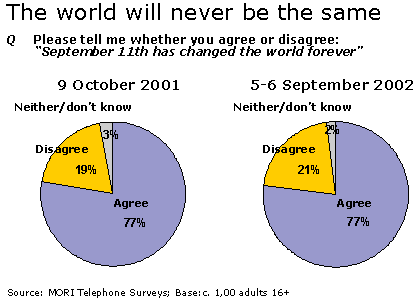
Yet the public's conviction that 'The world will never be the same' has remained solid, with seven in ten people in agreement that the world has changed forever, then (9 October 2001) and now (5-8 September 2002) - see graph. Further, a quarter of the British public are convinced that 'September 11th will change my life forever'.
Finally, drawing on our work for the German Marshall Fund and the Chicago Council of Foreign Relations (carried out in June) it is relevant to note that when asked 'From your point of view, how desirable is it that the US exert strong leadership in world affairs?', two thirds, 68%, of the British said that it was either 'very desirable' (22%) or 'somewhat desirable' (46%). Unsurprising? But what was, was that 74% of the people of The Netherlands, 65% of the Poles, 61% of the Germans (sic), 57% of the Italians felt that it was desirable for America to exert strong leadership. Of the six countries studied, only the French (unsurprisingly?) were opposed, 58% to 39% who were in favour.
These polls were of course taken before the Bali attacks last weekend. It will be a little time before a picture emerges of how Britons have reacted to the latest tragic developments and how this impacts on their views as to what Western leaders should do best.


