When forced to choose Britons prefer a Labour government led by Keir Starmer to a Reform UK government led by Nigel Farage
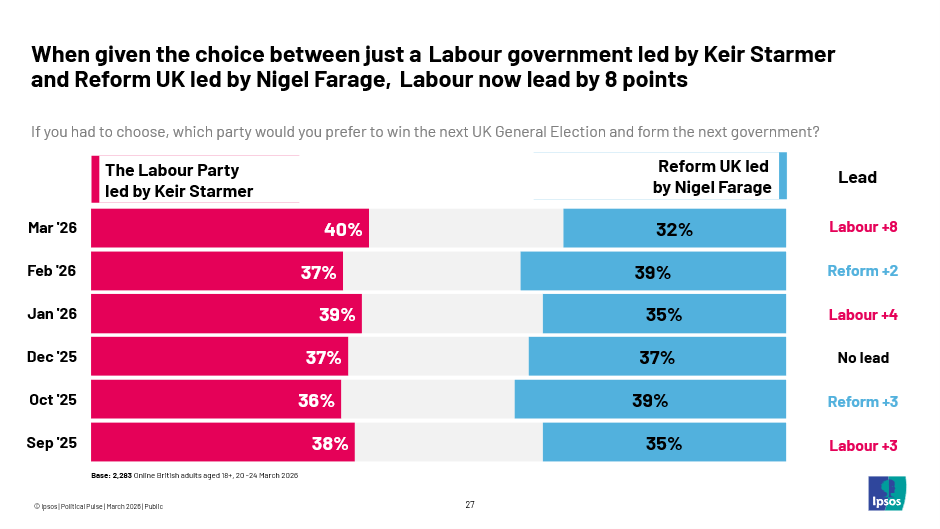
- When presented with a binary choice, the public prefer a Starmer-led Labour government by 8 points. In February there was an even split.
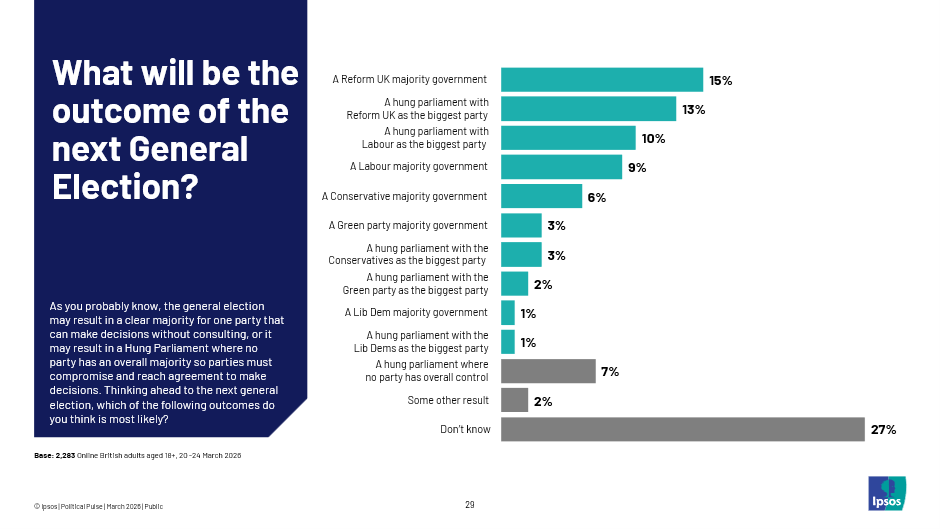
- But the public are more likely to expect Reform UK to either form a majority government or be the largest party in a hung parliament (28%) than Labour (19%).
New data from our latest Political Pulse survey, taken 20th-24th March, explores attitudes to GB political parties and leading politicians and whether the public prefer a Labour led government under Keir Starmer or a Reform UK led government under Nigel Farage.
Preferred government
- When presented with a choice, the public would prefer Labour under Starmer winning the next General Election to Reform UK under Nigel Farage by a margin of 40% to 32%. This 8 point lead is up from a 2 point lead for Farage / Reform in February.
- Those aged under 35 prefer a Labour government led by Starmer by a margin of 49% to 24%, those aged between 35-54 say the same by a margin of 39% to 29%. Those aged 55+ prefer a Reform UK government led by Farage by a margin of 41% to 34%.
- 2024 Labour voters prefer a Labour government by 76% to 12%, Lib Dems by 54% to 18% and Greens by 57% to 9%. 92% of Reform voters prefer a Reform government led by Farage and 2024 Conservatives prefer Reform by a margin of 54% to 18%.
Predicted General Election result
- Despite the above indicated preferences, the public are more likely to expect Reform UK to win a majority at the next General Election (15%) or be the largest party in a hung parliament (13%) TOTAL 28% than expect a hung parliament with Labour as the biggest party (10%) or a Labour majority government (9%) TOTAL 19%.
Favourability toward politicians: 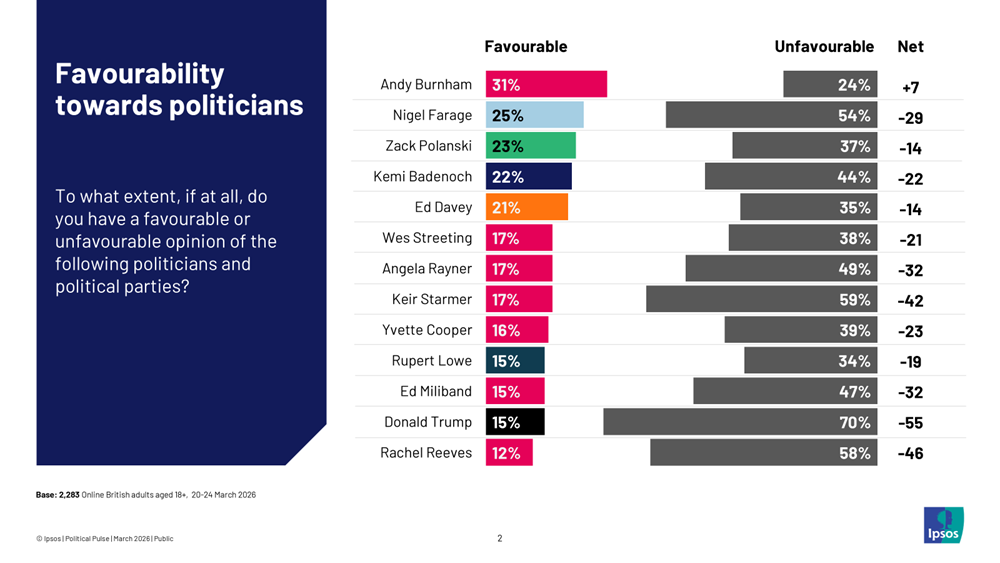
- Party leaders:
o Reform UK leader Nigel Farage has a net favourability of -29, down from -17 last month but similar to the -26 in January. 25% of Britons view him favourably and 54% unfavourably.
o Prime Minister Keir Starmer's net favourability stands at -42, similar to -44 last month and -42 the month before (17% favourable, 59% unfavourable).
o 22% hold a favourable view of Conservative party leader Kemi Badenoch, while 44% are unfavourable, giving her a net score of -22 (-18 last month).
o 21% hold a favourable view of Liberal Democrat leader Ed Davey, while 35% are unfavourable, giving him a net score of -14 (-10 last month).
o A quarter (23%) are favourable towards Green Party leader Zack Polanski, while 37% are unfavourable (net -14, down from -8 in February but similar to the -15 in January).
o 15% are favourable towards Restore Britain leader Rupert Lowe and 34% are unfavourable. - Labour figures: In terms of Labour figures who have been speculated as potential successors to Keir Starmer,
o Three in ten (31%) are favourable towards Greater Manchester Mayor Andy Burnham, with 24% unfavourable (net +7). Burnham remains the only politicians on our list with a net positive rating.
o 17% are favourable towards Health Secretary Wes Streeting, with 38% unfavourable (net -21, unchanged from February).
o 15% are favourable towards Secretary of State for Energy Security and Net Zero Ed Milliband, with 47% unfavourable (net -32, was -28 in Feb).
o 17% are favourable towards Former Deputy Prime Minister Angela Rayner, with half (49%) unfavourable (net -32, -33 in Feb). - Donald Trump: 15% are favourable towards US president Donald Trump, while seven in ten (70%) are unfavourable (net -55). In January 18% were favourable and 64% were unfavourable.
Favourability towards political parties
- Two in ten (19%) are favourable towards the Labour party, with 54% unfavourable (net -35, -36 in Feb).
- Reform UK has a net rating of -28, down from -15 last month but similar to -24 in January. A quarter (25%) hold a favourable view of the party, with 53% unfavourable.
- 20% express a favourable view of the Conservative party, with just over half (52%) unfavourable (net -32, was -28 in Feb and -34 in January).
- The Green Party’s net rating is -12 (slightly down from -9 last month and the month before. 27% are favourable towards the party, while 39% are unfavourable.
- The Liberal Democrats are at -14. 22% express a favourable view and 36% unfavourable. This net score is unchanged from February.
- 16% are favourable towards Your Party, while 32% are unfavourable (net -16). This score is not comparable to previous Ipsos polls as we have removed the descriptor making clear that this is a party former by Jeremy Corbyn and Zarah Sultana.
- 16% are favourable towards Restore Britain and 38% are unfavourable.
Right direction / wrong direction
- Elsewhere in the poll, 67% of Britons think things are heading in the wrong direction and 14% think things are heading in the right direction.
Keiran Pedley, Director of UK Politics at Ipsos said:
These findings reflect a key political challenge for Keir Starmer and the Labour Party. There is evidence that the public might prefer a Labour government led by Starmer to a Reform UK government led by Nigel Farage in the future. But persuading voters that currently support other parties to back Labour instead will be difficult in a world where support for the Greens is growing and a clear majority of the public think things in Britain are heading in the wrong direction.
Notes:
- Ipsos interviewed a representative sample of 2,283 adults aged 18+ across Great Britain. Interviews were conducted online between the 20th – 24th March 2026.
- Data are weighted to match the profile of the population. All polls are subject to a wide range of potential sources of error.