
Worcester's Weblog

Students are slightly more important in deciding the outcomes of British general elections than they have been in the past. There are many more of them now than there was 40 years ago. Students numbered around 400,000 in 1964 in an electorate of just over 36m (1.1%) but around 2m in 2001 in an electorate of 43.8m (4.6%).
The key question is whether or not students will turn up to vote. Given the UK's secret ballot, there is no definitive data on turnout among different age and sub-groups but MORI's estimates, based on aggregates of all 18,657 of its election polls for the 2001 election, suggest that turnout fell to 39% among 18-24 year olds, even worse than the 59% figure recorded by the general public. MORI's first quarter aggregate of 12,100 showed only 23% of 18-24 year olds were certain to vote. MORI's most recent survey, conducted between 7-11th April for London's Evening Standard, was based on a sample of 1,973 respondents, and only 24% of 18-24 year olds were absolutely certain to vote on May 5th. Not much change there then.
Turnout of the young to some extent depends on how meaningful they find the election. Previous research for the Electoral Commission conducted by MORI in 2004 indicated that young people's interest in politics depends to some extent on the 'political pulse' of the nation. In other words, what's happening out there and what the issues are.
The key issue for 18-24 year old students between January 2004 and March 2005 when asked the question "what is the most important issue facing Britain today?" was defence/ terrorism (49% naming this issue), but conversely more mature students, aged 25-34, regarded the NHS (48%) as the most important. The idea put forward by many commentators that students form a cohesive target group for the Lib Dems is arguable since Labour is regarded by most voters generally as the best party on the NHS, although Liberal Democrats are regarded by most people as the best party on Iraq. The graph below shows this clearly.
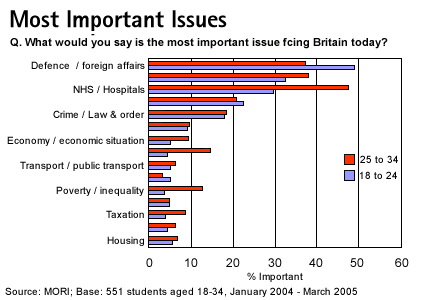
What does all this mean for the Lib Dems? That they are unlikely to win those seats where there are a large proportion of students, and where they are in a close contest with Labour, even assuming students vote in their university constituencies. They probably will, since many of them will be doing their end of semester exams. So much for a big win in Cardiff Central, and Oldham East and Saddleworth, although Canterbury might just go Labour from Conservative if the students turn out to vote in their university constituency.
Technical Details
Data taken from MORI's aggregated fortnightly, face-to-face political omnibus study with representative samples of c.2,000 adults aged 18+, including a total of 1,276 full-time students aged 18+ per survey January 2004 -- March 2005. Data are weighted to the national population profile.
Dr. Paul Baines, Principal Lecturer in Marketing at Middlesex University is on secondment to MORI. Tom Huskinson is a Researcher at MORI.
Sir Robert is in the USA, delivering a lecture at the University of Kansas. Back on Monday.


