Familiarity with the 988 Suicide & Crisis Lifeline remains low at two-year mark
Washington, DC, July 15, 2024 – Amidst the two-year anniversary of the 988 Suicide & Crisis Lifeline becoming available nationwide, the latest NAMI/Ipsos poll finds that familiarity with the Lifeline is up slightly from June 2023 but remains low. About half of Americans say they don’t know when a situation is serious enough to contact the Lifeline, and nearly two in five say they don’t know what to do if a loved one is experiencing a mental health crisis. These sentiments illustrate a knowledge gap about mental health crisis responses among Americans. Further, most Americans say they are not content with the current status of mental health treatment in the United States. More than half say Congress is doing too little to address the problem, and the vast majority of Americans say they support federal or state funding of Lifeline operations and crisis response services.
For more information about this study, please click here.
Detailed Findings
1. The majority of Americans are unhappy with mental health treatment in the United States. Over half say Congress is doing too little to address the current state of mental health care.
- Three-quarters of Americans say they are not content with the status of mental health treatment in this country, a measure that has been consistent since the study began in 2021.
- About seven in ten (69%) Americans agree people with mental health conditions face discrimination in their everyday life.
- Over half (54%) of Americans say Congress is doing too little to address the current state of mental health care in the United States. Pluralities of Americans say the same about their state’s legislature or state’s governor (46% and 42%, respectively).
2. Familiarity with the 988 Suicide & Crisis Lifeline is up slightly from June 2023. However, there remains a knowledge gap around what to consider a mental health crisis or emergency and how to respond if a loved one experiences one.
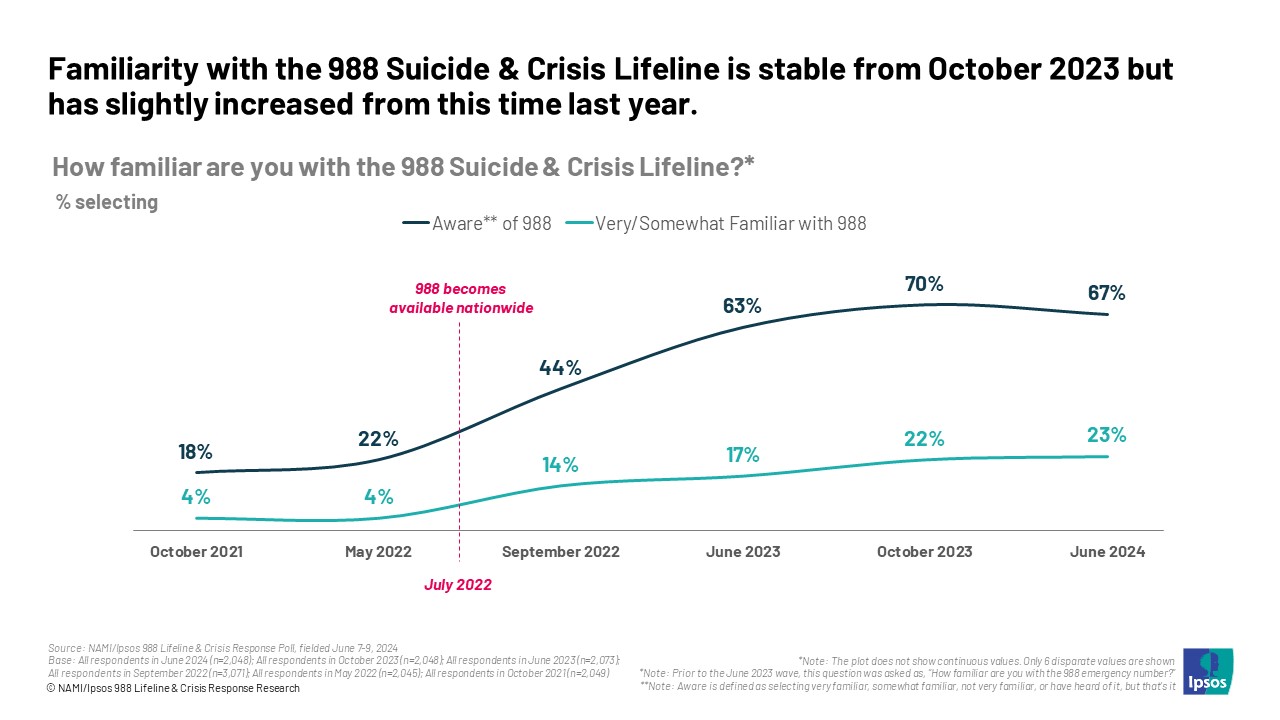
- Twenty-three percent of Americans say they are familiar with the 988 Suicide & Crisis Lifeline, stable from October 2023 (22%) and up six percentage points from June 2023 (17%).
- A bare majority (51%) of Americans say they don’t know when a situation is serious enough to contact the 988 Lifeline. Nearly two in five (38%) agree they don’t know what to do if someone they love is experiencing a mental health crisis.
- About one in ten Americans say having suicidal thoughts is not a crisis or an emergency (10% and 12%, respectively.)
- Roughly 1 in 5 Americans say they don’t know whether erratic behavior, talking to oneself, panic attacks, substance abuse, or delusions should or should not be considered crises/emergencies.
3. Trust in the 988 Suicide & Crisis Lifeline remains stable from May 2022. Compared to June 2023, Americans are now more likely to say they or their loved one received the help they needed if they contacted the Lifeline.
- About four in five (82%) Americans say they trust that they would receive the help they need if they contacted the 988 Lifeline. This sentiment is stable from May 2022 and June 2023.
- Among Americans who say they or a loved one has contacted the 988 Lifeline, nearly seven in ten (68%) say they received some or all of the help they needed. This sentiment is up 13 percentage points from June 2023 (55%).
4. Immediate support from a crisis counselor is the most important consideration for Americans when contacting the 988 Suicide & Crisis Lifeline. After that, Americans say it is most important to receive a health care response.
- About four in five (79%) Americans say they are more likely to contact the 988 Lifeline if they are able to speak with a crisis counselor immediately. A bare majority say receiving immediate support is the most important consideration when contacting the 988 Lifeline.
- Among Americans who say they or a loved one have contacted the 988 Lifeline, many say they received support right away. Some, however, cite the downsides of long wait times during times of mental health crisis.
- Twenty-seven percent of Americans say it is most important that health care professionals arrive to the scene of the crisis first when contacting the 988 Lifeline. This reading is also unchanged from June 2023.
5. Most Americans continue to say someone in a mental health crisis should receive a mental health response, not a police response. Americans are also more likely to report being comfortable reaching for support from mental health responders than police responders.
- Nearly nine in ten (86%) Americans say someone who is in a mental health or suicide crisis should receive a mental health response. Just 12% say they should receive a police response. These readings are stable from May 2022 and June 2023.
- Four in five (82%) Americans say they are comfortable going to a mental health provider for support during their own or a loved one’s mental health crisis. Seventy-two percent say the same about contacting a 988 Lifeline counselor.
- Just 56% say they are comfortable going to a 911 operator for support during a mental health crisis, and just 40% say the same for a law enforcement officer.
- Over half (54%) of Americans say police should not respond if someone contacts the 988 Lifeline for a mental health crisis, 11 percentage points higher than those who say police should respond (43%). This net difference is higher than from June 2023, when 51% agreed police should not respond and 45% disagreed.
6. Most Americans say Congress should highly prioritize federal funding for mental health care, consistent over the past year. Slightly fewer, however, now say Congress should highly prioritize funding the 988 Suicide & Crisis Lifeline.
- Eighty-three percent of Americans say they support providing state or federal funding of 988 Suicide & Crisis Lifeline call-center operations and crisis response services.
- Three in five (61%) Americans say Congress should highly prioritize federal funding for mental health care, stable from October 2023 (64%) and June 2023 (62%).
- Just under half (49%) of Americans now say Congress should highly prioritize federal funding for the 988 Suicide & Crisis Lifeline, down from 57% in October 2023 but similar to 50% who said so in June 2023.
About the Study
This NAMI/Ipsos poll was conducted June 7-9, 2024, by Ipsos using the probability-based KnowledgePanel®. This poll is based on a nationally representative probability sample of 2,048 general population adults age 18 or older.
The topline is trended with five surveys. The first survey was conducted October 22-25, 2021, the second was conducted May 20-23, 2022, the third was conducted September 23-26, 2022, the fourth was conducted June 2-11, 2023, and the fifth was conducted October 27-29, 2023, all for NAMI by Ipsos. The October 2021 survey was based on a nationally representative probability sample of adults age 18 or older (N=2,049). The May 2022 survey was conducted based on a nationally representative probability sample of adults age 18 or older (N=2,045). The September 2022 survey was conducted on a nationally representative probability sample of adults age 18 or older (N=3,071). The June 2023 survey was conducted on a nationally representative probability sample of adults age 18 or older (N=2,073). The October 2023 survey was conducted on a nationally representative probability sample of adults age 18 or older (N=2,048). Further information about each survey can be found at the following links: October 2021, May 2022, September 2022, June 2023, October 2023.
The margin of sampling error for this study is plus or minus 2.2 percentage points at the 95% confidence level, for results based on the entire sample of adults. The margin of sampling error takes into account the design effect, which was 1.07. The margin of sampling error is higher and varies for results based on other sub-samples. In our reporting of the findings, percentage points are rounded off to the nearest whole number. As a result, percentages in a given table column may total slightly higher or lower than 100%. In questions that permit multiple responses, columns may total substantially more than 100%, depending on the number of different responses offered by each respondent.
The survey was conducted using KnowledgePanel, the largest and most well-established online probability-based panel that is representative of the adult US population. Our recruitment process employs a scientifically developed addressed-based sampling methodology using the latest Delivery Sequence File of the USPS – a database with full coverage of all delivery points in the US. Households invited to join the panel are randomly selected from all available households in the U.S. Persons in the sampled households are invited to join and participate in the panel. Those selected who do not already have internet access are provided a tablet and internet connection at no cost to the panel member. Those who join the panel and who are selected to participate in a survey are sent a unique password-protected log-in used to complete surveys online. As a result of our recruitment and sampling methodologies, samples from KnowledgePanel cover all households regardless of their phone or internet status and findings can be reported with a margin of sampling error and projected to the general population.
The data for the total sample were weighted to adjust for gender by age, race/ethnicity, education, Census region, metropolitan status, and household income. The demographic benchmarks came from the 2023 March Supplement of the Current Population Survey (CPS).
- Gender (Male, Female) by Age (18–29, 30–44, 45-59 and 60+)
- Race/Hispanic Ethnicity (White Non-Hispanic, Black Non-Hispanic, Other, Non-Hispanic, Hispanic, 2+ Races, Non-Hispanic)
- Education (Less than High School, High School, Some College, Bachelor or higher)
- Census Region (Northeast, Midwest, South, West)
- Metropolitan status (Metro, non-Metro)
- Household Income (Under $25,000, $25,000-$49,999, $50,000-$74,999, $75,000-$99,999, $100,000-$149,999, $150,000+)
About Ipsos
Ipsos is one of the largest market research and polling companies globally, operating in 90 markets and employing over 18,000 people.
Our passionately curious research professionals, analysts and scientists have built unique multi-specialist capabilities that provide true understanding and powerful insights into the actions, opinions and motivations of citizens, consumers, patients, customers or employees. Our 75 solutions are based on primary data from our surveys, social media monitoring, and qualitative or observational techniques.
Our tagline "Game Changers" sums up our ambition to help our 5,000 customers move confidently through a rapidly changing world.
Founded in France in 1975, Ipsos has been listed on the Euronext Paris since July 1, 1999. The company is part of the SBF 120 and Mid-60 indices and is eligible for the Deferred Settlement Service (SRD).ISIN code FR0000073298, Reuters ISOS.PA, Bloomberg IPS:FP www.ipsos.com