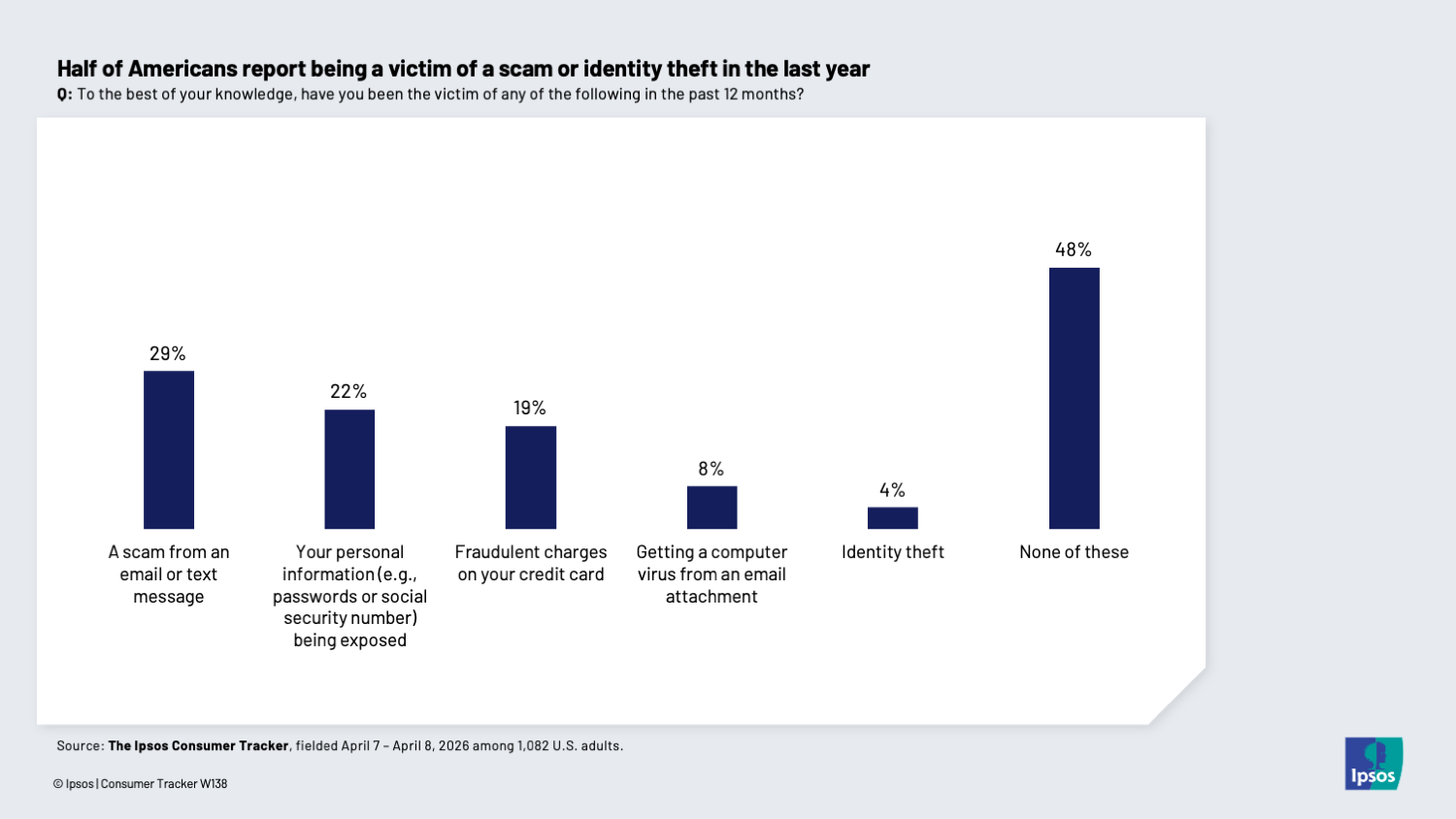
Half of Americans report being a victim of a scam or identity theft in the last year
The Ipsos Consumer Tracker asks Americans questions about culture, the economy and the forces that shape our lives. Here's one thing we learned this week.
Why we asked: At SXSW I did a demo for a personal data security start-up that just received $375 million in funding. Clearly, investors think there’s a market here. The demo was clever. You text a number, and then get a phone call back that tells you your name, address and Social Security number. To make you feel better, they gave you a cute plush squirrel. Yeah, my info is out there. I feel like everyone’s is. But do other folks think that?
What we found: Half of Americans report being victim of a scam or ID theft of some sort in the last year. That’s a pretty widespread phenomenon, and it’s a 10-point increase since we asked last in April 2024. (Note: We’re reading this by the inverse of “none of these” since it was a select-all.)
Despite what you might see on the scare segments in local TV news, there isn’t really much variation in responses based on age. Except for younger people over-indexing on being scammed by email or text (38% of 18- to 34-year-olds, vs. just one in four over 35.)
Nearly three in ten (29%) Americans report being victims of a scam from an email or text. Men (35%) report falling victim more frequently than women (24%). About one in five (19%) have dealt with fraudulent credit card charges in the last year. Higher-income earners ($100K+) are hit more often (24%) than those under $50K (14%). Over one in five (22%) have had personal information like passwords or Social Security numbers exposed.
More insights from this wave of the Ipsos Consumer Tracker:
Generative AI use is getting more mainstream in America
World War III is Americans' new top apocalyptic worry
Americans are seeing more sales, and also looking for more ways to pay over time
Only half of Americans can answer, 'what’s your sign?'
The Ipsos Care-o-Meter: What does America know about vs. what does America care about?