
Determining Strength of Conviction
It relies upon the measured response time to questions of association in milliseconds. This applies to brands and their attributes, products and benefits, political candidates and possible virtues and any object or entity and the characteristics potentially ascribed. Moreover, IRT™ can determine the strength of conviction people have to state intentions such as intent to buy, vote, try, use, discuss, etc.
The fundamental psychological principle behind IRT™ is that the brain holds an intricate network of neural associations that are based on our personal perceptions and experiences. The closer associations are, such as Apple and the attribute "innovative", the faster we respond to acknowledge them using IRT™. It is the same fast certainty as recognizing a loved one as they walk into a room vs. seeing a stranger or acquaintance at a party. If you are asked to confirm your gender or name, there is likely to be a very fast response. You are certain and you have conviction. But if asked if a restaurant is good, if you enjoyed your vacation or if even a product you are using is preferred, you may be conflicted between how you want to answer and how you really feel and this results in a longer time to answer.
What makes IRT™ so remarkable is that it enables us to capture the strength of non-conscious associations when we are conflicted, have feelings we are unaware of, or when our inclination is to give polite, socially acceptable responses.
For Example...
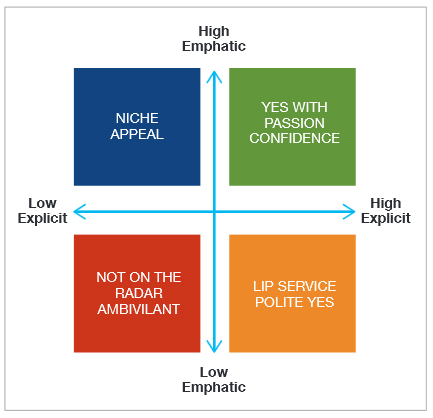
Ipsos IRT™ serves as a barometer for consumer commitment by providing granularity in the composition of rating scores. By decomposing "traditional" respondent ratings into two groups, Marketers will learn if attributes and associations are truly owned by a brand, product or person or if consumers are expressing doubt or possible lip service and vulnerability exists. The response patterns are:
- Explicit Yes %: traditional explicit agreement rating level (e.g., top 2 box score, % yes, etc.)
- Uncommitted Yes %: Comprised of respondents who agreed but responded with a slow or average response time. The higher the value, the more vulnerable the association.
- Emphatic Conviction %: Comprised of respondents who agreed and responded with a quick reaction time. The higher the value, the more widely and strongly held the association.
Ipsos analyzes the prevalence and relationship of these answers to determine if:
- Marketing communication is positively impacting brand perception
- New products or concepts effectively and meaningfully resonate with consumers
- Fragrances and product experiences evoke the intended emotional profile
- Package change reinforces brand KPIs
- Consumer segments have different explicit and implicit values, needs and desires
IRT™ Analytic Framework
For more insight into Implicit Reaction Time, please read our detailed White Paper.

![[WEBINAR] TOAST 2026: Under Pressure - Fewer, Fragmented, Fought-For](/sites/default/files/styles/list_item_image/public/ct/event/2026-07/thumbnail-templates_1_0.png?itok=MxL-wPJW)
